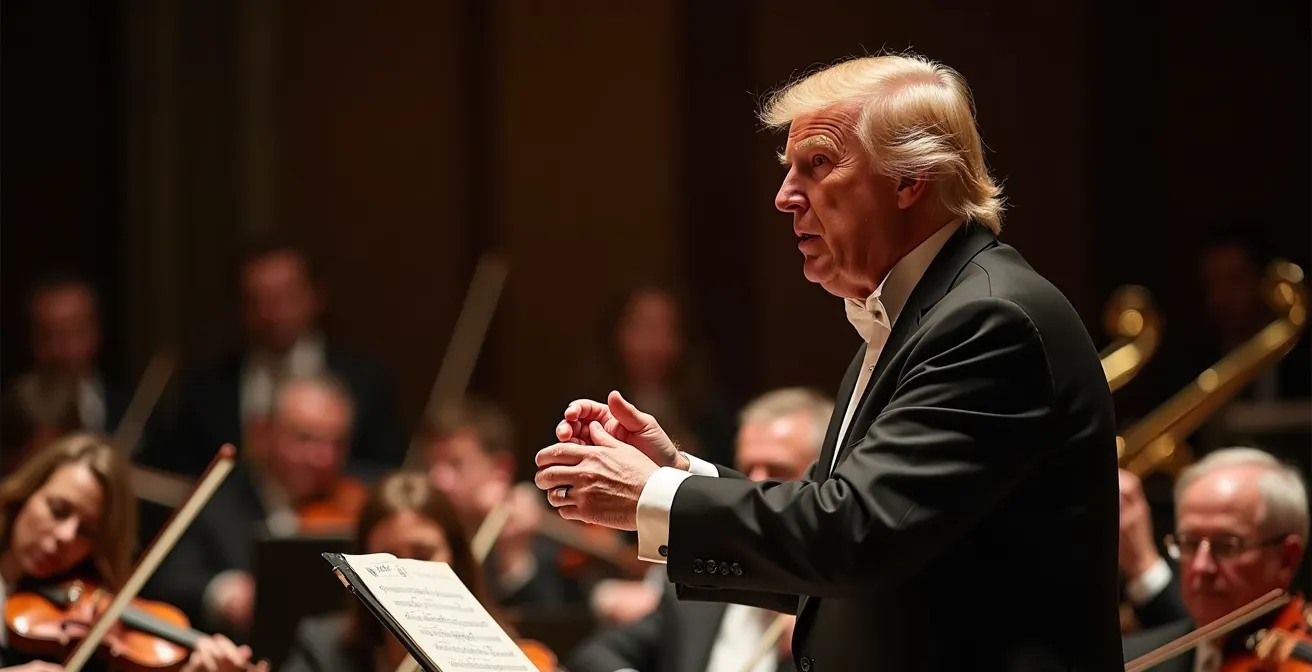
A conductor’s interpretation isn’t magic; it’s a series of forensic choices about a score’s contested history.
- The choice between a composer’s “pure” text (Urtext) and a heavily edited performance version is a primary philosophical battleground.
- Copyright doesn’t just protect the notes you hear, but also the editorial decisions—fingerings, dynamics, and articulations—printed on the page.
Recommendation: To truly understand a performance, start by asking: “Whose version of the score is the orchestra actually playing?”
You settle in to listen to Beethoven’s Fifth Symphony. You know the iconic opening: four thunderous notes that changed music forever. Yet, as you compare two different recordings—one by Karajan, another by Kleiber—you notice something strange. The tempo is different. The emotional weight feels heavier in one, more agile in the other. It’s the same piece, the same notes, so why does it sound like two different worlds? The common answer points to a conductor’s personal “feeling” or “emotion,” a mystical transfer of energy through the waving of a baton. This explanation, however, barely scratches the surface.
The truth is far more complex and fascinating. A conductor’s work is less about abstract emotion and more about deep, scholarly investigation. It’s a job that begins months, even years, before they ever step onto the podium. It involves acting as a historian, a detective, and a philosopher, all dedicated to deciphering the composer’s true intentions from a page that is often a minefield of ambiguity, error, and editorial interference. The real art of interpretation is not found in the grand gestures, but in the painstaking decisions made in the quiet of the library.
But if the conductor’s most critical work is unseen, how can we, the listeners, begin to understand it? This is where our journey begins. We will move beyond the podium to explore the very ink and paper of the score. This article deconstructs the conductor’s process, revealing that the profound differences we hear are rooted in a series of deliberate, high-stakes choices. We will investigate the editions they choose, the markings they make, and the very technology they use, to understand how a single musical blueprint can give rise to a thousand unique structures.
To witness the result of this deep interpretive process, the following performance by Carlos Kleiber is a masterclass. Watch not just for the gestures, but for the intense connection and the sheer clarity of musical thought—all stemming from an obsessive devotion to the secrets held within the score itself. It serves as a perfect visual testament to the principles we are about to explore.
To fully appreciate the layers of these interpretive decisions, this article is structured to guide you from the source material to the final performance. We will examine each facet of the conductor’s craft, peeling back the layers of tradition and technology to reveal the core of musical interpretation.
Summary: A Symphony of Interpretive Choices
- Which Edition Should You Buy: The Composer’s Hand or the Editor’s Changes?
- Reading Ahead: How to Process Complex Notes in Real Time?
- Tablets vs Paper: Is It Safe to Rely on an iPad for a Concert?
- Public Domain Myths: Why You Can Still Get Sued for Playing Bach?
- Pencil Only: The Etiquette of Marking Orchestral Parts?
- Waving the Baton: What Does the Conductor Actually Do During the Concert?
- Touching the Screen, Not the Book: Does Digitization Save the Original?
- How Symphony Orchestras Are Innovating to Attract Younger Audiences?
Which Edition Should You Buy: The Composer’s Hand or the Editor’s Changes?
The first and most fundamental choice a conductor makes concerns the score itself. This decision is not as simple as buying “the” score; it’s a dive into a musicological rabbit hole. Should one use an “Urtext” edition, which aims to be a faithful, scholarly reproduction of the composer’s original manuscript, free of later additions? Or is a “performance edition,” heavily edited by a later conductor or scholar with added dynamics, fingerings, and bowings, a more practical choice? This is the central philosophical battleground of interpretation. An Urtext promises authenticity, a direct line to the composer’s mind, warts and all—including potential errors or ambiguities. A performance edition offers a curated, often easier-to-read path, but one filtered through another interpreter’s lens.
To understand this dilemma, consider the case of Gustav Mahler. A legendary conductor in his own right, Mahler famously re-orchestrated Beethoven’s symphonies. He argued that Beethoven’s orchestration, designed for smaller halls and older instruments, needed adaptation for the modern, larger orchestras and venues of the early 20th century. He doubled woodwind parts for balance and added instrumental colors he felt were implied but not explicitly written. A conductor today choosing to perform Beethoven faces a stark choice: use a score reflecting Beethoven’s original orchestration for historical purity, or use Mahler’s practical, powerful, but fundamentally altered version? Neither is “wrong,” but the resulting sound and experience for the audience will be drastically different.
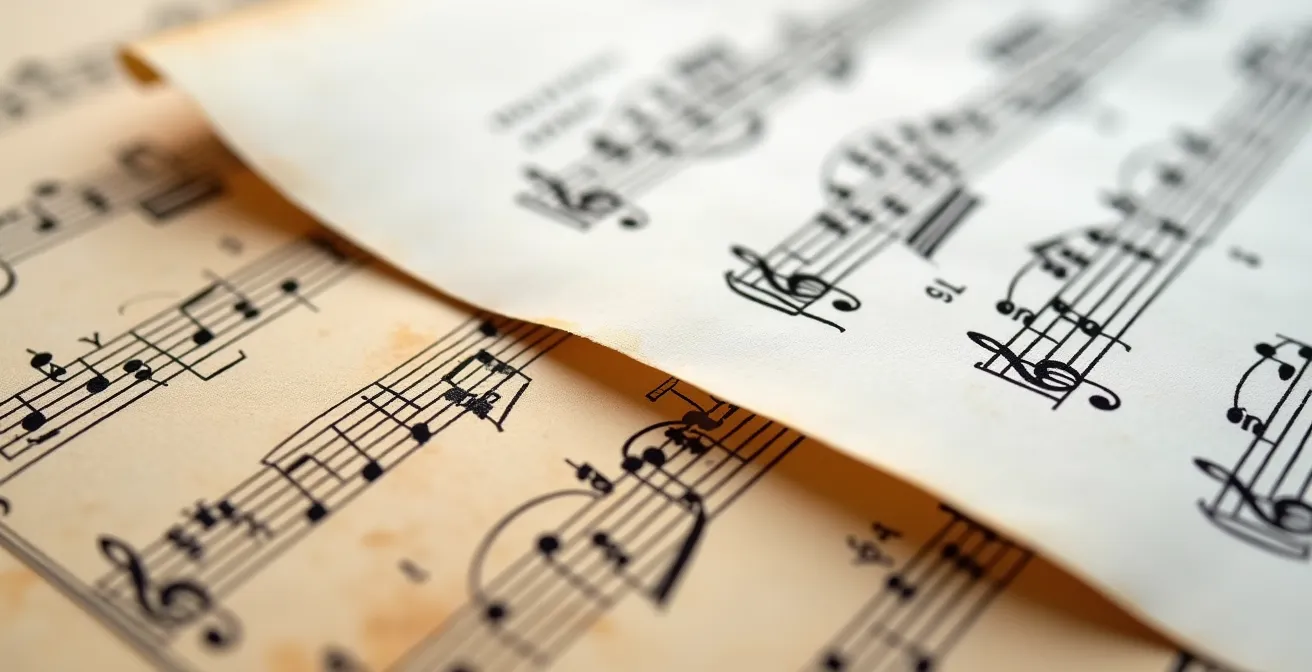
This conflict between the composer’s hand and the editor’s hand is visible on the page itself. The aged, sometimes messy manuscript of the composer contrasts sharply with the clean, printed certainty of a modern edition. As musician’s advocate Gerald Klickstein points out, the best editions are transparent about their changes. In his book “The Musician’s Way,” he notes:
High-quality performance editions identify their sources and indicate when revisions are editorial. Some even include facsimile or urtext versions as well as explanations that allow performers to assess an editor’s changes.
– Gerald Klickstein, The Musician’s Way
Ultimately, the choice of edition defines the starting point for the entire interpretive journey. It sets the boundaries and provides the raw material from which the conductor will build their unique sonic edifice. A conductor who chooses an Urtext is declaring their intent to grapple directly with the composer’s raw vision, while one who chooses a famous editor’s version is entering into a dialogue with a great interpreter of the past.
Reading Ahead: How to Process Complex Notes in Real Time?
Once a score is chosen, the musicians—and the conductor who leads them—face the immense cognitive challenge of translating static ink on a page into fluid, expressive sound in real time. This is not simply a matter of reading notes; it is a high-speed data processing task. For a professional musician, sight-reading involves looking several measures ahead, processing patterns, anticipating technical challenges, and executing the current passage, all simultaneously. The key to this seemingly impossible feat lies in a cognitive strategy known as “chunking.” Instead of seeing a flurry of individual notes, experienced musicians group them into meaningful patterns—chords, melodic fragments, rhythmic motifs. This drastically reduces the mental effort required. In fact, research into cognitive load theory demonstrates that chunking complex musical passages can reduce the cognitive burden by up to 40%.
This is where the conductor’s physical gestures become a critical tool for managing the orchestra’s collective mind. A clear, predictable beat pattern doesn’t just keep time; it provides a stable framework that helps players chunk the music more effectively. The conductor’s preparation, knowing exactly where the tricky passages are, allows them to give cues that simplify complex entries or clarify ambiguous rhythms, effectively offloading some of the players’ cognitive processing onto themselves. The gestures become a shared language for navigating the score’s architecture.
As conductor Jeremy Cuebas of the Fort Collins Symphony eloquently puts it, the conductor’s primary role is to lighten this mental load for the entire ensemble. This frees up the musicians’ mental bandwidth to focus on the higher-level aspects of performance.
A conductor’s primary, yet unseen, role is to reduce the orchestra’s cognitive load through clear, predictable gestures, allowing players to shift their mental energy from ‘counting and surviving’ to ‘expression and listening’.
– Jeremy Cuebas, Fort Collins Symphony
Therefore, a conductor who can effectively manage the cognitive load of 100 musicians is not just a timekeeper but a cognitive systems manager. Their ability to make the complex seem simple through clear communication is a core component of their interpretive power. A chaotic or unclear beat forces players into “survival mode,” where they focus only on their own part. A clear conductor fosters an environment where players can listen to each other, creating a cohesive and responsive ensemble sound.
Tablets vs Paper: Is It Safe to Rely on an iPad for a Concert?
The centuries-old tradition of paper scores is facing a seismic shift with the advent of high-resolution tablets. For conductors and musicians, the allure is undeniable: an entire library of music on a single device, instant annotations that can be shared with an entire section, and backlit screens that solve the age-old problem of poorly lit stages. Major ensembles like the Berlin Konzerthaus Orchestra are leading this digital transition, embracing specialized apps and hardware to create a more integrated performance experience. In these modern setups, a conductor’s markings can appear on the entire string section’s screens instantly. Page turns, once a source of anxiety and disruptive noise, can be executed silently with a tap of a foot pedal. However, this convenience comes with a new set of risks.
What happens if the battery dies mid-crescendo? Or if the app crashes during a critical solo? These are not hypothetical fears; they are legitimate concerns that have made many musicians hesitant to abandon the reliable, tangible security of paper. The solution, adopted by professional orchestras, lies in redundancy and rigorous protocol. Musicians use professional-grade apps with “performance modes” that disable notifications and prevent the screen from sleeping. Multiple backup systems, from secondary tablets to cloud-synced scores and, yes, even paper copies for the most critical moments, are standard practice. The Berlin Konzerthaus and others have demonstrated that with proper management, a digital workflow can be just as reliable as paper, while offering features—like linked recordings for study—that create what some call a ‘hyper-aware’ interpretive style.
While technology can mitigate the risk of technical failure, some musicians express a more philosophical concern: the loss of haptic feedback. The physical act of marking a score with a pencil—the pressure, the smudge, the layered history of erasures—is a deeply ingrained part of the learning process for many. Does the sterile perfection of a digital annotation create a subtle distance from the music? The debate is ongoing, but for any musician considering the switch, a strict safety procedure is non-negotiable.
Your Action Plan: Safety Protocol for Digital Score Usage
- Power Management: Always maintain fully charged primary and backup devices with airplane mode enabled during performance.
- Professional Software: Use professional music reader apps with a performance mode that prevents screen timeout and notifications.
- Local Storage: Pre-load all scores locally—never rely on cloud access or Wi-Fi during a concert.
- Rehearse Turns: Practice page turns with foot pedals during rehearsals to ensure smooth, silent transitions.
- Paper Backup: Keep a paper backup of the score readily accessible, especially for critical passages or in case of complete technical failure.
Public Domain Myths: Why You Can Still Get Sued for Playing Bach?
A common assumption is that the music of composers like Bach, Beethoven, and Mozart, who died centuries ago, is in the “public domain” and therefore free for anyone to use. While the original compositions are indeed free of copyright, the specific edition of the score you hold in your hands is almost certainly not. This is one of the most misunderstood aspects of music copyright. The myth is that public domain means “free to use in any form,” but the reality is that copyright can apply to the editorial content added to a score. This includes fingerings, slurs, dynamic markings, articulations, and even the layout and typesetting of the page. An editor who adds this material creates a new, derivative work that is eligible for its own copyright protection. Under international law, this protection can be extensive; for example, editorial additions can extend copyright protection for up to 70 years after the editor’s death.
This means that while you can’t be sued for performing Bach’s Chaconne in D minor, an orchestra could face legal action for photocopying and distributing an edition of that piece published by a modern editor like Bärenreiter or Henle without paying for the parts. The copyright isn’t on Bach’s notes, but on the scholarship, labor, and artistry of the editor who prepared that specific version for performance. This creates a complex legal landscape for performers, conductors, and librarians, where the “same” piece of music can exist in multiple forms with vastly different legal statuses. A conductor must not only be a musicologist but also possess a working knowledge of intellectual property law.
The following table illustrates how different editions of a work by a single composer like Bach can have dramatically different copyright implications, turning a simple performance into a potential legal minefield.
| Edition Type | Copyright Status | Usage Rights | Typical Cost |
|---|---|---|---|
| Original Manuscript (Facsimile) | Public Domain | Free to use, copy, perform | Free online |
| Urtext Edition (pre-1950) | Public Domain | Free to use if published before 1950 | Free/Low cost |
| Modern Performance Edition | Protected | Requires permission/purchase | $20-100 |
| Stokowski Transcriptions | Protected as new work | Arrangement copyright applies | Rental only |
This legal complexity reinforces the importance of the conductor’s initial choice of edition. Selecting a public domain Urtext from 1920 might be free, but it may be filled with errors. Choosing a modern, copyrighted scholarly edition is expensive, but provides a clean, reliable text. Each path has profound practical and financial consequences for an orchestra.
Pencil Only: The Etiquette of Marking Orchestral Parts?
Walk into any professional orchestra’s library, and you will find a strict, unwritten rule elevated to sacred law: orchestral parts must be marked in pencil only. This is not a matter of aesthetic preference; it is a cornerstone of professional etiquette and a mark of respect for the orchestra as a living institution. The parts an orchestra owns are valuable assets, passed down through generations of musicians. Using a pen is considered an act of vandalism, a permanent scar on a communal document. A pencil mark, by contrast, is temporary. It allows for the conductor’s instructions for a specific concert series to be added and then erased, returning the part to a neutral state for the next conductor and the next interpretation.
This practice, however, goes far beyond simple pragmatism. The layers of faint, erased pencil markings transform an orchestral part into a living document, a historical artifact. As conductor Kenneth Woods eloquently describes it, the score becomes a “palimpsest”—a manuscript page that has been written on, scraped clean, and used again, with traces of the earlier writing still visible.
A well-used orchestral part from a historic orchestra is a palimpsest of interpretive history. Analyzing the layers of pencil markings from different generations of musicians reveals the evolution of how a piece has been played over 100 years.
– Kenneth Woods, Conductor Blog
In these layers of graphite, a musicologist can trace the interpretive history of an orchestra. You might see a “T” for Toscanini’s famously fast tempo in one layer, and a “B” for Bernstein’s much broader approach in another, all on the same page. The pencil markings—bowings, breath marks, reminders to “watch!”—are the forensic evidence of past performances. They are the annotations of a continuing conversation between composers, conductors, and musicians that spans decades. The simple pencil, therefore, is not just a tool for taking notes; it is the instrument that records the ephemeral art of interpretation, allowing the ghosts of past performances to whisper to the musicians of the present.
Waving the Baton: What Does the Conductor Actually Do During the Concert?
To the casual observer, the conductor’s role during a concert can seem enigmatic, even superfluous. The musicians have the notes; can’t they just play them? Yet, the conductor’s influence is one of the most powerful variables in a performance. The most obvious tool is the control of tempo and dynamics, but the degree of variation is often staggering. A famous analysis of multiple performances of Beethoven’s 5th Symphony opening, for instance, revealed tempo variations of up to 30% between different conductors. One conductor’s “fate knocking at the door” is another’s urgent, breathless sprint. This single choice of speed fundamentally alters the entire emotional landscape of the piece.
The mechanism for this control is a highly specialized form of sign language. As conductor Mark Elder explains, the two hands have distinct roles. The right hand, typically holding the baton, is responsible for the “grammar” of the music. It provides a clear, unwavering beat, defining the tempo and structural grid of the piece. The left hand, by contrast, provides the “poetry.” It shapes phrases, cues dynamics, signals changes in color and texture, and communicates expressive nuance. A great conductor is a master of this two-handed language, capable of conveying incredibly detailed instructions without uttering a word. The orchestra learns to read this language with astonishing precision.
Case Study: Carlos Kleiber’s Minimalist Mastery
The legendary Carlos Kleiber turned this language on its head. He was famous for his minimalist conducting style, often using incredibly small, subtle gestures, and sometimes not moving at all for entire passages. Yet, he achieved results of electrifying intensity. His approach demonstrated that a conductor’s power extends far beyond physical gestures. He relied on intense eye contact, shared breathing patterns, and a powerful psychological presence that orchestra members learned to read as a more profound form of communication. Kleiber proved that the conductor’s most important work is to create an environment of such intense focus that the orchestra begins to think and breathe as a single organism.
The conductor is not merely a human metronome. They are the final arbiter of the interpretation, the shaper of sound in real time. They balance the sections, adjust to the acoustics of the hall, and guide the emotional arc of the entire work. They are the living embodiment of the interpretation that was decided upon long before the concert began, making micro-adjustments on the fly to bring that vision to life.
Touching the Screen, Not the Book: Does Digitization Save the Original?
The digitization of priceless musical manuscripts seems like an unequivocal good. Projects by institutions like the Library of Congress to scan and upload original scores by Bach, Mozart, and Beethoven make these treasures accessible to anyone with an internet connection, protecting the fragile originals from repeated handling. This process undoubtedly “saves” the manuscript in one sense—it preserves the intellectual content and protects the physical object from wear and tear. However, from a musicologist’s perspective, something crucial is lost in translation. The act of digitization is not neutral; it is an act of transformation and data loss.
As the experts at the Library of Congress Music Division suggest, the digital image is a sterile copy that strips away vital forensic evidence. The original manuscript is a physical artifact whose clues go far beyond the notes themselves. The weight and type of paper can help date a manuscript. Water stains or ink corrosion might reveal the conditions under which it was stored or used. Even the way the ink has bled into the paper fibers can provide information about the composer’s writing speed and, by extension, their state of mind. A high-resolution scan, for all its clarity, cannot replicate this material evidence.
Furthermore, not all digitization is created equal. The method used depends heavily on the intended purpose, and the results can be wildly different. An “archival scan” is a forensic process, while a “performance version” is a highly edited one. This distinction is critical for scholars and performers who rely on digital scores for their work.
| Digitization Type | Purpose | Quality Standard | File Size |
|---|---|---|---|
| Archival Scan | Preserve every flaw and detail | Multi-spectral imaging, 600+ DPI | 100-500 MB per page |
| Performance App Version | Optimize for readability | Clean, enhanced, 150 DPI | 1-5 MB per page |
A performer using a cleaned-up version from a music app might be unknowingly looking at a text that has been “corrected” and digitally altered, removing the very ambiguities that an interpreter might wish to explore. Therefore, while digitization is an indispensable tool for access and preservation, it is not a replacement for the original. It saves the music, but it can erase the history embedded in the artifact. The screen offers a window to the past, but it is not the same as touching the book itself.
Key Takeaways
- A conductor’s core interpretive choice is between an authentic “Urtext” edition and a practical but editorially influenced “performance” edition.
- Effective conducting is a form of cognitive management, where clear gestures reduce the orchestra’s mental load and free them to focus on musical expression.
- A musical score is a historical document, with layers of pencil markings and copyright protections that tell the story of its performance history.
How Symphony Orchestras Are Innovating to Attract Younger Audiences?
After exploring the intricate, internal world of musical interpretation, a final question remains: how does this art form survive and thrive in the 21st century? While conductors and musicians obsess over historical accuracy and interpretive depth, orchestra managers are tackling a more existential challenge: attracting new and younger audiences. The traditional concert format—a two-hour performance with an intermission, formal attire, and a rule of silence—can feel alienating to a generation accustomed to more interactive and flexible cultural experiences. Recognizing this, orchestras worldwide are innovating not just in how they play, but in how they present the music.
The data shows a clear path forward. While traditional ticket sales may be a concern, the National Endowment for the Arts reports that digital engagement with classical music has surged, increasing by 60% among audiences under 35. This indicates a hunger for the content, but a resistance to the traditional container. The most successful innovations, therefore, focus on breaking down these formal barriers and repackaging the concert experience.
Case Study: Berlin’s ‘8ZEHN30’ Concert Series
The Konzerthausorchester Berlin provides a brilliant example with its “8ZEHN30” (6:30 PM) series. These Thursday evening concerts last for just one hour, have no interval, and feature the chief conductor giving brief, engaging introductions from the podium. The stuffy rules are relaxed: clapping between movements is welcomed, and audiences are encouraged to grab a drink and mingle with the musicians afterward. This more casual, concentrated, and social format has been a resounding success, achieving 99% attendance for a performance of Beethoven’s Eroica and attracting a noticeably younger, more diverse crowd than their traditional subscription concerts.
Other innovations include performing in unconventional venues like warehouses and bars, creating immersive multimedia experiences with video projections, and programming concerts that feature film scores or video game music alongside classical staples. These initiatives are not “dumbing down” the music; they are intelligently re-contextualizing it. They respect the artistic core of the work while redesigning the user experience around it, proving that the symphony orchestra can be a dynamic, relevant, and exciting art form for a new generation.
The next time you listen to a classical piece, don’t just hear the music; listen for the choices. Explore different recordings of the same work, investigate the edition being used, and notice the conductor’s unique stamp. Begin your own journey into the fascinating world of interpretation, and you will find that the oldest music can still hold the newest revelations.