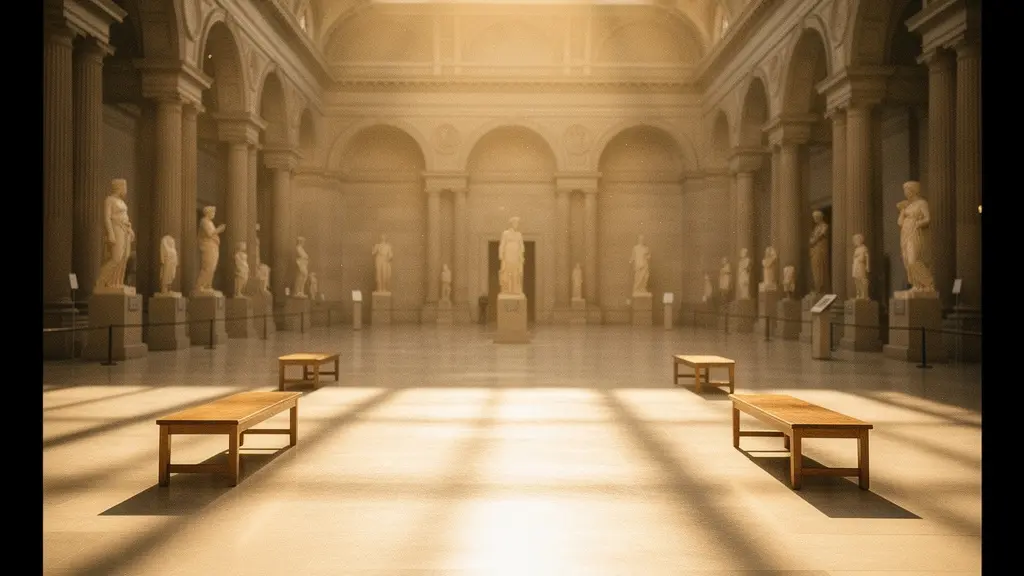
A truly quiet visit to the British Museum has less to do with avoiding people and more to do with intentionally curating your sensory environment.
- The architectural design—from the glass roof of the Great Court to the hard surfaces of modern galleries—dictates the acoustic atmosphere and your ability to focus.
- Conventional aids like audio guides can create a “learning deficit,” preventing direct, personal observation of the artifacts.
Recommendation: Shift your strategy from simple crowd avoidance to active sensory management by choosing galleries based on their material and acoustic properties for a deeper, more contemplative experience.
The thought of visiting the British Museum often conjures two conflicting images: the profound silence of millennia-old artifacts, and the deafening roar of a thousand simultaneous conversations echoing off stone floors. For the cultural tourist or contemplative Londoner, the central challenge is not merely seeing the collection, but truly experiencing it. The common advice—to arrive early, book a timed ticket, or visit in the off-season—treats the problem as one of simple crowd management. This approach, while practical, misses the fundamental point. It assumes that quiet is merely the absence of people.
But what if the key to a meaningful visit lies not in dodging the crowds, but in understanding and mastering your sensory environment? The quality of your experience is shaped by far more subtle forces: the acoustic properties of a gallery, the quality of light falling on a display case, and even the tools you use to learn. A visit can quickly lead to sensory fatigue, where the sheer volume of noise and visual information becomes overwhelming, leaving one exhausted rather than enriched. True quiet is not empty space; it is a space for focus, an environment that facilitates a direct, personal dialogue with history.
This guide moves beyond the platitudes. It proposes a new strategy, one rooted in the principles of sensory curation. We will explore how the museum’s very architecture influences your perception, why certain galleries foster solitary reflection, and how the tools designed to help might actually hinder your connection with the past. By understanding these dynamics, you can transform a passive viewing into an active, deeply personal, and genuinely quiet exploration.
This article delves into the specific strategies and environmental factors that allow for a truly contemplative experience. The following sections are structured to guide you from understanding the space to mastering your interaction with it.
Summary: A Historian’s Guide to Finding Quiet in the British Museum
- Why the Great Court’s Acoustics Change Your Perception of Space?
- Which Galleries to Visit for Solitary Reflection on Ancient History?
- Friday Late Openings: Are They Really Quieter Than Tuesday Mornings?
- The Learning Deficit: Why Audio Guides Might Hinder Your Observation
- Smartphone Flash in Dark Rooms: The Damage You Don’t See
- Timed Ticketing: Does It Really Reduce Wear and Tear on Historic Floors?
- Why the White Cube Experience Feels Colder Than the National Portrait Gallery?
- Why Reversibility is the Golden Rule of Modern Conservation?
Why the Great Court’s Acoustics Change Your Perception of Space?
The Queen Elizabeth II Great Court is often the first and most overwhelming sensory experience for any visitor. Its scale is breathtaking, but its acoustics are defining. The immense volume, enclosed by the iconic glass and steel roof, creates an environment where sound behaves in a unique way. With its stone flooring and the cylindrical form of the Reading Room at its center, the space is a study in sound reflection. Every footstep, conversation, and announcement bounces off these hard surfaces, creating a constant, high-level ambient hum. The architecture itself, with a roof composed of 3,312 individual glass panels, becomes a primary actor in your sensory experience.
This illustrates a key challenge in modern museum design. A study on museum acoustics notes that contemporary interiors often use highly reflective finishes like concrete, masonry, or marble to achieve a minimalist “white-box” aesthetic. While visually striking, these choices create significant acoustic problems. According to an analysis of contemporary museum architecture, large volumes and reflective surfaces lead to “excessive reverberation, poor speech intelligibility, and elevated background noise.”
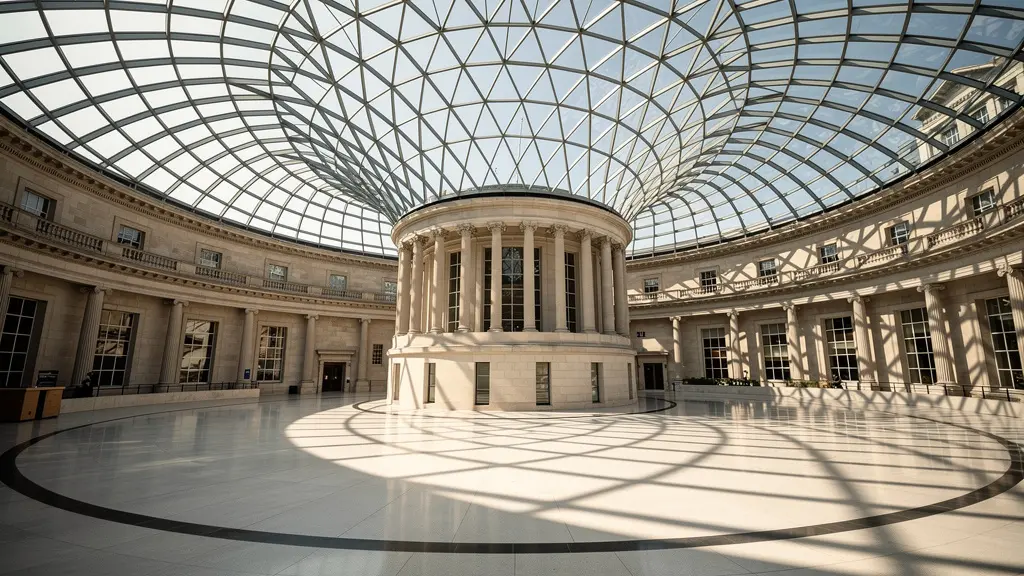
In the Great Court, you are not just hearing the crowd; you are hearing the acoustic architecture of the space itself amplifying that crowd. Understanding this allows you to re-frame the experience. Instead of being a victim of the noise, you can perceive it as a property of the space, a constant to be navigated. This is the first step in sensory curation: recognizing that the environment is not neutral. Its materials and volume are actively shaping your ability to think and reflect.
Which Galleries to Visit for Solitary Reflection on Ancient History?
Escaping the central thrum of the Great Court requires a deliberate strategy. The sheer size of the British Museum is an advantage, but only if you know where to go. The majority of visitors follow a predictable path, gravitating towards a handful of world-famous artifacts like the Rosetta Stone or the Parthenon Marbles. This concentration creates pockets of intense noise and crowding, but it also leaves vast sections of the museum relatively undisturbed. With the museum receiving as many as 6.5 million visitors in 2024, its highest number in nearly a decade, strategic gallery selection is paramount.
For solitary reflection, the key is to explore the upper floors and the collections dedicated to regions outside the Greco-Roman core. These galleries are not less significant, but they fall outside the main tourist circuit. Consider seeking out the Japanese galleries, with their serene design and delicate objects, or the vast and varied African collections. The exhibits on North America and Oceania also offer a much more intimate viewing experience, as do the specialized collections like the gallery for clocks and watches.
Another practical tactic is to begin your journey away from the main entrance. The museum’s Montague Place entrance is often significantly quieter, especially during peak hours. It provides a less crowded and more direct route into the northern and eastern wings of the museum, allowing you to start your visit in a state of relative calm. By consciously avoiding the main arteries of visitor traffic, you can curate a path that prioritizes depth over spectacle, creating the mental space needed for a contemplative dialogue with the past.
Friday Late Openings: Are They Really Quieter Than Tuesday Mornings?
The conventional wisdom for avoiding crowds is to visit on a weekday morning. The British Museum itself suggests that the quietest times are typically between 10:00 and 11:00 when the galleries first open, and again in the late afternoon after 16:00. However, the Friday Late openings (until 20:30) present an interesting alternative, challenging the assumption that “morning” always equals “quiet.” While a Tuesday morning may have fewer people overall, the demographic and atmosphere are entirely different. Mornings are often dominated by school groups and tour buses, creating a specific kind of high-energy, structured noise.
In contrast, Friday Lates tend to attract a different audience: adults, students, and Londoners seeking a cultural end to their week. The overall number of visitors might not be drastically lower than at other times, but the *nature* of the crowd is more dispersed and the ambient sound is often a low hum of conversation rather than the organized chaos of tour groups. Furthermore, seasonal variations play a huge role; any weekday morning during school holidays will be significantly busier than a Friday evening in November.
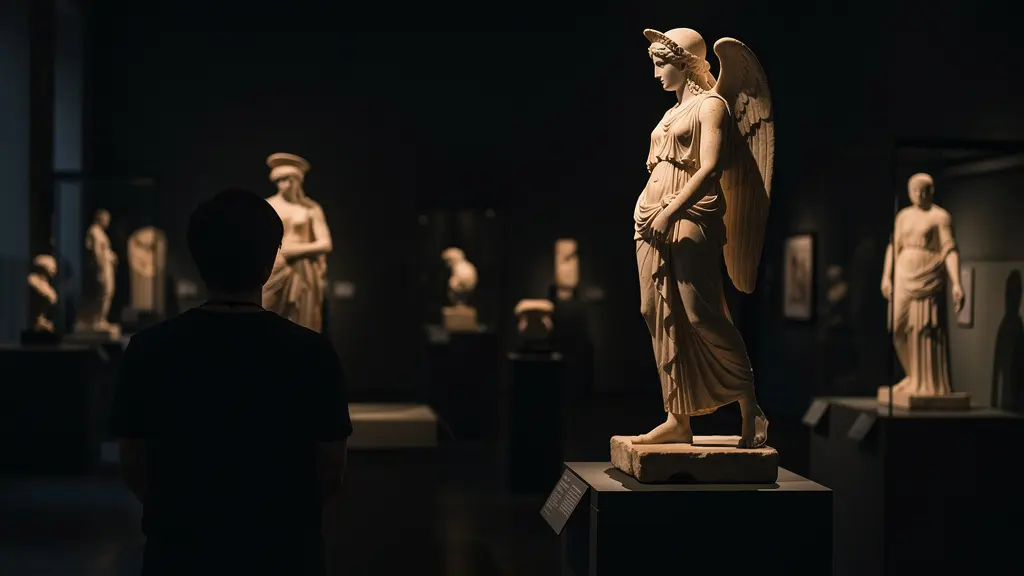
More importantly, the sensory experience of a late opening is entirely different. The galleries are transformed by dramatic artificial lighting, creating deep shadows and highlighting artifacts in a way that daylight cannot. This theatrical atmosphere encourages a more hushed, reverent mood. The experience becomes less about academic study and more about atmospheric immersion. Therefore, if your goal is a low-key, contemplative experience, a Friday Late might be qualitatively “quieter” than a Tuesday morning, even if the visitor counts are comparable. It is a perfect example of how sensory curation—choosing an environment for its mood and light—can be more effective than simply counting heads.
The Learning Deficit: Why Audio Guides Might Hinder Your Observation
In our quest for knowledge, we often turn to tools like audio guides, assuming they will enrich our understanding. However, these devices can paradoxically create a “learning deficit.” By channeling information directly into your ears, they demand a significant portion of your cognitive bandwidth. Your attention becomes divided between listening to a pre-recorded narration and looking at the object itself. This multitasking prevents the deep, unmediated observation required for a personal connection. You are no longer discovering the object; you are merely trying to match what you see with what you hear.
This creates a conflict within the museum’s soundscape. Instead of attuning your senses to the subtle acoustics of the gallery, you are introducing a competing sound source directly into your head. This problem is compounded in acoustically challenging environments. When there is significant background noise or sound bleeding from adjacent exhibits, you are forced to increase the volume of the audio guide, further isolating you from your surroundings and contributing to sensory fatigue. True engagement comes from direct observation: noticing the texture of a pot, the subtle tooling marks on a sculpture, or the way light catches a piece of ancient glass. An audio guide often tells you what to see, short-circuiting this personal process of discovery.
A more effective approach is to prepare beforehand. Read about the key galleries or objects you wish to see, then put the book or phone away. Allow yourself to simply look. A more effective approach is to understand how museums themselves manage sound to create specific experiences. The table below outlines how different acoustic challenges are addressed through design, demonstrating the importance of the physical environment over mediated information.
| Sound Challenge | Impact on Visitors | Design Solution |
|---|---|---|
| Reverberation | Creates distracting and confusing environment | Sound-absorbing materials, acoustic panels |
| Background noise | Competes with exhibit audio and concentration | Sound masking, strategic zoning |
| Sound bleed | Adjacent audio disrupts visitor experience | Beamforming technology, directional speakers |
Smartphone Flash in Dark Rooms: The Damage You Don’t See
The impulse to capture a memory with a photograph is understandable, but the use of a flash in a museum setting is profoundly damaging, even if the effects are invisible to the naked eye. Many of the most precious artifacts in the British Museum, such as ancient textiles, manuscripts, and watercolors, are housed in dimly lit rooms for a critical reason: light is a primary agent of decay. A core principle of conservation, as explained by the Northeast Document Conservation Center, is that all light is energy, and this energy fuels destructive chemical reactions that cause irreversible damage to cultural heritage.
The damage is cumulative. The concept is often measured in lux-hours, representing the total amount of light an object has absorbed over time. A single, intense burst of light from a camera flash contributes significantly to this total. It may seem harmless once, but when multiplied by thousands of visitors, it drastically accelerates the deterioration of sensitive materials. This exposure causes paper to yellow and become brittle, textiles to fade, and organic materials like wood or leather to crack. The flash’s high-intensity, uncontrolled spectrum of light initiates photochemical reactions that break down the very chemical bonds holding the object together.
The “no flash photography” rule is not about protecting a corporation’s copyright or preventing you from having a souvenir. It is a fundamental measure to preserve the object for future generations. When you see an artifact in a dimly lit room, you are witnessing an act of curatorial care—a delicate balance between allowing access and ensuring long-term survival. Using a flash is a direct violation of this principle, prioritizing a fleeting personal photograph over the permanent integrity of a shared global heritage. To truly respect the objects is to respect the conditions necessary for their preservation, including the carefully controlled absence of light.
Timed Ticketing: Does It Really Reduce Wear and Tear on Historic Floors?
Timed ticketing is now a standard practice at many major institutions, including the British Museum. While it is often perceived as a tool for crowd control within the galleries, its primary function is to manage the flow of visitors *at the entrance*. By booking a timed slot, you bypass the long queues, ensuring a smoother and quicker start to your visit. However, it does not inherently limit the total number of people inside the museum at any given moment. Therefore, its direct impact on reducing physical wear and tear on historic floors from footfall is debatable; it spreads the arrivals out, but the total daily traffic remains high.
Interestingly, a more insidious form of “wear and tear” comes not from feet, but from sound. The collective noise of thousands of visitors generates low-frequency vibrations that travel through the structure of the building. While seemingly minor, these acoustic vibrations can have a tangible impact on the artifacts. A report on sound-sensitive design in heritage sites highlights this often-overlooked threat. For instance, an analysis at the National Museum Cardiff found that after a musical event, approximately 12 ceramic objects had physically shifted on their shelves due to sound-induced vibrations.
This reveals a deeper truth about visitor impact. While we focus on the visible effect of footsteps, the invisible energy of our collective voice can also pose a risk. Timed ticketing is a logistical tool, not a conservation panacea. It helps manage the visitor experience at the door but does little to address the cumulative sensory impact—both audible and vibratory—once inside. True mitigation of visitor impact requires a more holistic approach, considering factors like acoustic dampening and the careful mounting of objects to isolate them from structural vibrations, a far more complex challenge than simply managing queues.
Key Takeaways
- A quiet museum visit is achieved through active sensory curation, not just avoiding crowds.
- The material and design of a gallery (e.g., “white cube” vs. classical) fundamentally shape its acoustic properties and your experience.
- Direct, unmediated observation of an artifact is often more enriching than relying on tools like audio guides, which can divide your attention.
Why the White Cube Experience Feels Colder Than the National Portrait Gallery?
The feeling a museum gallery evokes is not accidental; it is a direct result of its design philosophy, particularly its approach to materials and acoustics. Compare the experience of a modern “white cube” gallery with that of a more traditional space like the National Portrait Gallery. The white cube, with its hard, flat surfaces of polished concrete, plaster, and large panes of glass, is designed to be a neutral backdrop that highlights the art. However, this aesthetic simplicity creates an acoustic nightmare. These surfaces are highly sound-reflective, creating a clinical, cold environment where every footstep, cough, and whisper echoes distinctly. Very little sound is absorbed, leading to a build-up of noise that can feel harsh and unwelcoming.
In contrast, older museum designs, such as those found in parts of the National Portrait Gallery or classic 19th-century wings of other institutions, often feature more acoustically complex and absorbent materials. Wood flooring, ornate plasterwork with coffered ceilings, heavy draperies, and even the texture of the wall coverings all serve to break up and absorb sound waves. As one study notes, the ornate designs of classic museums, with their irregular surfaces, helped to spread out sound energy and reduce distinct echoes. This creates a “warmer,” more intimate acoustic environment. The sound is muffled and softened, encouraging quieter conversation and a more contemplative state of mind.
The difference in feeling is a direct consequence of a material choice. The table below, drawing from an analysis of museum acoustic design, breaks down how different surface treatments create a specific visitor experience.
| Surface Treatment | Acoustic Impact | Visitor Experience |
|---|---|---|
| Concrete/Glass (White Cube) | High reverberation, echo chamber effect | Clinical, cold atmosphere |
| Wood floors/panels | Reduces echo, absorbs high frequencies | Warmer, more intimate feeling |
| Carpets/Textiles | Maximum sound absorption | Quiet, contemplative environment |
Why Reversibility is the Golden Rule of Modern Conservation?
In the world of museum conservation, one principle stands above all others: reversibility. This golden rule dictates that any treatment or repair applied to an artifact should be, in theory, completely undoable. It is a profound act of humility and foresight. As one conservation expert states, “Reversibility ensures that future generations can undo today’s work to apply better techniques or get closer to the original.” This acknowledges that our current knowledge and materials are not final. A future conservator, armed with superior technology or a deeper understanding, must be able to remove our additions without damaging the original object.
This principle governs every decision a conservator makes, from the choice of adhesive to the method of cleaning. It is a commitment to do no permanent harm. This philosophy of care and respect for the object’s integrity offers a powerful metaphor for the thoughtful visitor. Just as a conservator seeks to leave an artifact stable but fundamentally unaltered, a visitor should aim to experience the museum without leaving a negative trace—be it the cumulative damage of a camera flash or the disruptive noise that degrades the experience for others. It reframes our role from passive consumer to active steward of the museum environment.
Your Action Plan for Ethical Conservation
- Assess Stability: Recognize that objects on display have been deemed stable enough for exhibition, and your role is not to test their limits.
- Use Reversible “Treatments”: When taking notes or sketching, use materials (like a pencil) that are removable and don’t risk marking the gallery environment.
- Document Your Path: Plan your visit in advance, creating a “conservation report” for your own journey that prioritizes less-trafficked areas, minimizing your impact on crowded spaces.
- Minimize Alterations: Refrain from using flash, touching surfaces, or leaning on cases. Leave the environment exactly as you found it.
- Test Inconspicuously: Try out a new route or a visit to a less popular gallery first to see if it provides the contemplative experience you seek before committing your entire visit.
Applying this mindset of stewardship to your own visit is the final step. Plan your route, manage your sensory input, and interact with the space respectfully. By doing so, you not only craft a more profound and personal experience for yourself but also contribute to the preservation of the contemplative atmosphere that makes the British Museum a treasure for all.