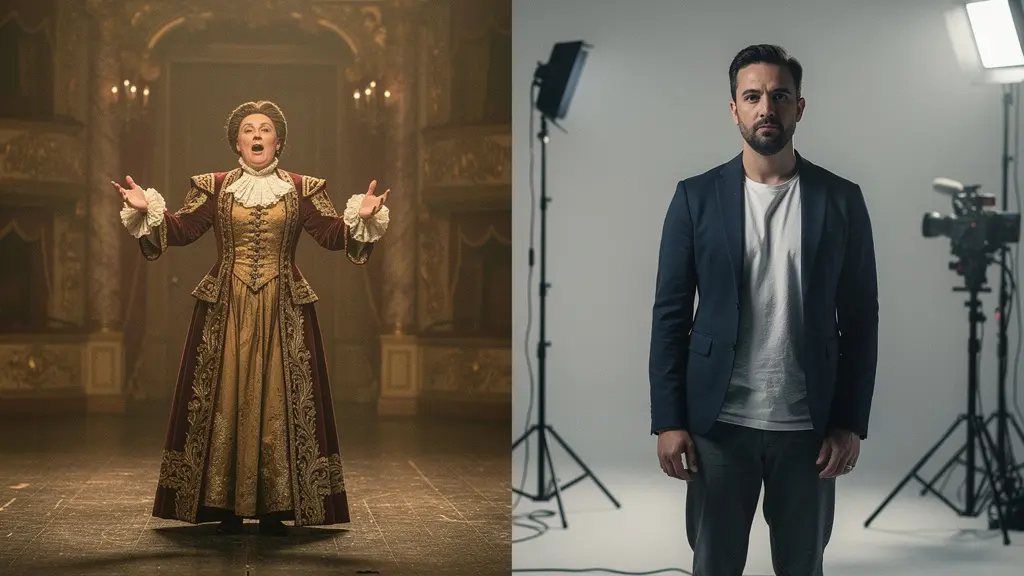
Classical training isn’t about being ‘big’ for the stage; it’s about building a versatile physical and vocal instrument that excels in any medium.
- True vocal power comes from breath control and bodily resonance, not yelling.
- Stage presence is built by releasing habitual tension, which allows for subtle, controlled expression on camera.
Recommendation: Focus on foundational technique first. The ability to scale your performance for the intimacy of the camera will follow naturally from a place of deep physical and vocal control.
As an aspiring actor, you stand at a critical crossroads: should you invest three years in a rigorous drama school education, or is a fast-paced screen acting workshop the more direct path to a career? The common wisdom pits these two worlds against each other. Stage acting, we are told, is broad, projective, and physical. Screen acting is intimate, subtle, and internal. This perception suggests a choice must be made between the grand tradition of the theatre and the modern reality of the film set.
But what if this is a false dichotomy? The truth, as any seasoned voice and movement coach will tell you, is that the rigorous discipline of classical training is not an alternative to screen work—it is the very foundation that forges a versatile actor capable of thriving in front of a camera. The techniques that allow a performer to command a 1,000-seat auditorium are the same ones that, when refined, create riveting, truthful, and minutely detailed performances in close-up. It is not a matter of “big” versus “small,” but of mastering your instrument so you can play it with power or with the most delicate precision.
This guide will deconstruct the core tenets of classical training—from voice and posture to combat and verse. We will explore not just what these disciplines are, but *why* they are the essential building blocks for any serious actor, regardless of the medium they ultimately choose to pursue. You will learn that the path to compelling screen performance does not bypass the rehearsal room; it runs directly through it.
Summary: The Actor’s True Foundation: From Classical Roots to Camera-Ready Technique
- Reaching the Back Row: How to Project Your Voice Without Yelling?
- Posture and Presence: Why Do All Drama Students Learn the Alexander Technique?
- Slaps and Swords: How to Make Violence Look Real Without Injury?
- Too Big for the Camera: How to Scale Down a Theatrical Performance for Film?
- De-mystifying Shakespeare: How the Rhythm Helps You Remember the Lines?
- Move to London or Stay North: Where are the Best Opportunities for New Actors?
- RCA vs CSM: Which Art School Philosophy Dominates the Current Market?
- How Does the Rehearsal Process Shape the Final Performance We See?
Reaching the Back Row: How to Project Your Voice Without Yelling?
The most common misconception about theatrical voice work is that projection equals volume. Aspiring actors often believe they must shout to be heard, leading to vocal strain and a one-dimensional performance. True classical voice training teaches the opposite: projection is not about force, but about building a powerful and efficient vocal architecture. The goal is to use the entire body as a resonating chamber, transforming breath into sound with clarity, colour, and emotional nuance.
Techniques pioneered by masters like Cicely Berry focus on connecting the voice to the body’s core. You learn to support the sound from your diaphragm, allowing it to resonate in the chest, head, and even the bones. This creates a rich, full sound that carries to the back of a theatre without the tension of a yell. This deep connection to breath is precisely what gives an actor control on a film set. When you no longer have to worry about “being heard” by a microphone inches away, that same breath support becomes the engine for emotional truthfulness, allowing for quiet intensity and whispered intimacy that feels completely authentic.
Think of Patrick Stewart as Captain Picard in Star Trek. His commanding vocal presence was forged in the Royal Shakespeare Company. He wasn’t yelling on the bridge of the Enterprise; he was using a classically trained, resonant voice that conveyed authority and gravitas, proving that this foundational skill translates powerfully to the screen. As RSVP’s breakdown of classic acting shows, training with classical texts is key to developing projection without strain.
Posture and Presence: Why Do All Drama Students Learn the Alexander Technique?
An actor’s primary tool is their body. Yet most of us move through life with an accumulation of unconscious physical habits: a slumped shoulder, a tilted head, a clenched jaw. These tensions are not just postural quirks; they are physical blocks that restrict movement, inhibit breath, and limit emotional expression. This is why a technique focused on *undoing* these habits, the Alexander Technique, is a cornerstone of training at nearly every major UK drama school.
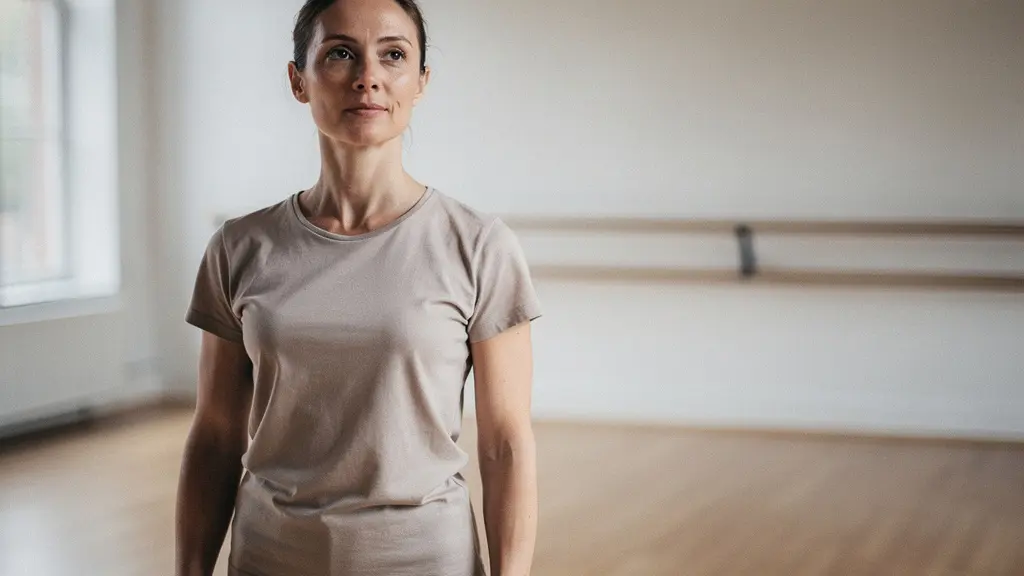
The Alexander Technique is not about learning to “stand up straight.” It is a method of developing profound awareness of your physical self and learning to exercise inhibitory control—the conscious choice to stop and release habitual tension. By doing so, an actor cultivates a state of “neutral.” This neutral posture is not a rigid position but a relaxed, aligned, and responsive state, a blank canvas ready to be shaped into any character without the interference of personal habits. This is a fundamental concept, as many UK drama schools, including Italia Conti, place a strong emphasis on classical acting and its integrated physical disciplines.
On stage, this physical freedom creates a powerful presence that can fill the space. For the camera, this same control is what allows for microscopic precision. An actor who has released their habitual neck tension can convey a universe of thought with a subtle turn of the head. An actor free from jaw clenching can deliver a line with effortless clarity. As the Italia Conti Drama School notes, “Techniques to develop physical alignment and relaxation/release and methods to free the voice and enhance emotional connection are often integrated into training.” This training provides the actor’s instrument with a far greater dynamic range, essential for both mediums.
Slaps and Swords: How to Make Violence Look Real Without Injury?
From a dramatic sword duel in Hamlet to a tense struggle in a modern thriller, physical conflict is a powerful storytelling tool. In classical training, stage combat is approached not as a simulation of violence, but as a form of physical dialogue. It is a meticulously choreographed sequence where every parry, shove, and slap reveals something about the characters’ relationship, objectives, and emotional state. The primary focus is always on safety and storytelling, not aggression.
The key to safe and effective stage combat is absolute partner awareness and control. Actors learn techniques like the “knap,” a sound made by the actor on the receiving end of a blow (often by clapping or striking a part of their own body) to create the illusion of impact without any actual contact. Fight sequences are rehearsed like a dance, with every movement and reaction precisely timed and repeated until it becomes second nature. This discipline removes the unpredictability of real fighting and replaces it with a shared physical narrative.
This training in precision, timing, and spatial awareness is invaluable for screen acting. Film sets, with their expensive equipment and tight camera angles, have zero tolerance for uncontrolled movement. An actor trained in stage combat understands how to sell a punch for the camera, how to handle a prop weapon safely, and how to work in close physical proximity to another actor while maintaining complete control. It is a discipline that, as the Italia Conti Academy’s curriculum highlights, involves “Training in actors’ movement, physical character creation, physical theatre, stage combat, and period-specific movement.”
Too Big for the Camera: How to Scale Down a Theatrical Performance for Film?
The fear of being “too big” for the camera is a common anxiety for actors transitioning from stage to screen. A performance that reads as powerful in a large theatre can feel exaggerated and false in an intimate close-up. The solution, however, is not to simply “do less.” It is to have such a deep command of your technique that you can scale your performance with precision. This is where classical training provides the ultimate advantage.
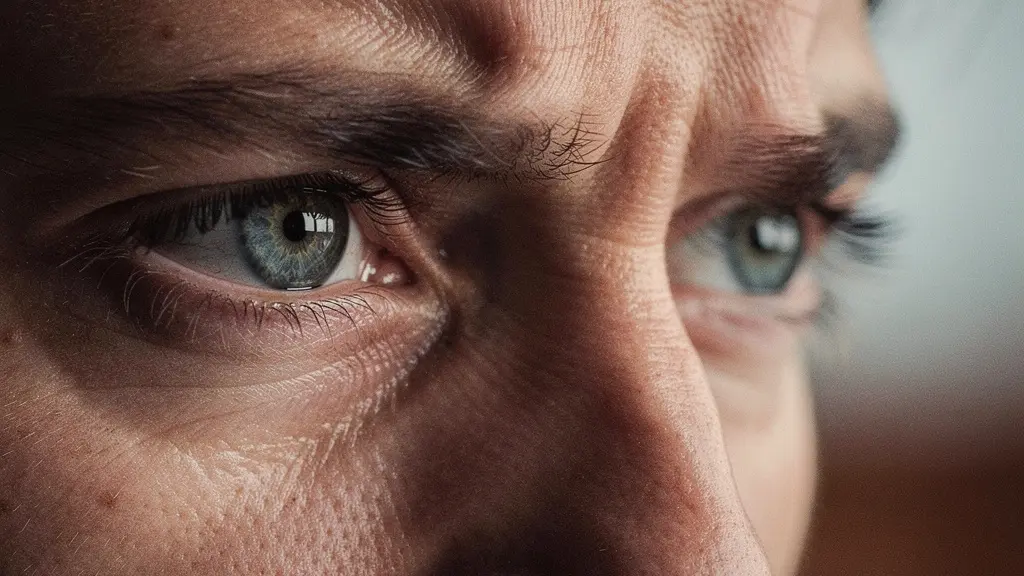
On stage, an actor must fill a large space; their voice and body must communicate with someone a hundred feet away. For the camera, the audience is the microphone and the lens, often just inches from your face. A classically trained actor understands how to produce a fully supported, emotionally connected thought or feeling. To scale it down for film, they don’t subtract the emotion; they simply channel that same energy through a much smaller vessel. The internal process is just as rich, but the external expression is distilled to its essence—a flicker in the eyes, a subtle tensing of the jaw, a slight shift in breath. These are the micro-expressions that a camera magnifies into profound moments of drama.
Consider Claire Foy’s meticulously controlled performance as Queen Elizabeth II in The Crown. Her classical training is evident in her ability to convey immense emotional weight and internal conflict with the utmost restraint. This is not “doing less”; it is the result of immense control. As a comparative analysis from Backstage highlights, the energy and vocal requirements differ vastly, but the core preparation remains. The actor’s instrument must be tuned to deliver either a full-bodied projection for the back row or a whispered confession for a boom mic.
De-mystifying Shakespeare: How the Rhythm Helps You Remember the Lines?
For many young actors, tackling Shakespeare feels like learning a foreign language. The complex sentence structures and unfamiliar words can be intimidating. Yet, within that language lies a powerful tool for the actor: the rhythm of iambic pentameter. This “de-DUM de-DUM de-DUM de-DUM de-DUM” heartbeat is not a rigid cage but a built-in roadmap to meaning, emotion, and memorisation. Mastering it unlocks a form of rhythmic intelligence.
Shakespeare was an actor and a playwright; he wrote his verse to be spoken and heard. The rhythm guides the actor’s breath and flags the most important words in a line. When the rhythm is smooth, the thought flows. When Shakespeare breaks the rhythm—with an extra syllable or a stressed first word—it is a deliberate signal, a piece of stage direction telling the actor that something has shifted emotionally or psychologically. By learning to identify and physicalise this rhythm, actors embed the lines deep within their bodies, freeing them from the intellectual task of simply “remembering words.” The verse itself does the work.
This process of deeply integrating text and rhythm has profound benefits beyond classical plays. It trains the actor’s ear for the music of language and develops an incredible capacity for handling complex text of any kind. Whether you are delivering a dense legal argument in a courtroom drama or a rapid-fire, witty exchange written by Aaron Sorkin, the ability to find the underlying rhythm and structure of the dialogue will make your performance clearer, more dynamic, and more memorable.
Action Plan: Mastering Iambic Pentameter for Performance
- Identify Variations: Treat rhythm breaks and feminine endings not as errors, but as built-in stage directions from the playwright indicating an emotional shift.
- Find the Emphasis: Use the points where the meter breaks to discover the key emotional turning points and stressed words within a speech.
- Physicalise the Verse: Embed the rhythm through physical repetition—walk the lines, tap out the beat—until it becomes instinctive and frees you from conscious thought.
- Follow the Heartbeat: Let the steady, rising pulse of the iambic pentameter guide the natural escalation of emotion within a monologue or scene.
- Trust the Rhythm: During performance, trust that the ingrained rhythm will carry you, allowing you to focus on intention and connection rather than line recall.
Move to London or Stay North: Where are the Best Opportunities for New Actors?
For decades, the path for an aspiring actor in the UK was clear: train, get an agent, and move to London. The capital, with its world-renowned West End theatre district and concentration of casting directors, was seen as the only place to build a serious career. While London remains a vital hub, the landscape of opportunity has undergone a significant and exciting shift. The notion that you must be in London to succeed is an increasingly outdated one.
Major production hubs have flourished across the country, particularly in the North of England. The growth of MediaCityUK in Salford, now home to major departments of the BBC and ITV, has created a gravitational centre for television production. Similarly, film studios in Yorkshire have attracted international projects, providing substantial work for local talent. This decentralisation means that actors can now build credible screen careers without the immense financial pressure of living in the capital.
Furthermore, the UK’s regional theatres remain some of the best places for a new actor to hone their craft. Theatres in cities like Sheffield, Manchester, and Liverpool are celebrated for their ambitious programming and commitment to ensemble work. Landing a role in a season at the Sheffield Crucible or the Royal Exchange in Manchester offers an actor the invaluable experience of performing challenging roles for discerning audiences—a powerful addition to any CV. The choice is no longer “London or nothing,” but a strategic decision based on personal goals, financial reality, and the type of work one wants to pursue.
RCA vs CSM: Which Art School Philosophy Dominates the Current Market?
In the visual arts, debates often rage about the prevailing philosophies of institutions like the Royal College of Art (RCA) or Central Saint Martins (CSM). In the world of acting, a similar, though distinct, conversation revolves around the great drama schools and their unique approaches to training. The most prominent of these debates often centres on the philosophies of London’s two titans: the Royal Academy of Dramatic Art (RADA) and the London Academy of Music and Dramatic Art (LAMDA).
These institutions, while both rooted in classical principles, represent subtly different philosophies that shape the actors they produce. Their perceived strengths and the success of their alumni in turn influence casting trends and the “market” for different types of performers. Understanding these distinctions is key for an aspiring actor choosing where to apply.
The following table provides a simplified overview of the perceived identities of these two powerhouse schools, whose alumni consistently dominate both stage and screen.
| Aspect | RADA | LAMDA |
|---|---|---|
| Philosophy | Upholds the grand classical tradition with rigorous technical focus. | Emphasises strong ensemble work, embracing both classic and contemporary texts. |
| Famous Alumni | Anthony Hopkins, Ralph Fiennes, Tom Hiddleston | Benedict Cumberbatch, Chiwetel Ejiofor, Ruth Wilson |
| Training Focus | Considered to have a more traditional, intensive classical methodology. | Known for its balance of classical technique and exploration of modern work. |
| Market Adaptation | Responds with intensive screen acting modules and high-profile industry showcases. | Produces actors celebrated for their versatility across stage and screen. |
Key Takeaways
- The actor’s body and voice are an instrument; classical training is how you learn to tune and play it with precision.
- Techniques for the stage (projection, presence) are not about being “big,” but about achieving profound control, breath, and physical release.
- This absolute control is the key to delivering powerful, subtle, and truthful performances for the intimacy of the camera.
How Does the Rehearsal Process Shape the Final Performance We See?
The final performance an audience sees, whether on stage or screen, is merely the tip of the iceberg. The immense, unseen bulk beneath the surface is the rehearsal process. This is the laboratory where the performance is built, deconstructed, and refined. It is a journey of discovery that begins with intellectual analysis and progresses into deep, physical embodiment. A disciplined rehearsal process is what transforms an actor from someone who is “saying lines” into someone who is living truthfully under imaginary circumstances.
The journey often begins with “table work,” where the cast and director analyse the text, character motivations, and thematic underpinnings. From there, it moves to “getting it on its feet,” where actors begin to explore the physical life of the characters and block the scenes. This is Peter Brook’s “Empty Space”—a place for experimentation, failure, and discovery. Layers of understanding are built through repetition, not to create a rigid, set performance, but to forge a deep, instinctual connection to the material.
Crucially, this deep preparation is medium-agnostic. As noted by the Denver Center for the Performing Arts, “Whether acting on the big screen or in front of an audience of several hundred people, both mediums require a similar amount of preparation.” An actor who has rigorously explored their character’s backstory, motivations, and physical life in the rehearsal room is prepared to deliver a truthful performance whether the audience is ten feet or a hundred feet away. The rehearsal room is where the work is done; the performance is simply the presentation of that work.
Ultimately, the choice is not between stage and screen, but between disciplined preparation and superficial work. Embrace the rigour of classical training not as a limitation, but as the very thing that will grant you the freedom and versatility to build a lasting career in any medium.