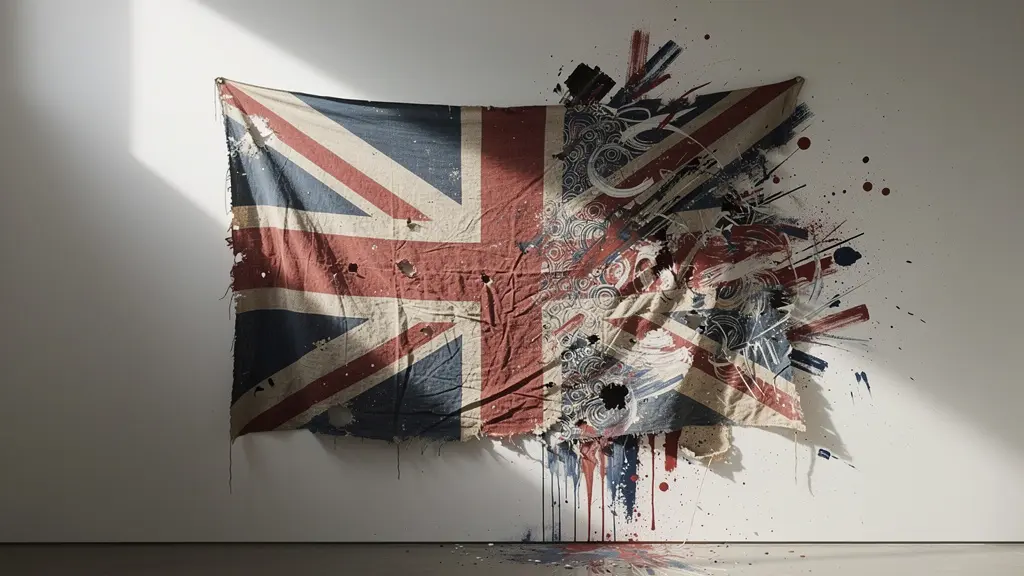
Brexit’s true impact on British art isn’t just political subject matter; it’s a fundamental shift in artistic language, creating a new, raw aesthetic of decay and bureaucracy.
- Artists now use fragmentation and mundane materials not just as a theme, but as their medium, reflecting a nation perceived as falling apart.
- Funding cuts and visa restrictions, while damaging, have paradoxically forced a more inventive, less commercial creativity to emerge outside of London.
Recommendation: Look beyond the gallery wall text and observe how the very materials and constraints of post-Brexit life—from broken barriers to visa paperwork—have become the art itself.
The conversation around Brexit’s impact on the British art scene often gets stuck in a familiar, dreary loop. We hear about the logistical headaches, the prohibitive visa costs, and the dwindling auction house receipts. These are, without a doubt, critical wounds. But to focus solely on the administrative and financial fallout is to miss the far more profound transformation happening in the studios, galleries, and warehouses across the UK. The real story isn’t just that British art has become more ‘political’ since 2020; it’s that Brexit has violently reshaped its very grammar.
While the old guard wrings its hands over London’s diminishing stature, a new generation of artists is forging a potent aesthetic language from the rubble. They are not merely depicting a divided nation; they are using the materials of that division—the bureaucratic red tape, the literal barriers, the sense of economic scarcity—as their clay. This isn’t the slick, ironic commentary of the Young British Artists (YBAs) of the 90s. This is something more visceral, more desperate. It’s an art of the scrapheap, a creative practice born from constraint and disillusionment.
But what if this very constraint is, paradoxically, productive? What if the funding cuts and the inward turn are forcing a necessary reckoning with what it means to create art in Britain today? This is the central question. This article explores how the aftershocks of Brexit are manifesting not just as themes, but as a new visual and material vernacular. We will examine the centrifugal forces pushing creativity out of the capital, the way funding crises are shaping experimental work, and how the nation’s identity crisis is being dissected by its most observant critics: its artists.
To understand this shift, we must look at the specific arenas where these changes are most visible. The following sections break down the key battlegrounds of the post-Brexit art world, from the rise of new creative hubs to the stark realities of making a living as a performer.
Summary: Britain’s New Artistic Vernacular
- Why Manchester is Becoming the New Creative Capital for Painters?
- The Impact of Arts Council Cuts on Experimental Theatre Productions
- Turner Prize Controversies: Are Shortlists Finally Reflecting Modern Britain?
- RCA vs CSM: Which Art School Philosophy Dominates the Current Market?
- How UK Artists Navigate Visa Complications for EU Exhibitions Now?
- Salford Quays: Has the Move of the BBC Changed the Cultural Output?
- The British Class System: How Photographers Document Social Divides Today?
- Is It Possible to Make a Living Solely as a Performer in the UK Today?
Why Manchester is Becoming the New Creative Capital for Painters?
For decades, the British art world has orbited a single, unshakeable sun: London. The capital’s gravity, created by its cluster of elite art schools, blue-chip galleries, and international market, has been absolute. As one commentator noted, even post-Brexit, “London is the place where innovations in art still take place.” But the economic pressures exacerbated by Brexit are creating a powerful creative centrifugal force. As London becomes increasingly unaffordable, artists are not just being pushed out; they are actively choosing to build sustainable careers elsewhere, and Manchester is emerging as the prime beneficiary.
The city’s rise is not merely about cheaper studio space. It’s about a distinct cultural identity rooted in its industrial past. Artists are not working on a blank canvas but on one layered with history. This embrace of a specific, non-metropolitan identity provides a powerful alternative to the often-homogenised internationalism of the London scene. This shift is happening within a complex national context for the arts. The UK’s creative industries are navigating Brexit alone, a challenge considering their significant economic contribution.
Case Study: Industrial Heritage as an Artistic Canvas
In the North of England, the post-industrial landscape is not a scar but a source of inspiration. According to a study in the journal Polysemes, “Old mills and other industrial remnants still give the landscape and cityscape of the North of England an industrial identity prone to fascinate and inspire artists.” This isn’t about nostalgic romanticism; it’s about artists who are “keen to explore and renew the purpose of former industrial buildings,” transforming symbols of past economic might into sites of contemporary cultural production. This practice directly informs a ‘Scrapheap Britain’ aesthetic, finding value and meaning in what has been left behind.
This development challenges the long-held assumption that to be a successful British artist is to be a London-based artist. Manchester is proving that a potent, critically engaged, and commercially viable art scene can thrive by doubling down on its own regional character, turning its post-industrial fabric into a core part of its artistic language.
The Impact of Arts Council Cuts on Experimental Theatre Productions
The post-Brexit economic climate, coupled with a government agenda to “level up” culture by redistributing funds outside of London, has created a perfect storm for the capital’s experimental arts scene. The Arts Council England’s strategy has resulted in devastating financial blows to institutions that have long been the lifeblood of avant-garde work. The headline figure is stark: London’s arts organisations are facing a cut of approximately £50 million over three years, a move that disproportionately affects non-commercial, experimental productions.
This isn’t trimming the fat; it’s cutting to the bone. For experimental theatre, which relies on public funding to take risks that commercial houses cannot afford, these cuts are an existential threat. The loss of funding means fewer opportunities for new writers, directors, and performers to develop unconventional work. It fosters a climate of risk aversion, where survival depends on programming safer, more predictable shows. The result is a potential hollowing-out of the very ecosystem that generates the next wave of theatrical innovation.
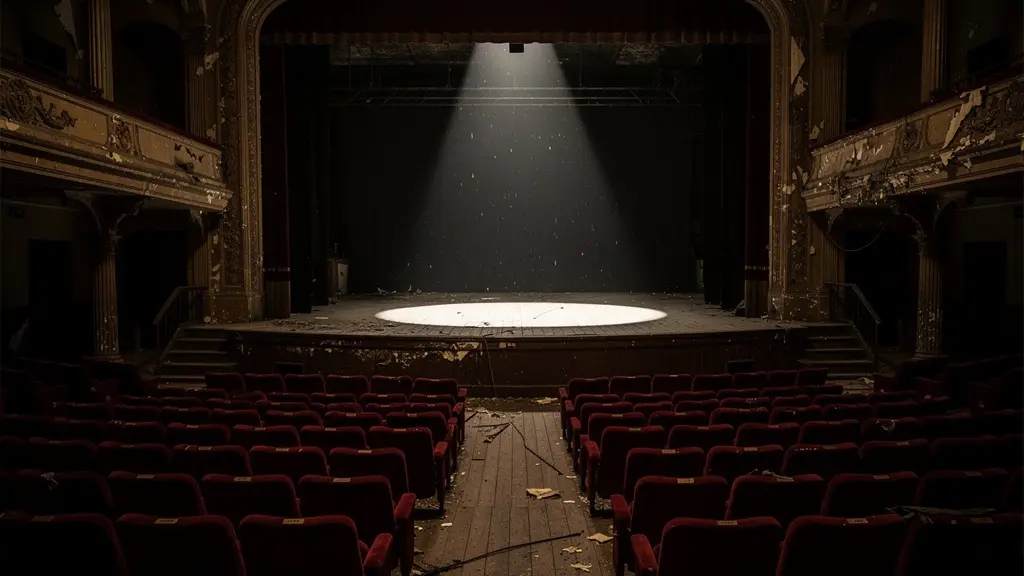
The visual of an empty stage, as depicted above, is no longer just a dramatic metaphor; it is the tangible reality for many small companies. Yet, within this climate of austerity, a grim sort of “productive constraint” can be observed. Forced to work with less, some creators are producing rawer, more stripped-back work where the lack of resources becomes a central aesthetic choice. This theatre of scarcity, born of necessity, often resonates more powerfully with the current national mood than any lavish production could.
The following table, based on data from the House of Lords Library, illustrates the scale of these reductions for some key London institutions, showing how deep the cuts truly are in real terms.
| Institution | Previous Funding | New Funding | Change |
|---|---|---|---|
| Camden Art Centre | £920,000 | £600,000 | -35% |
| Serpentine Galleries | £1,194,000 | £708,000 | -41% |
| Royal Opera House | Previous level | £22m annually | -19% real terms |
Turner Prize Controversies: Are Shortlists Finally Reflecting Modern Britain?
For years, the Turner Prize, Britain’s most high-profile art award, has been accused of navel-gazing, favouring opaque conceptualism over work that speaks to the nation’s lived experience. However, the shortlists since 2020 suggest a significant shift. The prize seems to have woken up to the fractured, contentious state of the nation, increasingly shortlisting artists who are directly grappling with the fallout of Brexit, austerity, and Britain’s unresolved colonial past. It has become a crucial barometer for the country’s artistic mood.
It feels particularly pertinent within a post-Brexit, post-pandemic Britain, which is still struggling to come to terms with its 21st-century identity.
– AnOther Magazine, Turner Prize 2023 Review
This struggle is no longer a subtext; it is the main text. The recent focus on artists whose work is politically charged, materially inventive, and often deeply personal marks a departure from the detached irony that once dominated. The controversy is no longer about an unmade bed, but about whose stories are being told and who gets to tell them. The prize is finally beginning to reflect a Britain that is less confident, more divided, and angrier than the one celebrated by the YBAs.
Case Study: Jesse Darling’s ‘Scrapheap Britain’ Wins the 2023 Prize
The 2023 winner, Jesse Darling, provides the most potent example of this new aesthetic. Their winning installation was a masterclass in the ‘Scrapheap Britain’ style. As reported by The Art Newspaper, Darling used “motifs of the British state to conjure a dystopian end of the world environment.” Crucially, this vision was fashioned from “the sort of quotidian materials one finds on a walk down any city street.” The work’s power came from its use of broken and battered crowd control barriers to open the show. This wasn’t a depiction of chaos; it was chaos assembled from the mundane objects of state control, a perfect metaphor for a nation’s crumbling infrastructure and authority.
By rewarding work like Darling’s, the Turner Prize is not just chasing relevance; it is acknowledging that the most vital art of our time is being made from the fragments of a broken political consensus. It validates an artistic language of decay, precarity, and disillusionment as the true vernacular of modern Britain.
RCA vs CSM: Which Art School Philosophy Dominates the Current Market?
The soul of London’s art scene has long been forged in the crucible of its two dominant art schools: the Royal College of Art (RCA) and Central Saint Martins (CSM). While both are world-leading institutions, they represent fundamentally different philosophies. The RCA has traditionally been seen as the home of technical mastery and craft, producing painters and sculptors with a deep understanding of their medium. CSM, by contrast, is the temple of the Big Idea, championing conceptualism, performance, and a cross-disciplinary approach. For years, the art market has swung between valuing the tangible object and the provocative concept, a tension embodied by these two schools.
The post-Brexit landscape has complicated this dynamic. On one hand, in an uncertain economic climate, the market often gravitates towards ‘safe’ investments: well-made, aesthetically pleasing works that demonstrate clear technical skill—the traditional strength of the RCA graduate. A beautiful painting can feel like a more stable asset than a fleeting performance piece. This reinforces the idea that, as an industry insider noted, “London is the place where innovations in art still take place, surrounded by top-tier art schools and universities.”
On the other hand, the political turmoil has created an appetite for art that is challenging, immediate, and conceptually sharp—the hallmark of CSM’s philosophy. The success of artists like Jesse Darling, whose work is driven by a powerful political concept rather than traditional craft, suggests that the market is also rewarding art that captures the zeitgeist. This creates a fascinating tension: is the dominant force the market’s conservative desire for tangible assets, or its cultural need for incisive political commentary?
The reality is that neither philosophy is ‘winning’. Instead, the most successful young artists are those who can bridge the gap, combining rigorous conceptual thinking with a compelling, often unconventional, use of materials. They possess the intellectual audacity of a CSM graduate and the material sensitivity of an RCA alumnus, creating work that is both smart and viscerally present. The post-Brexit market isn’t choosing one school over the other; it’s demanding a hybrid artist who can do both.
How UK Artists Navigate Visa Complications for EU Exhibitions Now?
Of all the consequences of Brexit, the loss of freedom of movement has been the most brutally practical blow for artists. The seamless ability to travel, transport artwork, and perform across 27 member states has been replaced by a labyrinthine nightmare of individual visa requirements, work permits, and customs declarations (carnets). This isn’t just an inconvenience; it’s a fundamental barrier to cultural exchange and financial viability. As Dr. Kate Mattocks of ‘UK in a Changing Europe’ explains, creative professionals must now “navigate 27 different systems… In some cases, it costs hundreds of pounds for a temporary visa.”
This bureaucratic wall has had a devastating financial impact. While comprehensive data for visual artists is still emerging, a survey from the music industry—which faces identical mobility issues—paints a grim picture. A UK Music report revealed that a staggering 82% of music creators report decreased earnings since the UK left the EU, directly linking this to the new barriers.
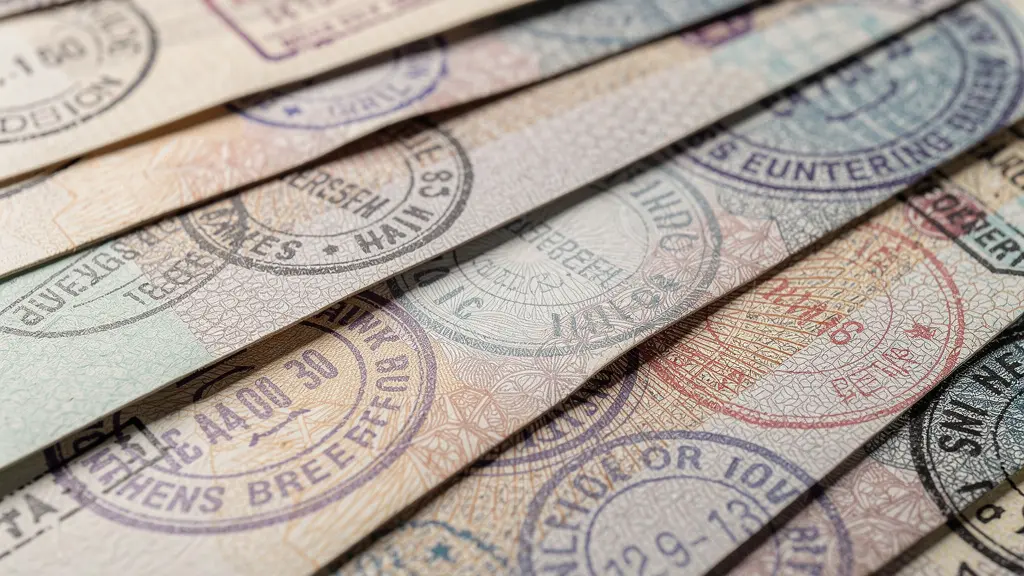
For many artists, the time, cost, and sheer administrative burden of navigating these rules make exhibiting in the EU prohibitively difficult, particularly for those without gallery representation. This has led some to embrace the ‘aesthetic of bureaucracy’, turning the paperwork, the stamps, and the endless forms into the subject of their work. The passport itself, a former symbol of freedom, has become a canvas for exploring themes of restricted movement and national identity, as the image above suggests. The process of being an artist has become the art.
Your Essential Checklist for EU Exhibitions Post-Brexit
- Research Country-Specific Rules: Don’t assume a one-size-fits-all approach. Check the visa and work permit requirements for each specific EU country you plan to exhibit or work in. Some offer visa-free short-term work; many do not.
- Secure an ATA Carnet: For transporting artwork (‘goods’), an ATA Carnet is essential to avoid import duties and taxes. Start the application process months in advance.
- Budget for Bureaucracy: Factor visa fees, carnet costs, and potential legal advice into your exhibition budget. These are no longer negligible expenses.
- Consult Your Union: Organisations like Artists’ Union England provide invaluable, up-to-date advice and resources on navigating the new rules. Don’t go it alone.
- Document Everything: Keep every form, every stamp, every rejection letter. This frustrating paper trail is not just an administrative record; it’s the raw material for your next masterpiece on the theme of state-sanctioned absurdity.
Salford Quays: Has the Move of the BBC Changed the Cultural Output?
The relocation of major parts of the BBC to MediaCityUK in Salford was heralded as a landmark moment in decentralising the UK’s creative industries. The promise was that this massive injection of media infrastructure and personnel would act as a catalyst, transforming the local cultural landscape and fostering a new creative ecosystem far from the London bubble. Years on, the question remains: has it actually changed the art being produced in and around Manchester?
The answer is a nuanced yes. The arrival of the BBC has undeniably created a magnetic field, attracting a critical mass of creative professionals to the area. This has led to the growth of new studios and collaborative networks, creating a more dynamic and interconnected local scene. The atmosphere is one of regeneration and reinvention, a theme that local artists are actively exploring. As one commentary from Art UK notes, “Paintings poignantly capture the changing cityscape, how it once was and how it has reinvented itself.”
However, the influence isn’t just about depicting new buildings. The proximity to a global media giant has subtly shifted the thematic concerns of some artists. There is an increasing interest in exploring the intersection of media, technology, and identity. Artists are questioning the nature of broadcast media, the influence of digital culture, and the contrast between Salford’s industrial working-class heritage and its new identity as a slick, modern media hub. This tension between the old and the new, the authentic and the manufactured, has become a fertile ground for artistic inquiry.
The change is perhaps most evident in the career paths of young creatives. The presence of the BBC and a host of other media companies provides a tangible career ecosystem that encourages art school graduates from institutions like Manchester Metropolitan University to stay in the region. This retention of talent is perhaps the most significant long-term impact, creating a self-sustaining cycle of creative production and innovation that is less dependent on the gravitational pull of London.
The British Class System: How Photographers Document Social Divides Today?
If Brexit was a political earthquake, its aftershocks have been most keenly felt along Britain’s oldest and deepest fault line: class. The vote exposed and amplified profound social divides, and contemporary photographers have become the nation’s most vital social documentarians. Their work has moved beyond the simple “rich vs. poor” binary to explore the nuances of a society grappling with identity, heritage, and a pervasive sense of powerlessness. As the celebrated artist Sean Scully bluntly put it, the government is “powerless to deal with or sell Brexit to the people or prevent an economic slide.”
This sense of systemic failure and social fracture is the raw material for today’s photographers. The ‘new vernacular’ of social documentary photography is less about capturing decisive moments and more about documenting atmospheres and environments. It’s in the peeling paint of a seaside town, the defiant pride of a community centre facing closure, or the stark contrast between a new luxury development and the council estate it overlooks. These artists are creating a visual archive of austerity’s long tail and Brexit’s broken promises.
The work is often quiet, contemplative, and deeply empathetic, rejecting photojournalistic sensationalism for a more sustained, intimate gaze. It asks difficult questions about who belongs in modern Britain and whose heritage is valued. The focus has shifted to communities and individuals caught in the crossfire of grand political narratives, giving a face to abstract concepts like ‘social mobility’ and ‘national identity’.
Case Study: Barbara Walker’s Windrush Portraits at the Turner Prize
A prime example is the work of 2023 Turner Prize nominee Barbara Walker. Rather than creating esoteric works, Walker focused her lens on a deeply political and human story of social division. As noted by Artnet News, “Walker took sensitive portraits of Brits affected by the Windrush scandal and blew them up into an impressive mural.” This act of making the marginalised monumental is a powerful political statement. It uses the tools of portraiture and scale to demand visibility for a community wronged by the state, directly confronting the hostile environment that was a precursor to and a product of the Brexit mindset. Her work exemplifies how photographers are using their medium not just to document, but to advocate and bear witness.
Key Takeaways
- The primary artistic response to Brexit is not just political themes, but a new aesthetic of fragmentation, decay, and bureaucracy.
- Funding cuts and visa issues, while damaging, are forcing raw, inventive creativity and pushing artistic energy to cities outside of London, like Manchester.
- Major art awards like the Turner Prize are now validating this “Scrapheap Britain” aesthetic, rewarding artists who use mundane or broken materials to comment on the state of the nation.
Is It Possible to Make a Living Solely as a Performer in the UK Today?
For performers—actors, dancers, and musicians—the post-Brexit landscape presents a brutal economic equation. The twin pressures of visa restrictions for EU work and a saturated, underfunded domestic market have made the dream of a sustainable career more precarious than ever. The UK’s performing arts have long thrived on a fluid exchange of talent with the continent; before Brexit, it was estimated that 21% of British orchestra members were from the EU. This internationalism is now under severe threat.
The inability to tour the EU easily has decimated a crucial income stream. For many performers, European tours were not a luxury but a financial necessity, supplementing often meagre UK earnings. The statistics are damning: a UK Music survey found that for a staggering 43% of those affected, it was no longer financially viable to tour EU nations. This effectively traps UK-based talent within a highly competitive, and now smaller, domestic market.
The human cost of these statistics is immense. It means talented individuals leaving the profession, a reduction in the diversity of performances available to UK audiences, and a growing sense of isolation from the European cultural scene. The testimony of working performers reveals a deep-seated anxiety and a tangible loss of opportunity.
Opera singers and classical musicians have seen volume of work in Europe shrink by as much as 80%, thanks to a combination of visa red tape, reduction in touring, and the general perception across Europe that it’s not a good idea politically to employ many British artists.
– Opera singer, UK Music Brexit Impact Report
Making a living solely as a performer in the UK today requires more than just talent. It demands extraordinary resilience, entrepreneurial ingenuity, and often, the safety net of a portfolio career or independent wealth. The path has narrowed, and for many, the curtain is coming down on a once-viable profession.
The cumulative effect of these pressures—the funding cuts, the visa walls, the social divisions—has forged a British art scene that is tougher, more resourceful, and more politically direct than it has been in a generation. The challenge now is to ensure this raw creativity finds the space and support it needs to survive.
Frequently Asked Questions About Salford Quays and its Cultural Output
How has Salford’s artistic community evolved since BBC’s arrival?
The area has seen an influx of creative professionals and studios, with artists like those at Hot Bed Press in Salford establishing new creative spaces and collaborative networks.
What new artistic themes have emerged in Salford post-BBC relocation?
Artists are increasingly exploring themes of urban regeneration, media influence, and the intersection of traditional working-class identity with new creative industries.
Has the BBC presence influenced local art education and opportunities?
Manchester Metropolitan University and local art institutions report increased interest in media-related arts, with more graduates staying in the area to pursue creative careers.