
The successful transition from commercial to fine art photography is not a matter of technical skill, but of mastering an entirely new business philosophy.
- Success hinges on shifting from a service mindset (fulfilling briefs) to a value-creation mindset (articulating an artistic thesis).
- Pricing, presentation, and marketing must be re-engineered to build collector confidence and perceived value, not just cover costs.
Recommendation: Stop thinking like a hired photographer and start acting like the director of your own artistic enterprise. Focus first on defining the ‘why’ behind your work; the ‘how’ of selling will follow.
For the technically proficient commercial photographer, the allure of the fine art world is undeniable. It represents a shift from executing a client’s vision to expressing one’s own, from transient campaigns to lasting artifacts. Yet, many who attempt this leap find themselves adrift. They possess the skills to create a flawless image, but their portfolios often fail to resonate with galleries and collectors. The common advice—”find your style,” “use quality materials”—is true, but woefully incomplete. It addresses the craft, not the strategy.
The frustration is understandable. You follow the rules, produce stunning work, yet the doors to the gallery world remain closed. This is because the market operates on a different set of principles. It doesn’t reward technical perfection alone; it rewards narrative cohesion, intellectual rigor, and a clearly articulated artistic voice. The fundamental error is believing that a collection of beautiful but disconnected images constitutes a fine art portfolio. It does not.
The real key to a successful transition lies in a profound mindset shift. It requires moving beyond the role of a service provider to become a creator of intrinsic value. This guide is not another checklist of technical tips. It is a strategic blueprint from a curator’s perspective, designed to reframe your approach to your work. We will dissect the critical distinctions between a commercial and a fine art practice, from conceptual development and pricing strategy to presentation and building a dedicated collector base. It’s time to stop executing briefs and start building a legacy.
This article provides a structured path for this transformation. We will explore the essential elements that define a valuable artistic series, the mechanics of pricing for the collector market, and the subtle but critical choices in presentation that signal professionalism and intent. Follow this guide to build a practice that is not only artistically fulfilling but also commercially viable in the discerning world of fine art.
Summary: From Client Briefs to Collector Sales: A Strategic Guide
- What Distinguishes a Fine Art Series From a Random Photo Collection?
- Pricing Artwork: How to Set Values for Your First Limited Edition Run?
- Paper Types and Finishes: Which One Suits High-Contrast Black and White?
- The Mistake That Gets Your Portfolio Rejected by London Galleries
- How to Build an Email List of Collectors Without Being Spammy?
- Physical Book or iPad: Which Presentation Format Wins High-End Clients?
- Buying Fresh or Buying Proven: Where is the Best ROI for New Collectors?
- How to Sequence a British Landscape Portfolio to Impress Editors?
What Distinguishes a Fine Art Series From a Random Photo Collection?
A commercial portfolio is a demonstration of capability; it shows a client you can solve their problem. A fine art series, in contrast, must pose its own question or present a distinct worldview. This is the most crucial distinction and the first hurdle for any transitioning photographer. A collection of your “greatest hits”—a stunning portrait, a dramatic landscape, a clever still life—is a showcase of technical versatility. A fine art series is a testament to intellectual and emotional consistency. It is a cohesive body of work bound by a central thesis.
This thesis does not need to be a complex academic argument, but it must be a guiding principle that informs every image. It is the “why” behind the work. As landscape photographer Mark Denney advocates, one should think like a filmmaker telling a complete story. When his images are assembled side by side, a narrative emerges—a tale of dawn’s first light, the dance of clouds, and nature’s quiet majesty. Each image serves a role in this narrative tapestry, contributing to an experience far greater than the sum of its parts. A random collection impresses; a cohesive series resonates.
To achieve this, you must be ruthless in your editing. An image may be technically perfect and aesthetically pleasing, but if it does not serve the central concept, it dilutes the entire series. The goal is to create a body of work where each photograph feels both inevitable and indispensable, building upon the others to create a singular, immersive statement. This is what a curator looks for: not just a great photographer, but a compelling artist with a clear and focused vision.
Your Action Plan: Transform a Collection into a Cohesive Series
- Define your central thesis or question: Move beyond subject matter to identify what argument or perspective your series will explore.
- Write a concise statement of intent: Articulate the ‘why’ in 150-200 words to force clarity about your artistic vision.
- Map your narrative arc: Plan the emotional journey with establishing shots, climactic images, and quiet resolutions.
- Audit existing work against your thesis: Remove images that don’t serve the central concept, regardless of technical quality.
- Identify gaps and plan targeted shoots: Create new work specifically to complete your narrative sequence.
Pricing Artwork: How to Set Values for Your First Limited Edition Run?
Pricing is where the commercial mindset most often sabotages the emerging fine art photographer. The formula of `cost + time = price` is irrelevant here. In the fine art market, price is a function of perceived value, scarcity, and the artist’s career trajectory. You are not selling a product; you are selling a piece of your artistic legacy. Setting your initial prices too low can be more damaging than setting them too high, as it signals a lack of confidence and devalues the work from the outset. Many successful fine art photographers report exponential growth, moving from modest sales to significant figures as their reputation builds, but this journey starts with strategic initial pricing.
The most effective strategy for a first run is the tiered edition model. A limited edition run (e.g., 10 prints + 2 Artist’s Proofs) creates inherent scarcity. The tiered model rewards early collectors and builds momentum as the edition sells out. The first few prints are offered at a base price. Once a certain number are sold, the price for the remaining prints increases. This strategy leverages powerful psychological drivers: early adopters feel rewarded for their foresight, and later buyers are motivated by the fear of missing out as both availability and affordability decrease.
This approach transforms the sales process from a simple transaction into a narrative of growing demand. It establishes your work as an asset with the potential to appreciate, a key consideration for serious collectors. Your base price should be ambitious but justifiable, factoring in your production costs, but more importantly, your exhibition history (even small shows count), press, and the strength of the series itself. This strategy demonstrates business acumen, which gives collectors confidence not just in the art, but in the artist as a professional entity.
The following table illustrates a common tiered pricing strategy, showing how value is constructed throughout the lifecycle of a limited edition.
| Edition Number | Price Multiplier | Buyer Psychology | Market Dynamic |
|---|---|---|---|
| Prints 1-3 | 1.0X (Base Price) | Early adopter advantage | Rewards first collectors |
| Prints 4-7 | 1.3X | Mid-tier accessibility | Creates perceived momentum |
| Prints 8-10 | 1.8X | Scarcity premium | Drives urgency for final prints |
Paper Types and Finishes: Which One Suits High-Contrast Black and White?
In the commercial world, paper choice is often a matter of client budget or standard practice. In fine art, it is an integral part of the artwork’s conceptual and physical presence. For high-contrast black and white photography, where the interplay of deep blacks and brilliant whites is paramount, the choice is not merely aesthetic—it is technical. The goal is to maximize the print’s D-MAX, which is the measure of the deepest black a paper and ink combination can produce. A higher D-MAX translates to richer, more profound blacks and an expanded tonal range, giving the print a sense of depth and dimensionality.
For this reason, baryta papers are the undisputed standard for gallery-quality black and white prints. These papers have a coating of barium sulfate beneath the ink-receptive layer. This coating acts as a natural brightener, enhancing the luminosity of whites and, crucially, allowing for an exceptionally high D-MAX. In fact, many professional baryta papers achieve density levels of a D-MAX of 2.7, a figure that matte papers simply cannot approach. This results in blacks that are not just dark gray, but have a deep, velvety, and almost liquid quality.
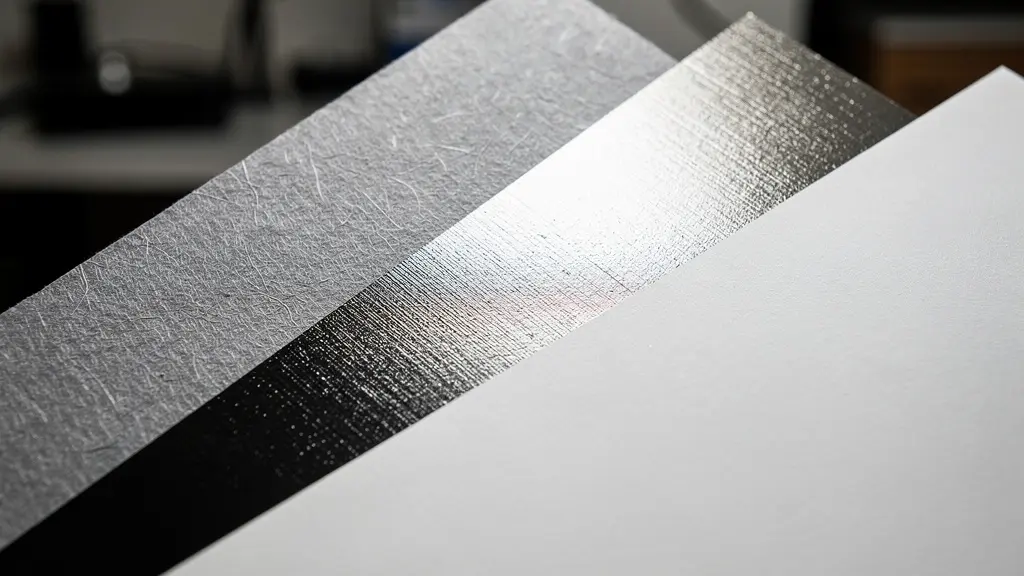
Beyond the technical performance, the physical properties of the paper—its weight and texture—contribute to the artwork’s perceived value. A heavier paper, such as one with a weight of 310 GSM (grams per square meter) or higher, feels substantial and significant in the hands. This tactile experience is the collector’s first interaction with the physical object, and it immediately communicates quality and permanence. Choosing between a glossy finish for dramatic impact or a semi-gloss/pearl finish to reduce glare in gallery lighting is a final strategic decision. The choice of paper is not an afterthought; it is the foundation upon which the final image is built and valued.
The Mistake That Gets Your Portfolio Rejected by London Galleries
Many talented photographers have their work dismissed by London galleries before it’s even properly viewed. The fatal mistake is rarely a single bad photograph; it is a fundamental misunderstanding of the submission process. The error is a lack of targeted research, resulting in a generic, one-size-fits-all submission. As the editorial team at Booooooom advises, “Familiarize yourself with the recipient before you finalize your submission. Research the organization, competition, or platform.” This is not a suggestion; it is a prerequisite for being taken seriously.
Galleries are not interchangeable venues. Each has a specific curatorial program, a roster of artists with a certain aesthetic or conceptual through-line, and a director with a distinct vision. Sending a portfolio of minimalist architectural studies to a gallery known for expressive, figurative painting is a waste of everyone’s time. It demonstrates that you have not done your homework and are simply casting a wide, indiscriminate net. This immediately signals a lack of professionalism and strategic thinking, qualities essential for a successful gallery partnership. Your submission should be a tailored proposal, not an unsolicited application.
Furthermore, failing to adhere to a gallery’s specific submission guidelines is an immediate red flag. If they ask for 10 images in a single PDF, and you send a link to your website, you are creating work for the curator. That is the fastest way to the rejection pile. This extends to the quality of the submission files themselves. According to a 2024 survey of gallery directors, a staggering 47% reported rejecting submissions due to poor image quality, even when the artwork itself appeared promising. This doesn’t mean the art was bad; it means the documentation—poorly lit, low-resolution, or incorrectly formatted JPEGs—failed to represent it adequately. Your submission is your first professional handshake; a weak grip will end the conversation before it begins.
How to Build an Email List of Collectors Without Being Spammy?
The commercial photographer is accustomed to marketing: running ads, posting on social media, and driving traffic. Applying these mass-market tactics to the fine art world is often counterproductive. Collectors are not looking for a sales pitch; they are looking for a connection. Building a list of potential buyers is not about lead generation, it’s about cultivating a community of engaged patrons who feel a personal stake in your artistic journey.
The most effective approach is to reframe your email list not as a sales channel, but as an exclusive “studio insider” pass. Instead of announcing new prints for sale, share the process behind them. Document your intellectual struggles, developmental sketches, and behind-the-scenes stories. This content builds a narrative and creates an intimate connection. It allows subscribers to invest emotionally in the work long before they are asked to invest financially. When you do announce a new piece, it feels less like an advertisement and more like a privileged opportunity offered to a small circle of supporters.

Another powerful strategy is to provide educational value. Position yourself as a knowledgeable guide to the art world. Share content on how to frame prints, what to look for when collecting, or interviews with other artists. By educating your audience, you empower them as collectors and build trust. You become a resource, not just a vendor. This approach is more time-consuming, but as Art Business News notes, interacting with potential buyers and informing them about your process can lead to very positive outcomes. Start by building genuine, one-to-one relationships with a few key people—curators, critics, designers—and let your community grow organically from that foundation of authenticity.
Physical Book or iPad: Which Presentation Format Wins High-End Clients?
In a meeting with a high-end client, curator, or gallerist, every detail of your presentation is scrutinized. The choice between a physical portfolio book and a digital presentation on an iPad is not merely a matter of convenience; it is a strategic decision that sends a powerful message about you and your work. There is no single “correct” answer, as the optimal choice depends entirely on the context and the person you are meeting. As artist Jason Matias wisely states, “The more an artist understands the market and his clients, the better chance he has of fulfilling their desires.”
A beautifully crafted physical book is a statement object in itself. It is a tactile, immersive experience. The weight of the paper, the quality of the binding, and the richness of the prints create a slow, deliberate viewing process. This format is exceptionally powerful for work that relies on texture, subtlety, and a sense of permanence, such as fine art landscapes or portraits. A physical book communicates a commitment to craft, a respect for tradition, and a belief in the artwork as a precious object. It is often the preferred format for established gallerists and serious collectors who value the haptic connection to the work.
Conversely, an iPad presentation signals modernity, efficiency, and adaptability. It allows for a dynamic presentation, including the ability to zoom in on details, show related images quickly, or even present video work. For photographers whose work is conceptual, graphic, or intended for digital display, the backlit vibrancy of a high-resolution screen can be more impactful. This format can be highly effective when meeting with art consultants, interior designers, or corporate clients who value speed and a clear, bright presentation. The choice itself is a demonstration of your understanding of your audience. The wrong format can create a subtle dissonance, while the right one shows you are not just an artist, but a savvy professional.
Key Takeaways
- Thesis Over Technique: A successful fine art series is defined by a cohesive narrative and a central artistic question, not just a collection of technically perfect images.
- Price for Perception: Value in the art market is built on scarcity and career trajectory. Use a tiered edition strategy to reward early collectors and create momentum.
- Materiality is Meaning: Your choice of paper is a critical artistic and strategic decision that directly impacts the print’s D-MAX, permanence, and perceived value.
Buying Fresh or Buying Proven: Where is the Best ROI for New Collectors?
As an artist, understanding the psychology of your potential collectors is paramount. A key consideration for any buyer, especially a new one, is the balance between risk and reward. They are often torn between two paths: acquiring work from a “fresh,” emerging artist at a lower price point, or investing in a “proven” artist with an established track record and a higher price tag. Your job is to understand this dynamic and strategically position yourself to de-risk the investment for them, even when you are just starting out.
Work becomes “proven” through a process of third-party validation. This includes gallery representation, sales history, critical reviews, press coverage, and, crucially, inclusion in juried exhibitions and competitions. These milestones act as external signals of quality and market viability. For example, when a competition like the Lensculture Art Photography Awards announces that winners will be exhibited in New York and receive extensive media coverage, they are actively manufacturing “proven” status. These accolades serve as proof points that give a collector confidence that they are not just buying a picture, but investing in an artist with recognized potential.
For the emerging artist, the path is to proactively build this sense of validation from day one. You can do this by:
- Leveraging your commercial background as proof of professionalism and reliability.
- Aggressively entering prestigious juried competitions to gain quick, credible validation.
- Collaborating with interior designers or brands to borrow their credibility.
- Diligently documenting every exhibition, even small group shows, to demonstrate market presence.
- Providing unimpeachable provenance from the start, with signed certificates of authenticity for every piece sold.
By taking these steps, you build a case for your work, offering the collector the exciting prospect of “buying fresh” but with the confidence typically associated with “buying proven.”
How to Sequence a British Landscape Portfolio to Impress Editors?
After developing a cohesive series, the final act of creative and strategic curation is sequencing. Whether for a physical book, a gallery wall, or a PDF submission, the order in which your images are presented can dramatically alter their impact. A well-sequenced portfolio guides the viewer on an emotional and visual journey, demonstrating a level of sophistication that separates the professional from the amateur. As the Pulitzer Prize-winning photo editor Stella Kramer states, “Photographers who figure out how to sequence their work ultimately come across as the most professional (even if they don’t have the best work).”
The most effective sequencing strategy often mirrors a cinematic three-act structure. You need an establishing shot, a rising action, a climax, and a resolution. Start with one of your strongest, most impactful images to immediately capture the editor’s attention. This is your opening scene. Follow this with images that build on the theme, perhaps introducing complexity or tension. Avoid placing all your “bangers” at the beginning; instead, create a rhythm. Intersperse statement pieces with quieter, more minimalist “breather” images to prevent visual fatigue and create moments of reflection.
Think in terms of pairings and micro-sequences. A powerful diptych can create a dialogue between two images, telling a story that neither could alone. A short sequence of 4-5 images can explore a specific aspect of your theme in greater depth before returning to the main narrative. Pay attention to flow—alternating between dominant colors, horizontal and vertical orientations, or wide and detailed shots can create a compelling pace. Finally, conclude with your second-strongest image. Ending on a high note leaves the viewer with a lasting impression and a desire to see more, which is precisely the goal of any portfolio presentation.
Begin today by re-evaluating your existing work not as individual images, but as potential components of a larger, cohesive narrative. This strategic shift is the first and most critical step in your journey from commercial photographer to fine art professional.