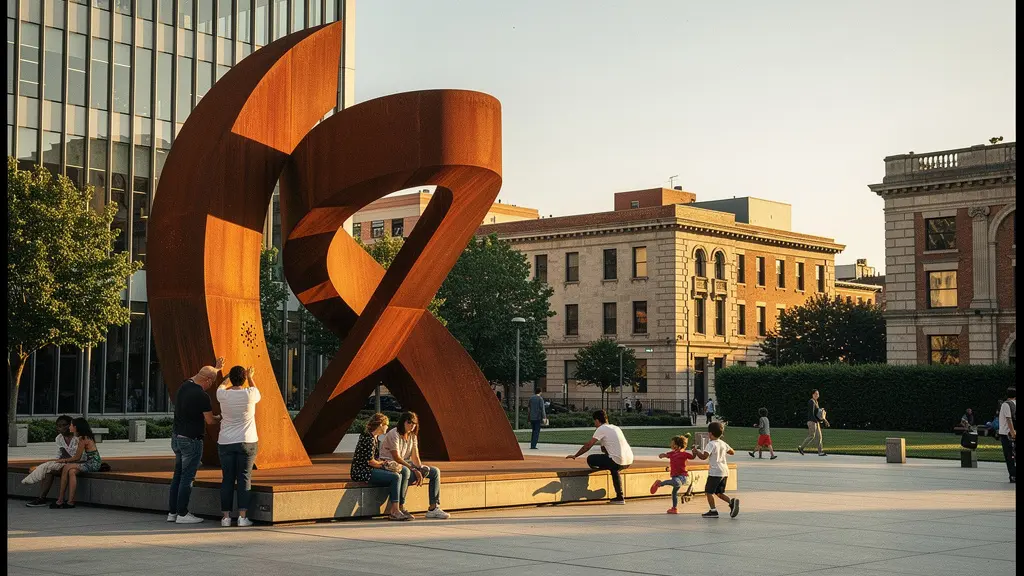
Public art is not just for looking at; it’s a functional tool for choreographing human behavior and rewriting the spatial grammar of our cities.
- The choice of material (like Corten steel) dictates a sculpture’s dialogue with time and invites specific tactile interactions.
- A sculpture’s form and placement are not arbitrary; they actively guide pedestrian flow, creating new paths, pause points, and social zones.
- Temporary and kinetic installations introduce a sense of urgency and unpredictability, transforming a passive space into an active, evolving experience.
Recommendation: Urban planners and designers must evaluate a proposed sculpture on its functional impact—how it will manage movement, wear, and human touch—not solely on its aesthetic merit.
When a new sculpture appears in a city square, the initial conversation often revolves around aesthetics: “Do I like it?” or “What does it mean?”. This perspective, while valid, misses the more profound and functional role of the artwork. As urban designers and sculptors, we see these installations not as mere decorations but as active agents that fundamentally alter the DNA of a public space. They are interventions that rewrite the unspoken rules of how people move, gather, and interact. The form of a sculpture can create a new desire line for pedestrians, its material can invite the human hand, and its sheer presence can turn a forgotten corner into a destination.
The common approach is to judge public art by its capacity to “beautify” or to serve as a backdrop for photos. While these outcomes have value, they are byproducts, not the core function. The true measure of a contemporary sculpture’s success in an urban plaza lies in its ability to engage with the public on a physical and temporal level. It’s a question of durability, flow, and touch. Does the piece withstand the rigors of public life? Does it channel or obstruct movement? Does it offer a place to sit, lean, or play? These are the questions that define the deep interaction between object and citizen.
This article moves beyond the surface-level critique of public art. We will explore the deliberate choices and unforeseen consequences that arise when a three-dimensional form is placed in the civic landscape. We’ll analyze how materiality, context, and even the logistics of installation become part of the sculpture’s story and its relationship with the public. The real impact of a sculpture is written not in art reviews, but in the foot traffic patterns, the worn-smooth surfaces from countless hands, and the new social behaviors that emerge in its shadow. It’s about understanding sculpture as a piece of high-performance urban equipment.
This guide delves into the key facets of how contemporary art actively shapes our shared spaces. We will examine everything from the raw materials that define a sculpture’s life to the social responsibilities that come with altering a public landscape. The following sections break down this complex interaction.
Summary: Redefining Urban Plazas Through Sculptural Intervention
- Why Corten Steel is the Go-To Material for Modern Public Sculpture?
- Yorkshire Sculpture Park: How Landscape Changes the Meaning of Large Forms?
- Beyond Dead Men on Horses: What Should Modern Monuments Celebrate?
- Moving Art: How Mechanics and Wind Create Unpredictable Forms?
- The Logistics of Installing a 5-Ton Sculpture in a City Centre?
- Pop-Up Parks: Why Temporary Installations Often Have More Impact Than Permanent Ones?
- Glass Floors: Is Leaving Ruins Visible Under Buildings a Good Idea?
- How Art Installations Can Revitalize Neglected Civic Landscapes?
Why Corten Steel is the Go-To Material for Modern Public Sculpture?
The material of a sculpture is its first language. Before the form is even interpreted, the surface speaks of texture, temperature, and permanence. In modern public art, Corten steel has become a dominant voice for a specific reason: it engages in a deliberate, controlled dialogue with its environment. Unlike stainless steel, which reflects its surroundings, or bronze, which carries the weight of classical tradition, Corten is designed to weather. Its signature rust-like patina is not a sign of decay but a stable, protective layer that forms over time when exposed to the elements. This process makes each sculpture unique, as its final appearance is a direct record of the local climate—the rain, the humidity, the air quality.
From a designer’s perspective, this quality is invaluable. It means the sculpture is not a static object fighting against time, but a dynamic surface that co-evolves with its setting. This “living” finish provides a rich, warm, and tactile quality that is less intimidating than polished metal, often inviting touch. However, this choice is also a practical one. The protective patina eliminates the need for paint or other coatings, drastically reducing long-term maintenance costs. As sculptor David Harber notes, its longevity is a key factor:
Mild steel in the right environment should last for centuries; Corten steel will last for centuries.
– David Harber, David Harber US
This durability, combined with its aesthetic evolution, makes Corten a material that performs on both artistic and civic levels. While the initial investment can be significant— market data from 1stDibs reveals that the average selling price can be around $12,500—cities often see it as a worthwhile long-term expenditure. It embodies a modern aesthetic of rugged authenticity and sustainable design, a material that tells a story of resilience and adaptation, mirroring the very cities it inhabits.
Yorkshire Sculpture Park: How Landscape Changes the Meaning of Large Forms?
A sculpture’s meaning is never created in a vacuum; it is profoundly shaped by its surroundings. Placing a monumental form in a controlled, white-walled gallery is one thing; setting it against the rolling hills and open skies of a landscape is another entirely. Yorkshire Sculpture Park (YSP) is perhaps the world’s foremost laboratory for this principle. Here, 500 acres of parkland, woods, and lakes are not merely a backdrop for art but an active participant in its interpretation. The scale of the human body against a vast sculpture and an even vaster landscape creates a powerful, visceral experience that a gallery cannot replicate.
This setting transforms the act of viewing art from a static, contemplative moment into a physical journey. To see the next piece, you must walk, climb a hill, or follow a path through a forest. This movement, this choreography of discovery, becomes part of the art. The changing seasons, the shifting light from dawn to dusk, and the unpredictable British weather all continuously re-contextualize the works. A Henry Moore bronze glistens differently in the rain than it does in the summer sun, its relationship to the earth around it constantly in flux. It’s this dynamic interplay that draws so many people; Yorkshire Sculpture Park welcomes approximately 380,000 visitors each year, all seeking an experience that marries art with nature.
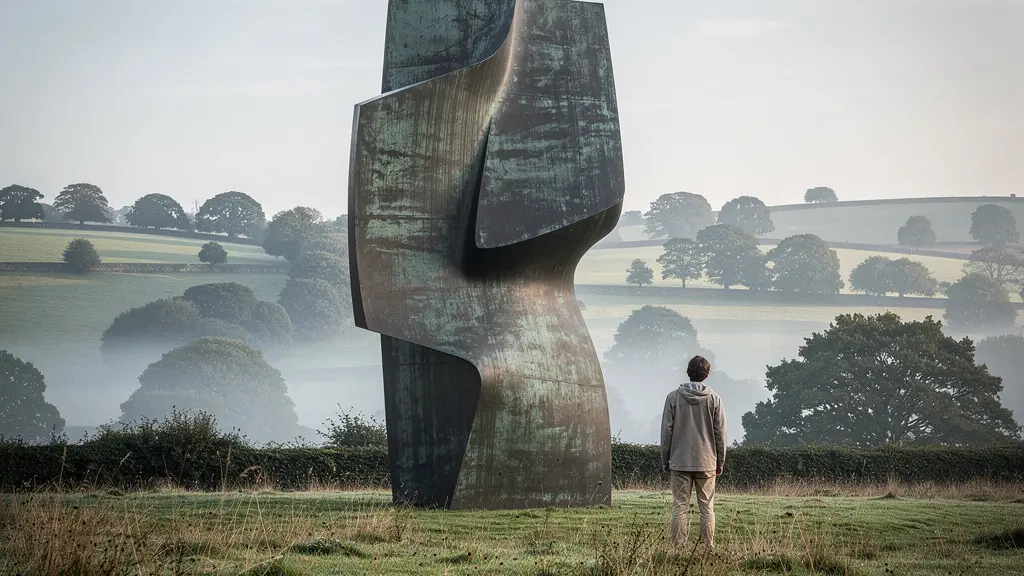
As the image illustrates, the human figure becomes the primary unit of measurement. Your own body is the reference point for understanding the immense scale of the work. This forces an awareness of your own physical presence in the space, turning a visual interaction into a full-body, phenomenological one. The sculpture is not an object on a plinth; it is a landmark, a peak, a strange and wonderful feature of the terrain itself. It teaches us that the “public space” for art doesn’t have to be a paved urban plaza; it can be a field, a forest, or a lakeside, where the dialogue between the man-made and the natural generates a unique and profound meaning.
Beyond Dead Men on Horses: What Should Modern Monuments Celebrate?
For centuries, the default language of public monuments was figurative and triumphalist: a general on a horse, a politician on a plinth. These statues were intended to project a singular, permanent narrative of power and history. Today, that model is being fundamentally questioned. Contemporary artists and city planners are asking a more complex question: what and who should we memorialize in our shared spaces, and how can we do it in a way that reflects a more democratic and evolving society? The answer is shifting away from deifying individuals and towards celebrating collective experiences, abstract concepts, or even the public itself.
This evolution involves moving from static representation to active engagement. Instead of presenting a finished story, modern monuments often create a framework for public dialogue. London’s Fourth Plinth program in Trafalgar Square is a prime example. By rotating contemporary artworks on a plinth that was originally intended for an equestrian statue, the program turns a space of historical commemoration into a site of ongoing cultural debate. It acknowledges that public sentiment is not fixed and that our values change over time. As one gallery observed in an analysis of the program:
By gathering responses from the public to new shortlisted proposals via an exhibition and a website, the Fourth Plinth programme encourages an appreciation of and familiarity with contemporary art.
– Halcyon Gallery, Public Art Analysis
This approach transforms monuments from didactic objects that lecture the public into platforms that listen to it. The goal is no longer to immortalize a single hero but to capture a moment, provoke a question, or create a shared experience. This can take the form of abstract sculptures that honor victims of injustice, interactive installations that celebrate community, or ephemeral works that mark a specific event. The modern monument is less about what we are told to remember and more about creating a space where we can collectively decide what is worth remembering. It is a shift from monologue to dialogue.
Moving Art: How Mechanics and Wind Create Unpredictable Forms?
While most sculpture is defined by its static form, a growing movement in public art embraces the opposite: change, unpredictability, and motion. Kinetic sculptures—artworks designed to move—introduce a powerful new element into the urban plaza: time. Powered by wind, water, or hidden mechanics, these pieces are never the same from one moment to the next. They refuse to be captured in a single photograph or understood in a single glance. This constant transformation is their primary mode of interaction, turning a passive viewing experience into an ongoing performance.
From a designer’s perspective, this dynamism is a powerful tool for activating a public space. A static statue can become part of the background, eventually rendered invisible by familiarity. A kinetic sculpture, however, continually recaptures our attention. The gentle sway of its elements, the flash of light off a rotating panel, or the soft chime of its parts colliding creates a sensory experience that enriches the urban environment. As landscape architect David Burke states, these evolving artworks keep public spaces lively and continually engaging. They create a focal point that is alive, rewarding repeat visits and extended observation.
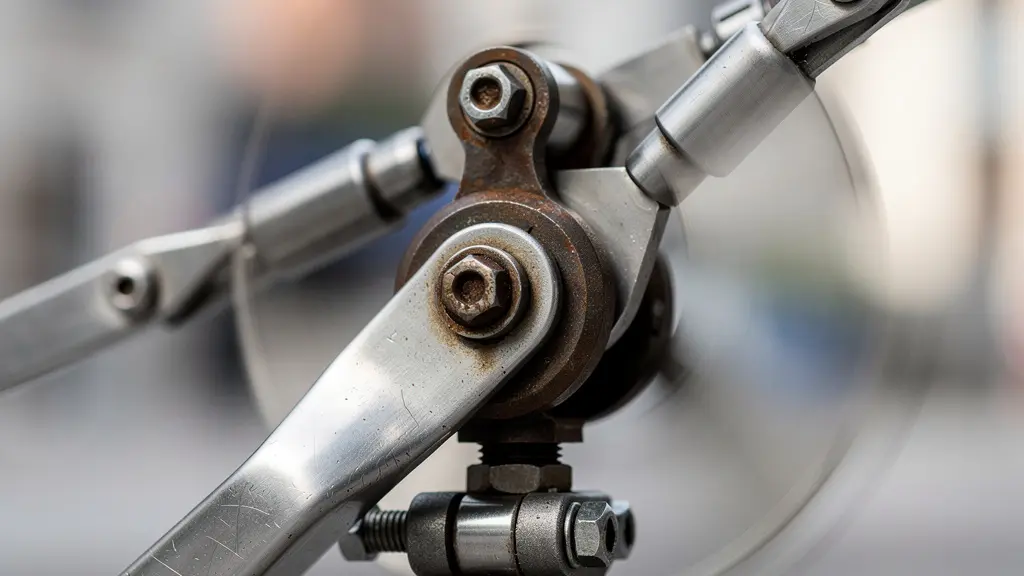
The beauty of kinetic art lies in its collaboration with natural forces. Artists like George Rickey or Anthony Howe design complex systems of weights and balances that allow massive steel forms to dance in the slightest breeze. This creates a direct, visible connection between the artwork and its invisible environment. You are not just seeing a sculpture; you are seeing the wind itself, made tangible. This mechanical poetry introduces a sense of wonder and unpredictability into the highly structured, often rigid, urban grid. It reminds us that even in the heart of the city, we are subject to the same natural forces that shape the wider world, creating a space that feels both engineered and organic.
The Logistics of Installing a 5-Ton Sculpture in a City Centre?
The arrival of a monumental sculpture in a city plaza often feels like magic—one day there is an empty space, the next a towering form stands in its place. But behind this “magic” is a complex and highly choreographed operation that is, in itself, a form of public performance. As a sculptor and urban designer, I can attest that the engineering, planning, and negotiation required to install a multi-ton artwork are as much a part of the piece’s story as its final form. This process is the sculpture’s first, and often most dramatic, interaction with the city.
The logistical challenges are immense. It begins with extensive subsurface analysis. Before a single bolt is placed, we must know what lies beneath the plaza: subway tunnels, water mains, fiber-optic cables, and forgotten utility lines. A foundation designed to support a 5-ton sculpture, while also resisting hurricane-force wind loads, must be engineered without disrupting this critical infrastructure. Then comes the labyrinth of permits. Street closures, crane operations, and police details require coordination across multiple municipal departments, each with its own concerns and regulations. Even insurance underwriters play a role, their risk assessments influencing what designs a city is ultimately willing to accept.
This process of installation, with its cranes, barriers, and teams of engineers, often provides the public’s first engagement with the artwork. It generates curiosity and anticipation. The disruption to daily life—the closed street, the diverted bus route—announces that something significant is happening. It frames the artwork not as an object that was simply dropped into place, but as a major civic undertaking, a testament to a city’s investment in its cultural landscape. Successfully navigating these hurdles is a hidden art form, one that ensures the sculpture can safely and permanently integrate into the fabric of the city.
Action Plan: Navigating Urban Sculpture Installation
- Frame the Process as Performance: Recognize that cranes, cordoned-off streets, and engineering teams are the public’s first interaction with the piece, and plan public communication accordingly.
- Navigate Permit Complexity: Map out and engage early with all municipal departments involved in street closures, crane operations, and building codes to create a unified timeline.
- Conduct Subsurface Surveys: Commission comprehensive ground-penetrating radar and utility maps to identify and protect all underground infrastructure like tunnels and cables.
- Calculate Foundational Needs: Engineer the footing based on both the sculpture’s dead weight and the dynamic wind load factors specific to the site’s surrounding architecture.
- Coordinate with Insurers: Involve insurance underwriters early in the design process, as their liability assessments can significantly influence material and structural choices the city will approve.
Pop-Up Parks: Why Temporary Installations Often Have More Impact Than Permanent Ones?
In the pursuit of creating memorable public spaces, permanence is often seen as the ultimate goal. We build monuments in bronze and granite to last for centuries. Yet, there is a growing recognition that temporary, “pop-up” installations can often generate a more intense and lasting impact on a community’s collective memory. The fleeting nature of these works creates a sense of urgency and specialness. You have to be there *now*, because it won’t be there forever. This “fear of missing out” can drive engagement in a way that a permanent fixture, which can always be seen “later,” rarely does.
These temporary installations often prioritize play and direct participation. Works like the musical swings of *21 Balançoires* in Montreal transform a mundane commute into an opportunity for spontaneous collaboration and joy. As the blog Aesthetics of Joy points out, installations like Impulse and 21 Balançoires help us imagine a city where play isn’t confined to playgrounds, but is woven into the fabric of everyday life. Because they are not designed to last for decades, these pieces can be more experimental, whimsical, and tactile. They give permission for a type of public behavior—playfulness, silliness, exploration—that more stoic, permanent monuments often discourage.
This focus on a unique, unrepeatable experience is a powerful tool for activating underused public spaces. A temporary installation can quickly and cost-effectively test a new use for a plaza or park, gathering real-world data on how people interact with it before committing to a costly permanent redesign.
Case Study: The “Rainbow Machine” and Private Experience in Public Space
The “Rainbow Machine” installation in Auckland’s Silo Park exemplifies how temporality creates value. This unique structure hosted a private, individual interaction within a busy public area. Each viewer entered the machine alone to witness an ephemeral play of light and color. Because the experience was dependent on the specific quality of daylight at that exact moment, no two encounters with the artwork could ever be identical. This mechanism demonstrates how temporary installations generate excitement and urgency by offering a singular, unrepeatable experience, making the act of participation a coveted event.
The memory of a joyful, fleeting experience can embed itself more deeply in a community’s identity than a permanent statue that eventually fades into the background. The impact of temporary art is measured not in its material longevity, but in the richness of the social interactions and personal memories it creates during its brief existence.
Glass Floors: Is Leaving Ruins Visible Under Buildings a Good Idea?
One of the most compelling ways contemporary design interacts with public space is by making the invisible visible. In historically rich cities, the ground beneath our feet is often a layered archive of previous civilizations. The decision to expose these archaeological ruins through glass floors in plazas or buildings creates a literal window into the past. This act of “in situ” preservation turns a simple floor into a museum exhibit, creating a powerful and constant dialogue between the present and the past. Pedestrians are no longer just walking across a plaza; they are floating over Roman walls or medieval foundations. This creates an immediate, visceral connection to the deep time of the city.
From a design standpoint, this technique offers tremendous educational value and a unique sense of place. It prevents history from being excavated, documented, and then reburied or moved to a museum. Instead, history remains part of the living fabric of the city. However, as a designer and builder, I know this transparency comes with significant technical and experiential challenges. The space between the glass and the ruins can become a trap for dust and condensation, obscuring the view. The structure must be engineered to support heavy public loads while maximizing visibility. There is also the risk of what some call “museumification”—turning authentic history into a sterile display that feels detached from daily life. A careful balance must be struck to ensure the intervention feels like a genuine connection, not a gimmick.
The following table, inspired by discussions among architects and preservationists, outlines the key considerations when contemplating this type of historical revelation. As one analysis on a platform like ArchDaily might suggest, the decision involves weighing historical reverence against practical realities.
| Benefits | Challenges |
|---|---|
| Creates historical connection and context | Condensation obscures view regularly |
| Preserves archaeological sites in situ | High specialized cleaning costs |
| Educational value for public | Dust and mold accumulation underneath |
| Tourist attraction potential | Structural complexity supporting public loads |
| Visual transparency of history layers | Creates detachment – ‘museumification’ effect |
Ultimately, the success of such an installation depends on meticulous design and maintenance. When done well, it doesn’t just show history; it integrates it into the rhythm of the city, allowing the past to inform and enrich the present moment in a uniquely powerful way.
Key Takeaways
- Public sculpture is a functional urban tool that choreographs movement and social interaction, not just a decorative object.
- Material choice, like Corten steel, is a critical decision that dictates a sculpture’s long-term relationship with its environment and the public.
- The most impactful public art often moves beyond memorializing individuals to celebrating collective experiences, asking questions rather than providing answers.
How Art Installations Can Revitalize Neglected Civic Landscapes?
The narrative of public art as a tool for urban revitalization is a powerful one. The argument is compelling: introducing vibrant, engaging sculptures and murals into neglected or underutilized areas can attract foot traffic, foster community pride, and signal a neighborhood’s renewal. This “creative placemaking” can, in the best cases, transform a forgotten plaza or a derelict waterfront into a thriving civic hub. By providing a new focal point and a reason for people to gather, art can be the catalyst that breathes social and economic life back into a space.
However, as urban designers, we must approach this narrative with a critical eye. Revitalization is a complex process with real social consequences, and art can sometimes be an unwitting instrument of displacement. When “street art” becomes a marketing tool for real estate development, it can accelerate gentrification, pushing out the very communities that gave the neighborhood its original cultural identity. This paradox is a central ethical dilemma in contemporary urbanism. As one curator noted, the commercialization of street art has led to the erasure of the very communities that created it.
The data often supports this concern. A city’s embrace of public art as a regeneration strategy can correlate with rising property values and the displacement of long-term, lower-income residents. For example, research from the National Community Reinvestment Coalition found that Denver, a city known for its public art initiatives, ranked as the second most gentrifying city in the U.S. and led the nation in Hispanic displacement during a key period. This does not mean art is inherently harmful, but it demands that any revitalization project be paired with robust community engagement and policies that protect existing residents. The goal should be to revitalize for the community that is already there, not for a new one that is yet to arrive. True success is when art empowers a neighborhood from within, rather than simply making it more attractive to outside investment.
To apply these insights effectively, the next step is to analyze any proposed public art not just for its form, but for its function within the urban ecosystem—considering its impact on pedestrian flow, social gathering, and community identity. Evaluate your next civic project through this critical lens.