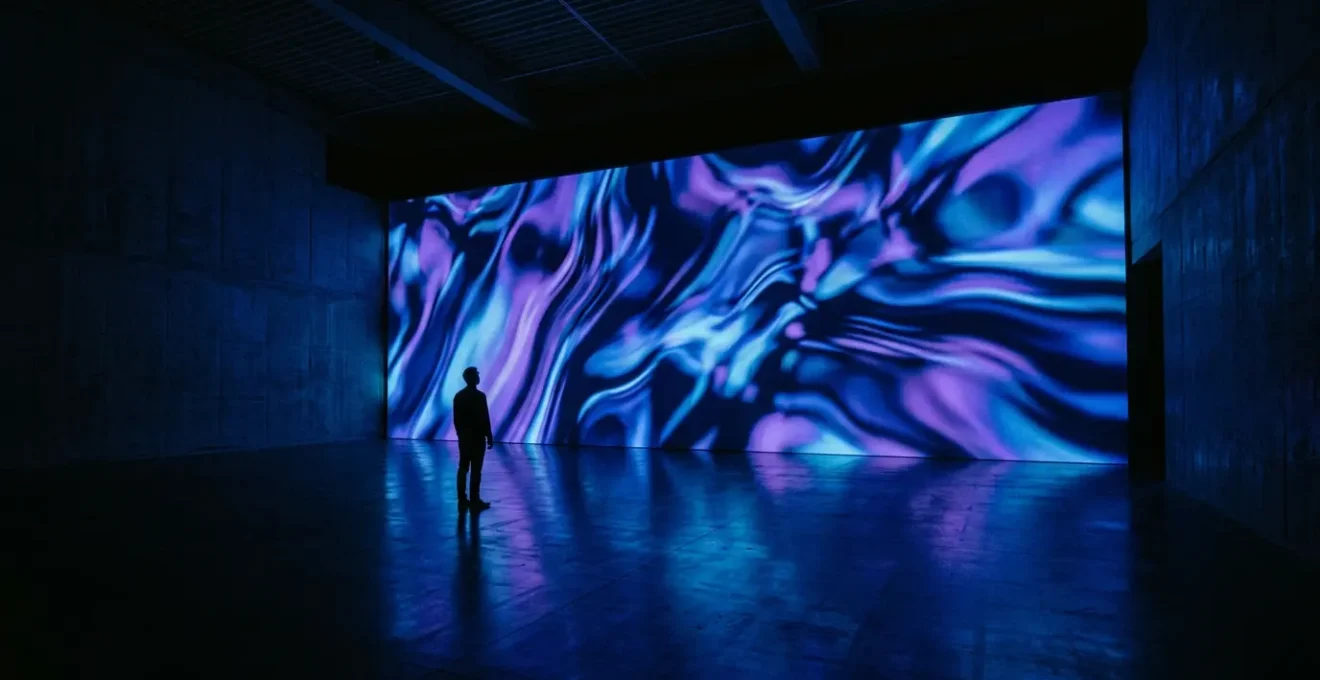
The key to truly immersive art isn’t the technology, but the precise psychological “flow state” it engineers in the visitor’s mind by managing their cognitive resources.
- Effective immersion hinges on eliminating “extraneous cognitive load”—like confusing navigation or sensory overload—allowing for deeper engagement.
- Spatial audio is not an accessory but a foundational tool, capable of tricking the brain into accepting the visual illusion and directing attention more effectively than visual cues alone.
- The most successful experiences guide visitors implicitly through environmental affordances (light, sound, texture), transforming the physical space into a narrative engine.
Recommendation: Shift design focus from creating purely “Instagrammable” moments to architecting a seamless cognitive journey that minimizes distraction and maximizes embodied presence.
The rise of large-scale digital art installations has created a new category of cultural experience, one that promises to swallow us whole. We are invited to step inside a painting, walk through a field of light, or lose ourselves in a symphony of sound and color. For creators and psychologists, the central question is not *what* technologies make this possible, but *why* it feels so compelling. The common discourse often centers on creating “wow factor” or “Instagrammable moments,” but this superficial view misses the deeper mechanism at play.
From a cognitive psychology perspective, the most profound of these experiences achieve something far more elusive than mere spectacle: they induce a flow state. This is a mental state of being fully immersed in an activity, characterized by energized focus, deep enjoyment, and a temporary loss of self-consciousness. It’s a delicate balance. Too much stimulus leads to cognitive overload and anxiety; too little leads to boredom. The true art of the immersive designer, therefore, is not in being a technologist, but in being a cognitive architect—someone who consciously shapes a visitor’s attention, perception, and emotional journey through a carefully constructed environment.
This article will deconstruct the psychological principles that enable designers to build these cognitive architectures. We will move beyond a simple inventory of tools and instead analyze the strategies used to manage sensory input, guide behavior without explicit instruction, and craft narratives that feel both infinite and personal. By understanding these mechanisms, we can begin to grasp how a physical space is transformed into a landscape of the mind.
This analysis will explore the precise techniques used to craft these transcendent experiences. We will examine the delicate balance of sensory input, the power of implicit guidance, the role of interaction, the controversial influence of social media, the neuro-scientific trickery of 3D sound, and the evolving business models that this new art form is generating.
Summary: The Cognitive Architecture of Immersive Flow
- Too Much Stimulus: When Does Immersion Become Nausea or Anxiety?
- Spatial Storytelling: How to Guide a Visitor Without Signs or Maps?
- Lean Back or Lean In: Do Visitors Want to Watch or Interact?
- The Instagram Trap: Are We Designing for the Eye or for the Phone Lens?
- Binaural Audio: How 3D Sound Tricks the Brain into Believing the Illusion?
- Spatial Audio: Why Sound is 50% of the Immersive Visual Experience?
- Looping Stories: How to Write a Script That Has No Beginning or End?
- How Immersive Digital Installations Are Changing the Museum Business Model?
Too Much Stimulus: When Does Immersion Become Nausea or Anxiety?
The promise of immersion is total sensory engagement, but the line between profound and painful is perilously thin. From a cognitive standpoint, our brains have a finite processing capacity. The goal of a designer is to occupy this capacity fully to induce a flow state, but exceeding it triggers a defensive response. When visual, auditory, and proprioceptive inputs become too dense, chaotic, or contradictory, the brain struggles to build a coherent model of reality. This isn’t just confusing; it’s physiologically stressful. The result can manifest as sensory overload, leading to feelings of anxiety, disorientation, or even physical nausea, a phenomenon well-documented in early virtual reality applications.
The challenge for designers lies in managing what is known as cognitive load. Intrinsic cognitive load (the inherent complexity of the art) should be high enough to be engaging, but extraneous cognitive load (distracting or overwhelming elements) must be ruthlessly minimized. As researchers noted in a study on art education in virtual environments, creating joyful immersive experiences and good recall at the same time is exceptionally difficult. The experience that feels thrilling in the moment may be too chaotic for the brain to encode into memory, leaving the visitor with a fleeting emotion but no lasting impression. Achieving the right balance requires careful orchestration—modulating the intensity, rhythm, and complexity of stimuli to guide the visitor toward the edge of their perceptual limits, without pushing them over.
Spatial Storytelling: How to Guide a Visitor Without Signs or Maps?
The most elegant immersive experiences guide visitors with an invisible hand. Instead of relying on explicit instructions like signs, maps, or arrows—all of which are forms of extraneous cognitive load that break immersion—designers use the environment itself to tell a story and direct movement. This is spatial storytelling, a practice that leverages innate human instincts for exploring and understanding space. Designers become architects of attention, using light, sound, and texture as primary tools. A brightly lit pathway naturally draws the eye and foot, a pool of darkness suggests a boundary, and a focused sound source creates a point of interest to investigate.
These environmental cues are known as affordances. A pathway affords walking, a low ceiling affords ducking, and a change in floor texture affords a new sensory experience. The teamLab Planets installation in Tokyo, which broke records by welcoming over 2.5 million visitors in a year, is a masterclass in this approach. As detailed in an industry analysis on successful immersive art experiences, visitors navigate the space barefoot, moving through water and across varied surfaces. The artworks are not static displays but reactive environments that shift and respond to the visitor’s presence, blurring the line between observer and participant. The journey is the narrative, and movement is the mechanism of discovery. There are no signs because the space itself communicates where to go and what to do next, creating a seamless and deeply personal exploration.
This method works because it taps into fundamental cognitive processes. Our brains are wired to seek patterns and follow paths of least resistance. By creating a clear, intuitive, and rewarding sensory trail, designers can guide thousands of people through a complex journey without a single word of text, preserving the magic of unmediated discovery.
Audit Checklist: Architecting Visitor Flow
- Points of Contact: List every channel where a guiding signal is needed (e.g., transitions between rooms, points of interest, exits).
- Collecte: Inventory existing guidance elements. Are they explicit (signs, text) or implicit (light paths, sound cues, architectural funnels)?
- Cohérence: Confront existing cues with the desired emotional journey. Does a harsh “EXIT” sign shatter a moment of quiet contemplation?
- Mémorabilité/Émotion: Identify unique, ownable sensory cues versus generic ones. Is your light path visually distinct, or does it look like airport runway lighting?
- Plan d’intégration: Create a priority list to replace explicit signage with implicit, narrative-driven environmental cues.
Lean Back or Lean In: Do Visitors Want to Watch or Interact?
The debate between passive observation (“lean back”) and active participation (“lean in”) is central to the design of immersive experiences. While a purely passive, cinematic experience can be beautiful, cognitive science suggests that interaction is a powerful catalyst for deeper immersion. When a visitor’s actions have a direct and immediate effect on their environment—touching a wall causes ripples of light, or their movement alters the soundscape—the brain’s sense of agency is activated. This transforms the individual from a mere spectator into a co-creator of the experience, fundamentally strengthening the feeling of presence. Presence is the psychological state of “being there,” where the technology becomes invisible and the virtual or created world is accepted as real.
Research consistently supports the power of interaction. For instance, a 2024 study on educational VR found that interactive groups showed significantly higher attention levels via EEG monitoring compared to passive viewing groups. This heightened attention is not just about being more entertained. As other researchers have pointed out, well-designed interaction can actually make an experience feel *less* mentally taxing. They found that “higher immersion not only led to a greater sense of presence but also lowered extraneous cognitive load.” Why? Because interaction provides a clear focus for our attention. Instead of passively trying to process an entire overwhelming scene, the visitor is given a specific task, even a simple one, which channels their cognitive resources and deepens their engagement with the core of the artwork.
The most effective designs often offer layered interactivity. Some visitors may prefer to simply watch, while others will want to explore every interactive element. The key is to create an environment that rewards both approaches. The experience should be compelling at a baseline “lean back” level but reveal greater depth and nuance to those who choose to “lean in.” This allows each visitor to calibrate their own level of engagement, leading to a more universally satisfying and psychologically resonant experience.
The Instagram Trap: Are We Designing for the Eye or for the Phone Lens?
In the age of social media, it’s impossible to ignore the role of the smartphone in cultural spaces. The “Instagram Trap” refers to the temptation to design experiences primarily for their photographic potential, prioritizing visually striking but shallow “moments” over deep, sustained engagement. This approach risks reducing a complex work of art to a two-dimensional backdrop for a selfie. It shifts the visitor’s cognitive goal from experiencing the art to documenting the art, a process that can actively pull them out of the flow state. The act of framing a shot, choosing a filter, and thinking of a caption is a form of cognitive load that is entirely extraneous to the artistic intent.
However, dismissing “Instagrammability” entirely is a missed opportunity. The desire to capture and share beauty is a deeply human impulse. The most strategic designers don’t fight this impulse; they integrate it. They create installations that are spectacular enough to be photogenic but also rich enough to reward the visitor who puts their phone away. As a 2025 study in *Media Psychology* is set to highlight, there’s a strong correlation between higher sensory intensity, attention, and esthetic perception in immersive exhibitions. A spectacular visual can be the hook that draws a visitor in, a gateway to deeper engagement.
Case Study: Area15’s Balanced Approach
Area15 in Las Vegas exemplifies this balanced strategy. It features overtly “Instagrammable” installations like a giant, projection-mapped skull or a Japanese maple tree with 5,000 LED lights. These are designed to be visually stunning and highly shareable. However, they also function as genuine points of interactive engagement and wonder for the in-person visitor, such as the 360-degree projection-mapped room that creates a true sense of envelopment. Area15 understands that the phone lens and the human eye do not have to be in opposition. By designing for both, they cater to the modern visitor’s dual desires: to be present in the moment, and to share that moment with the world.
The key is intentionality. If the only thing to do in a space is take a picture, the design has failed. But if the picture becomes a byproduct of a genuinely awe-inspiring and engaging experience, then the design has succeeded in bridging the gap between personal immersion and social expression.
Binaural Audio: How 3D Sound Tricks the Brain into Believing the Illusion?
While visuals often get the spotlight, binaural audio is the unsung hero of convincing immersion. It is a method of recording and rendering sound that uses two microphones, often placed on a dummy head with pinnae (outer ears), to replicate how humans hear in the real world. When played back on headphones, the recording preserves the subtle, direction-dependent cues—inter-aural time differences, level differences, and frequency filtering—that our brains use to localize sound in three-dimensional space. This is not mere stereo; it’s a high-fidelity auditory illusion that can place a sound above, behind, or right next to the listener’s ear with uncanny accuracy.
The psychological impact is profound. Our brains have evolved to trust our ears for situational awareness and survival. When the audio environment perfectly matches the visual one, it creates a powerful sense of perceptual anchoring, making the entire illusion more believable. The brain is tricked into accepting the fabricated reality because a primary sensory system confirms its validity. This technology has been a cornerstone of virtual reality’s push for presence. As highlighted by research from the University of York AudioLab, whose SADIE binaural filters were foundational, the rapid adoption of VR headsets like Google Cardboard saw over 10 million units shipped, enabling a massive platform for 3D audio experiences. This scale demonstrates the industry’s bet on audio as a key to immersion.
The binaural version achieved higher narrative engagement, enjoyment, imagery, and information recognition than the stereo stories.
– Researchers, The 3D Sound Power of Immersion Processing Study
This isn’t just about realism; it’s about narrative power. As one study in *Media Psychology* found, stories told with binaural audio were perceived as more engaging and memorable than their stereo counterparts. By controlling the precise location of sound, a designer can direct the listener’s attention, evoke specific emotions (like suspense from a sound behind them), and build a world that feels not just seen, but inhabited.
Spatial Audio: Why Sound is 50% of the Immersive Visual Experience?
The common expression “seeing is believing” is a profound oversimplification of human perception. In reality, our senses work in concert, with the brain constantly cross-referencing inputs to build a stable model of the world. In immersive environments, sound is not an accompaniment to the visuals; it is a co-equal partner in constructing the illusion. Spatial audio—a broader term than binaural audio that includes systems for multi-speaker setups—is arguably the most powerful tool for grounding a visitor and making a synthetic environment feel real. It provides crucial information about the size, volume, and material properties of a space through reverberation and reflection, details that visuals alone cannot convey.
The psychological weight of audio is so significant that it can override visual information. Our auditory system is our primal alarm system, constantly scanning for threats and opportunities, and it often has a more direct line to our emotional centers than our visual cortex. This is why a well-placed sound can create a more powerful emotional response than a purely visual effect. As researchers exploring interactive audio have shown, “dynamic binaural audio rendering allowed a greater level of immersion and more detectable fear-related emotions.” The sound design was directly responsible for modulating the user’s emotional state.
The value of high-fidelity audio is not just theoretical; it has been quantified. In a striking finding, research demonstrates that participants rated virtual reality experiences with high-quality, head-tracked spatial audio as being just as immersive as experiences with video quality that was five times higher. This is a critical insight for designers: investing in audio is one of the most cost-effective ways to enhance perceived quality and achieve a profound sense of presence. Neglecting sound is not just a missed opportunity; it’s a fundamental misunderstanding of how the human brain builds its reality.
Looping Stories: How to Write a Script That Has No Beginning or End?
Traditional narrative is linear, with a clear beginning, middle, and end. Immersive installations, however, are often experienced in a non-linear, cyclical fashion. Visitors enter and leave at different times, and the experience must be coherent and compelling regardless of their entry point. This requires a shift from linear scripting to designing looping narratives or experiential cycles. The goal is not to tell a single story, but to create a world with its own internal logic and rhythm, one that a visitor can step into and out of while still feeling a sense of completeness.
Writing for a loop is not about creating a repetitive sequence. It’s about designing a system of interconnected moments, themes, and sensory shifts that can be assembled in any order by the visitor’s unique journey. Instead of a plot, the designer works with a palette of emotions, visual motifs, and auditory cues. The narrative “arc” is replaced by a narrative “orbit,” where key moments or climaxes repeat periodically, but the experience between them is one of continuous, self-directed discovery.
A Framework for Cyclical Flow
A 2025 study from *Frontiers in Virtual Reality* provides a powerful cognitive framework for achieving this. Researchers developed an evaluation system for flow experience, identifying three essential, progressive stages that work in a cycle. First is environmental immersion, the objective design of the space (lighting, scale, sound). This creates the foundational world. Second is the audience immersion experience, the subjective feelings of the visitor as they move through and interact with that world. Finally, there is the impact value, the lasting emotional or intellectual impression after they leave. By designing modularly across these three stages, creators can ensure that no matter when a visitor enters the cycle, they can progress through the full sequence of objective immersion, subjective experience, and final impact, achieving a complete narrative loop without a formal “start” or “finish.”
This model fundamentally changes the author’s role. The designer is no longer a storyteller in the traditional sense, but a “world-builder” and a “system-designer.” They create the conditions for stories to emerge, but the final narrative is uniquely constructed in the mind and memory of each individual visitor, making the experience both communal and profoundly personal.
Key Takeaways
- Flow state in immersive art is an engineered cognitive outcome, not an accident of technology.
- Effective design prioritizes the reduction of extraneous cognitive load (e.g., confusing navigation) to allow for deeper immersion.
- Spatial audio is a primary tool for establishing presence and directing attention, often more powerful and efficient than visual cues.
How Immersive Digital Installations Are Changing the Museum Business Model?
The rise of immersive digital art is not just an artistic movement; it’s a significant business model disruption for the cultural sector. Traditional museums, often reliant on the quiet contemplation of static objects, are now competing with for-profit “experience economies” that offer dynamic, interactive, and highly shareable content. This has forced a fundamental rethink of how cultural institutions attract audiences, generate revenue, and define their mission in the 21st century. Immersive installations are at the heart of this transformation, acting as powerful engines for audience growth and financial sustainability.
The economic impact is undeniable. The U.S. museum exhibition design market, heavily driven by this trend, is a significant industry; a market analysis from Precision Business Insights shows it was valued at US$292.1 million in 2024 and is projected to grow. As their analysts note, “Museums are leveraging immersive technologies… to enhance engagement and appeal to a diverse audience.” These blockbuster shows draw in new, often younger, demographics who might not typically visit a museum, creating a “gateway” to the institution’s other offerings. They also create new and diverse revenue streams. A 2024 MuseumNext survey of 242 museum professionals revealed that while online ticket sales are the primary driver (76%), institutions are diversifying with digital content licensing (13.8%) and online workshops (14.3%), business lines that are perfectly suited to digital-native content.
This shift represents more than just a new way to sell tickets. It signals a change in the museum’s role from a passive archive of artifacts to an active producer of cultural experiences. By embracing the cognitive and emotional power of immersive design, these institutions are not just adapting to a new market; they are evolving their relationship with the public, proving that art can be both a profound personal experience and a sustainable enterprise.
By understanding and applying the principles of cognitive psychology, designers can move beyond creating mere spectacles and begin to architect truly transcendent experiences that are memorable, meaningful, and commercially viable.