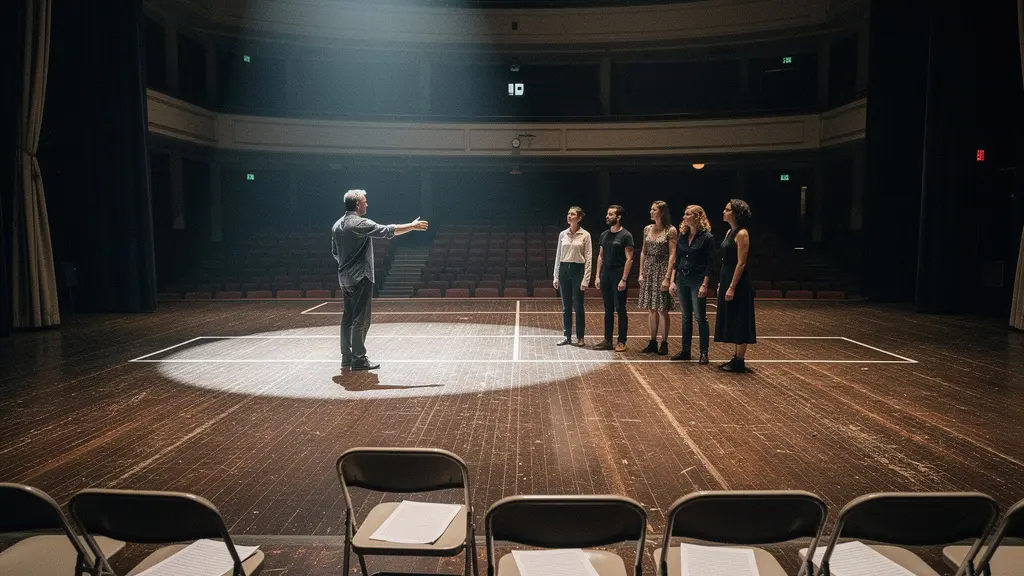
Most people think theater rehearsals are simply for memorizing lines and learning where to stand. The reality is far more architectural. The rehearsal room is a laboratory where every moment, from the first script reading to the final dress, is a deliberate act of construction. It’s where we, as creators, build the emotional architecture of the story—a structure designed to guide the audience’s experience, often by using pressure, constraint, and planned chaos as our most powerful tools.
The house lights dim. A hush falls over the crowd. For the next two hours, an audience will be transported, captivated by a story that feels immediate, alive, and seamlessly woven. But that final, polished performance is merely the tip of the iceberg. Beneath the surface lies a complex, often chaotic, and deeply intentional process: the rehearsal. Many assume this period is a straightforward journey of memorizing a script and getting actors from point A to point B. This view misses the essence of the craft.
As a stage director, I see the rehearsal room not as a classroom for recitation, but as a studio for sculpture. The script is the block of marble, but the tools we use are time, space, movement, and even friction. It’s a process of chipping away, discovering the form within, and building a shared understanding of the story we want to tell. The true work isn’t about avoiding mistakes; it’s about making them in a safe space to unearth moments of genuine truth. We don’t just stage a play; we construct its emotional world from the ground up.
But what if the key to a powerful performance isn’t found in perfect execution, but in the managed chaos of “tech week hell” or the creative spark ignited by a tiny budget? The real magic lies in understanding the *why* behind each stage of the process. This guide will take you inside the rehearsal room to explore how we transform words on a page into a living, breathing experience, shaping every choice to build the story’s final emotional architecture.
This article breaks down the crucial stages and philosophies that govern the journey from the first read-through to opening night. We will explore how each phase contributes to the final, invisible structure that holds the audience captive.
Summary: Deconstructing the Rehearsal Process
- Why Spending a Week Reading the Script Saves Time on the Floor?
- Tech Week Hell: Why is the Week Before Opening the Most Stressful?
- Creative Vision vs Budget: Who Really Makes the Decisions in a Production?
- The Danger of Immersion: When Does Method Acting Become Unsafe for the Cast?
- Telling the Story Through Movement: How Blocking Directs the Audience’s Eye?
- Action Painting: How Physical Movement Translates to Emotional Weight on Canvas?
- Slaps and Swords: How to Make Violence Look Real Without Injury?
- Why Suspension of Disbelief Fails When the Audience is Distracted?
Why Spending a Week Reading the Script Saves Time on the Floor?
The first week of rehearsal is often spent sitting around a table, reading the script aloud. To an outsider, this might seem unproductive—why read when you could be on your feet, acting? But this “table work” is the most critical investment we make. It’s not about memorization; it’s about building the intellectual and emotional foundation of our entire production. This is where we collectively ask the big questions: What is this play *really* about? What does each character want? What are the unspoken histories between them?
This phase allows actors to explore the text without the pressure of physicalization or making definitive choices. It’s a time for questions, debates, and discovering the play’s rhythm and musicality. Professional directors often recommend between six and twelve full script readings to allow the story’s layers to reveal themselves. By the time we get the play “on its feet,” the cast shares a common language and a deep, unified understanding of the narrative’s spine. This shared blueprint prevents countless hours of confusion and correction later on.
The StageMilk Theater Company captures this exploratory spirit perfectly in their guide for actors. They note that the best performers use this time for pure potential, as their advice highlights:
The greatest actors I’ve had the privilege of working with use this time like they were a blank canvas. They free themselves of the obligation to lock in choices in these early reads.
– StageMilk Theater Company, Guide to a Successful Rehearsal Process
This initial period of deep textual analysis ensures that when an actor makes a move on stage, it’s rooted in a rich understanding of their character’s “why.” It’s the slow work that makes the fast work possible.
Tech Week Hell: Why is the Week Before Opening the Most Stressful?
Ask any theater professional about “tech week,” and you’ll likely see a shudder. It’s famously the most grueling, high-stress period of the entire process. This is the week we finally integrate all the technical elements—lights, sound, set changes, costumes, and props—with the actors’ performance. It often involves long, tedious hours of “cue-to-cue” rehearsals, where we jump from one technical event to the next, skipping large chunks of dialogue. The process can feel frustratingly disjointed for actors and is a logistical nightmare for the crew.
So why do we put ourselves through this “hell”? Because it’s the only way to transform the play from a performance into a fully realized world. Every lighting change and sound effect is a character in itself, shaping the mood and directing the audience’s focus. Tech week is where we choreograph this complex dance between human and machine. It’s where a lighting designer’s subtle shift in color can amplify a character’s inner turmoil, or a perfectly timed sound cue can make a dramatic moment land with devastating impact. The chaos is a controlled burn, designed to expose every potential failure before an audience does.
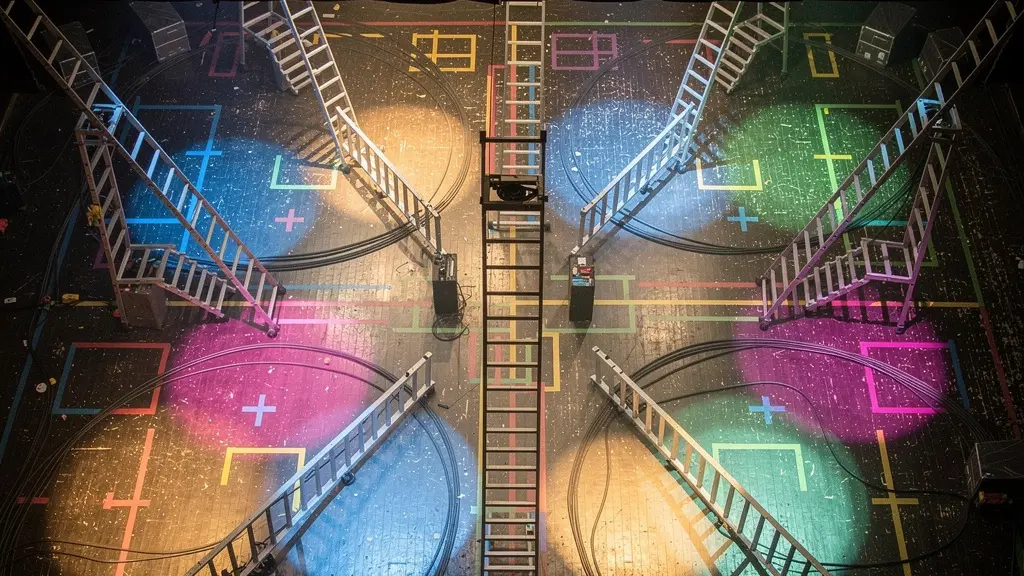
This period of intense problem-solving is where the show truly solidifies. The apparent chaos is, in fact, a highly structured sequence of events designed to layer each technical element onto the performance. The goal is to make the technology invisible on opening night, so it supports the story seamlessly rather than distracting from it.
Your Action Plan: The Five Stages of Tech Week
- Stage 1: Cue-to-cue rehearsal for lighting and sound technicians
- Stage 2: First dress rehearsal without makeup to focus on costume issues
- Stage 3: Full technical run with all departments coordinating
- Stage 4: Final dress rehearsal with complete production elements
- Stage 5: 24-hour break before opening night
Creative Vision vs Budget: Who Really Makes the Decisions in a Production?
A common myth is that the director is an autocrat, wielding absolute creative power. While the director is the artistic leader, their vision is constantly negotiated against a formidable, and often unmovable, force: the budget. In reality, the ultimate decision-maker is frequently the producer, the person responsible for the financial health of the production. The director proposes, and the producer, armed with a spreadsheet, disposes.
This tension between creative ambition and financial reality defines much of the production process. A director might envision a lavish, revolving set, but if the budget only allows for a few chairs and a table, a different solution must be found. This is where the true collaboration—and sometimes conflict—happens. The power dynamic is a constant negotiation between the director, producer, and designers, each advocating for their department’s needs while working within the show’s overall financial framework.
This table illustrates how budget allocation often dictates where the real power lies, as outlined in a recent analysis of production roadmaps.
| Department | Typical Budget % | Decision Authority | Flexibility Level |
|---|---|---|---|
| Actor Salaries | 40-50% | Producer | Low |
| Set Design | 15-20% | Director/Producer | Medium |
| Costumes | 10-15% | Director | Medium |
| Lighting/Sound | 10-15% | Technical Director | Low |
| Contingency | 5-10% | Director | High |
However, this friction is not always a negative. An experienced director learns to see constraints as a creative opportunity. As one expert puts it, limitations can be a powerful driver of innovation.
Constraint as a Creative Catalyst: Moving beyond the idea of cuts, budget limitations force innovative problem-solving, such as using light to suggest a set piece.
– Theater Production Expert
A limited budget might force a director to use lighting to create a forest instead of building trees, a choice that can be far more evocative and theatrical. This is intentional friction—using limitations to spark more imaginative storytelling.
The Danger of Immersion: When Does Method Acting Become Unsafe for the Cast?
The pursuit of emotional truth is at the heart of acting, but there’s a fine line between profound immersion and psychological danger. “Method acting,” a technique where actors attempt to live their character’s experiences, is famous for producing powerful performances. It’s also infamous for creating toxic and unsafe rehearsal environments. When one actor’s process involves staying in character offstage, blurting out unscripted insults, or behaving erratically, it can disrupt the entire company’s work and well-being.
The rehearsal room must be a space of trust and psychological safety. This is built over the four to six weeks of a typical theater rehearsal schedule, where actors establish boundaries and a shared respect. An actor’s process is their own, but it cannot come at the expense of their scene partners’ ability to do their job safely. A performance is a partnership, and if one partner feels threatened or disrespected, the collaborative art form breaks down.
In recent years, the industry has become far more proactive in addressing these dangers. The rise of intimacy coordinators for scenes involving nudity or sexual content is a prime example. These professionals choreograph intimate moments with the same technical precision as a fight scene, ensuring consent and safety are paramount. Similarly, many productions now implement formal protocols that create clear boundaries and provide safe channels for feedback when one actor’s process negatively impacts others.
The goal is not to stifle an actor’s creativity but to channel it within a professional and respectful framework. The ability to “drop” a character at the end of the day—a process known as de-roling—is a crucial skill. It protects not only the actor’s own mental health but also the collaborative ecosystem of the entire cast and crew.
Telling the Story Through Movement: How Blocking Directs the Audience’s Eye?
To the untrained eye, “blocking”—the process of staging actors’ movements—can look like a director simply playing traffic cop. “You cross to the sofa here; you exit on that line.” But effective blocking is one of the most powerful and subtle storytelling tools a director has. It is the visual grammar of the stage, composing a series of pictures that guide the audience’s focus and subconsciously communicate relationships, power dynamics, and emotional states.
Where an actor stands in relation to another can say more than a page of dialogue. A character who consistently stands on a higher level or occupies center stage is visually dominant. Two characters who are always physically close create a sense of intimacy or claustrophobia. A character isolated in a corner of the stage is immediately perceived as lonely or alienated. As a director, I am constantly thinking about the stage picture. What is the focal point of this moment? Who has the power? How can I use distance and proximity to tell the story?

This choreography is not arbitrary. It is deeply connected to the script analysis done during table work. A character’s movements stem from their objectives. Why do they cross the room? To confront someone, to escape, to seek comfort? Every move must have an intention behind it.
Every movement on stage should serve the story, so think of blocking as choreography with intention.
– Theater Director, Inside the Rehearsal Room
Ultimately, blocking creates a physical score that runs parallel to the text. It directs the audience’s gaze from one important moment to the next, ensuring they are looking exactly where you want them to be, feeling the emotional weight of the physical space.
Action Painting: How Physical Movement Translates to Emotional Weight on Canvas?
While dialogue carries the plot, it’s often an actor’s physical life that delivers the emotional payload. The “canvas” of the stage is painted not just with words, but with the energy, tension, and grace of the human body. An actor’s posture, a gesture, the speed of their walk—these physical choices can communicate a character’s inner world with an immediacy that language sometimes cannot match. This is the principle of kinesthetic empathy.
Kinesthetic empathy is the phenomenon where an audience member subconsciously mirrors the physical state of a performer. When we watch an actor whose body is coiled with tension, our own muscles tighten. When we see a character move with joyful abandon, we feel a sense of release. A skilled actor doesn’t just show an emotion; they embody it so fully that the audience experiences a physical echo of that feeling. This concept is a cornerstone of performance theory.
It’s the intention and history behind the movement, not the movement itself, that conveys emotion—a concept known as ‘kinesthetic empathy’.
– Performance Theory Scholar, Theater Movement Analysis
Developing this physical vocabulary is a core part of the rehearsal process. It’s why major institutions like the Royal Shakespeare Company invest heavily in workshops with voice, text, and movement coaches for their actors. These sessions help performers connect their emotional intentions to specific physical expressions. They might explore how a character carries their grief in their shoulders or their pride in their stride. This work ensures that the physical performance is not a decorative layer but an integrated part of the character’s truth.
The result is a performance that resonates on a visceral level. The story is no longer something the audience is just watching; it’s something they are feeling in their own bodies.
Slaps and Swords: How to Make Violence Look Real Without Injury?
A poorly executed stage kiss can be awkward, but a poorly executed stage fight can be catastrophic. Staged violence, whether it’s a simple slap or a complex sword fight, is one of the highest-stakes challenges in theater. The goal is to create a visceral illusion of danger while maintaining absolute safety for the performers. This is not achieved through bravery or luck; it is achieved through meticulous choreography and relentless practice.
Stage combat is a dance where every move is predetermined. The key principle is that the victim is always in control. The person receiving the slap or punch is the one who creates the sound (a “knap” made by clapping their own hands) and sells the reaction. The aggressor is focused on missing their partner by a safe distance while maintaining a look of convincing intent. This creates a powerful illusion for the audience without ever putting the actors at risk.
This illusion depends on achieving perfect muscle memory. Fight calls—rehearsals specifically for violent sequences—are held before every single performance, no matter how many times the show has run. The choreography must become second nature, which requires multiple daily repetitions during the rehearsal process. The safety protocol is non-negotiable and includes several key tenets:
- Choreographing every single movement down to the millimeter.
- Establishing clear verbal and non-verbal safety cues if something feels wrong.
- Focusing the storytelling on the victim’s reaction, which sells the impact.
- Practicing de-roling techniques to release the scene’s aggressive energy.
- Maintaining constant eye contact and communication between fight partners.
By treating violence as a precise and technical craft, theater can deliver moments of shocking brutality or thrilling action that are, behind the scenes, models of safety, trust, and control.
Key Takeaways
- Rehearsal is a process of discovery and foundation-building, not just memorization. The first week of table work is the most critical investment.
- Constraints like budget and time are not just obstacles; they are creative catalysts that force innovative and often more theatrical storytelling.
- Every element—from an actor’s physical movement to a lighting change—is a piece of the story’s emotional architecture, designed to guide the audience’s experience.
Why Suspension of Disbelief Fails When the Audience is Distracted?
The ultimate goal of every decision made in the rehearsal room is to earn the audience’s suspension of disbelief. We are inviting them to invest emotionally in a fictional world, and that invitation is a fragile one. Any unintended distraction—a fumbled line, a late sound cue, a wobbly set piece, an actor who doesn’t seem focused—can shatter the illusion and pull the audience right out of the story. They stop being participants and become critics.
As a director, I know that every moment of the play vies for the audience’s attention. My job is to ensure that focus is always directed toward the heart of the story. This is a constant process of prioritization.
The audience isn’t going to be equally interested in everything you do. What moments in the script do you want to have the most focus?
– Professional Director, The stages of rehearsal
This is why the “hell” of tech week is so vital. We want the lighting fixture to fail or the sound cue to be misplaced during rehearsal, not in front of 400 people. Every problem solved before opening night is one less distraction that could break the audience’s trust. The performance they see must feel inevitable and seamless, even though it is the product of thousands of tiny, deliberate, and often-corrected choices.

The final performance is the culmination of this architectural work. The foundation of script analysis, the structure of the blocking, the wiring of the technical cues, and the emotional authenticity of the actors all come together to create a world strong enough to hold an audience’s belief for two hours. When it succeeds, the artifice disappears, and only the story remains.
The journey from a cold script to a vibrant, living performance is a testament to the power of collaborative craft. By understanding the intention behind each stage of rehearsal, you can begin to see the invisible architecture that holds up every great theatrical experience. The next step is to apply this lens to the performances you see or the productions you are a part of.