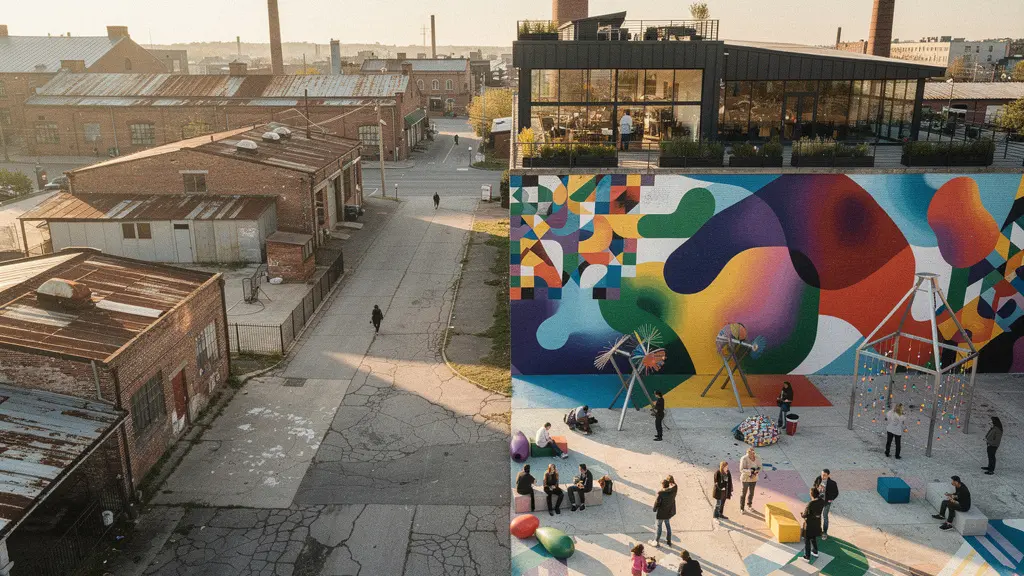
Strategic art is not about decoration; it’s a powerful tool for solving the core issues of neglected public spaces.
- Well-placed art, from murals to lighting, can actively deter crime and improve perceived safety.
- Temporary “pop-up” installations are low-risk, low-cost ways to test revitalization ideas and build community support before major investment.
Recommendation: Stop parachuting art into plazas and start with a “site pathology” assessment to diagnose and treat the space’s underlying problems.
Every town has one: the windswept concrete plaza, the forgotten underpass, the derelict industrial lot. These are spaces defined not by their use, but by their vacancy. They are gaps in the civic fabric, places people hurry past, not towards. As a local councillor or community leader, the pressure to “do something” is immense. The default solution is often a simple one: “Let’s put some art there.” A statue is commissioned, a mural is painted, and for a brief moment, it feels like progress. Yet, too often, the space remains empty, the problems of neglect persist, and the art becomes a lonely monument to good intentions.
This common failure stems from a fundamental misunderstanding of art’s role in public space. We treat it as a cosmetic fix, a decorative afterthought to be dropped into a pre-existing problem. But what if we stopped thinking of art as decoration and started seeing it as a strategic intervention? What if its primary purpose wasn’t just to be looked at, but to actively solve the root causes of neglect—poor lighting, lack of social connection, and a pervasive sense of danger? This is the core belief of modern placemaking: art is a functional tool for building safer, happier, and more connected neighborhoods.
This guide reframes the conversation. It moves beyond aesthetics to demonstrate how art, when planned and executed with purpose, becomes an essential part of the urban revitalization toolkit. We will explore how high-quality street art can function as a crime deterrent and how creative lighting can reclaim spaces after dark. We will diagnose the “plop art” problem and outline a process for true community co-creation. Finally, we will delve into the practical and legal realities of transforming derelict sites into vibrant civic assets. The goal is to equip you with the strategic mindset to turn your most neglected landscapes into celebrated landmarks.
To navigate these strategies, this article breaks down the key challenges and opportunities you will face. The following summary outlines how we will explore the journey from identifying a problem space to implementing a successful, long-lasting artistic intervention.
Summary: How Strategic Art Installations Revitalize Neglected Civic Landscapes
- Does High-Quality Street Art Actually Deter Graffiti Tagging?
- Safety Meets Aesthetics: How Creative Lighting Transforms Nighttime Walkability?
- The “Plop Art” Problem: Why Parachuting Art Into Communities Fails?
- Biophilic Design: Integrating Sculpture With Living Plant Walls?
- Pop-Up Parks: Why Temporary Installations Often Have More Impact Than Permanent Ones?
- Rotting Floors and Asbestos: How to Spot Invisible Hazards in Derelict Mills?
- Glass Floors: Is Leaving Ruins Visible Under Buildings a Good Idea?
- Is Urban Exploration Legal in the UK: Trespass Laws Explained?
Does High-Quality Street Art Actually Deter Graffiti Tagging?
One of the most visible symptoms of neglect in an urban space is the proliferation of unsolicited graffiti tags. The common response is a cycle of costly cleanup and rapid re-tagging. However, a more strategic approach uses art itself as a deterrent. The principle is not about replacing one form of paint with another; it’s about leveraging the internal codes of conduct within the street art world. A high-quality, respected mural is far less likely to be tagged over than a blank wall. This isn’t just theory; it’s a proven strategy.
The key is authenticity and respect. When a mural is created by an artist with genuine ties to the graffiti community, it is often protected by an unwritten code of honor. As Natalie Raben of the Lower East Side Business Improvement District explains, “The artists have ties to the graffiti community, and the idea is that when graffiti taggers come and see it’s the work of veteran artists, they know better than to tag out of respect.” This tactic has been used with great success; a New York initiative saw 25 artists successfully deter tagging through such respect-based mural programs.
However, this strategy is not a simple panacea. The dynamic can be complex, as seen with The Bushwick Collective, where artists began applying smiley-face Band-Aids to cover tags on their murals. This act highlights a tension where commissioned street art can be seen as a tool of gentrification, prompting a defensive response from the graffiti community. For a mural program to be a successful strategic intervention against tagging, it must be perceived as an authentic contribution to the local culture, not an imposition from outside forces.
Safety Meets Aesthetics: How Creative Lighting Transforms Nighttime Walkability?
A neglected landscape is often most dangerous after sunset. Poorly lit underpasses, parks, and plazas become no-go zones, which only deepens their cycle of decay. The traditional solution—installing harsh, uniform sodium lamps—prioritizes visibility but does little to make a space feel welcoming or safe. A more effective placemaking strategy integrates lighting as an artistic element, transforming nighttime walkability by addressing both physical and psychological safety.
Creative lighting design moves beyond mere illumination. It uses light to sculpt the environment, guide movement, and create a sense of wonder and security. Interactive installations that respond to movement can turn a lonely walk into a playful experience, while colored lights can alter the mood of a space from menacing to magical. This isn’t just about aesthetics; it’s about human perception. A 2024 Rome study demonstrates that 40 participants reported significantly improved walking comfort with enhanced luminance not just on the path, but on the lateral walls of an underpass. This shows that lighting the entire volume of a space, not just the floor, is key to making people feel secure.
This image of a dynamically lit pathway illustrates the concept perfectly. The lighting is not just functional; it is a core part of the landscape’s identity.
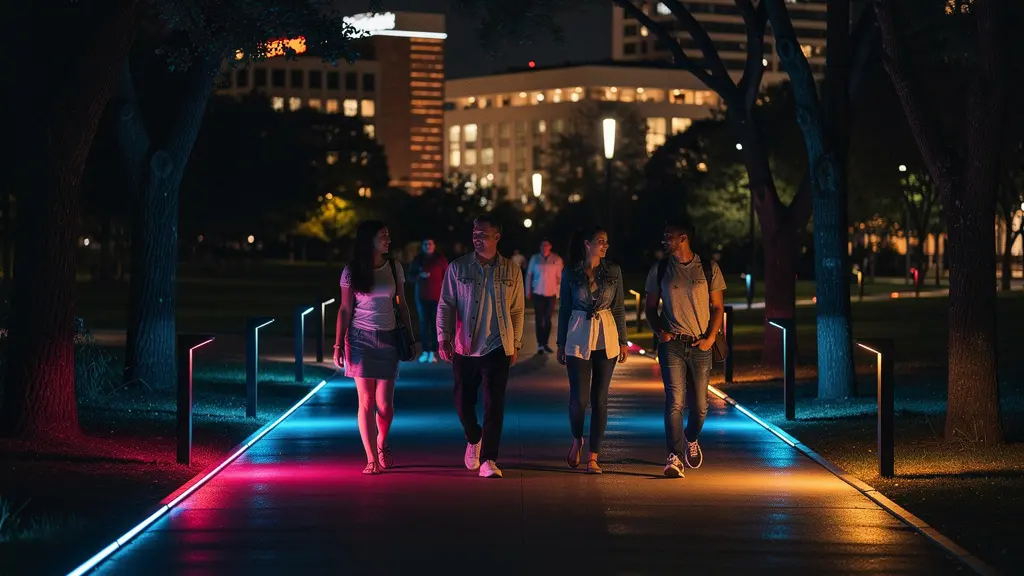
As you can see, the light creates clear sightlines and eliminates intimidating shadows, directly addressing safety concerns. But it also creates a unique visual experience, turning a simple path into a destination. This dual function is the hallmark of a successful programmed space. The art is not separate from the function; it *is* the function, transforming a utilitarian pathway into a memorable and reassuring journey.
The “Plop Art” Problem: Why Parachuting Art Into Communities Fails?
The biggest pitfall in public art is what professionals call “plop art” or “turds in the plaza.” The term describes a familiar scenario: a piece of art, often selected by a committee with little local input, is simply dropped into a public space as a last-minute beautification effort. It fails because it has no connection to the site, the community, or the daily life of the people who use the space. It is an object, not an intervention. It sits in the plaza, ignored and often disliked, a testament to a failed process.
This problem almost always stems from poor planning and a lack of early engagement. As placemaking expert Afolabi notes, the issue arises when art is an afterthought. He states, “Challenges typically come up when you’ve left it too late in the day. Then you’ve got this indicative budget and a certain amount of space… and that’s your public art location.” According to this analysis from The Developer Podcast, the art is forced to fit the constraints of a project that’s already been designed, rather than informing the design from the start. True success comes when artists and community members are treated as co-authors of the space, not as decorators.
To avoid this, you must shift from a mindset of “placing art” to one of “creating place.” This requires a structured process that embeds the community and the site’s unique character into the project’s DNA from day one. The following audit checklist provides a framework for doing just that.
Placemaker’s Audit: A Checklist for Avoiding “Plop Art”
- Project Inception: Begin community engagement at the project’s very beginning, not after key design decisions have been made.
- Co-Authorship: Involve local residents in every stage, from brainstorming and artist selection to the fabrication of the work itself.
- Scale & Context: Analyze the physical proportions of the space to ensure the artwork’s scale is appropriate and harmonious.
- Material Harmony: Scrutinize material choices to ensure they are compatible with the local architectural vernacular and environmental conditions.
- Cultural Resonance: Conduct thorough research into local history and cultural narratives, and ensure the design respects and reflects this context.
Biophilic Design: Integrating Sculpture With Living Plant Walls?
Neglected civic landscapes are often stark, sterile environments, dominated by concrete and steel. Biophilic design offers a powerful counter-strategy by intentionally weaving nature and natural forms back into the urban fabric. This goes beyond simple landscaping; it’s about creating a living, breathing ecosystem where art and nature are seamlessly integrated. Integrating sculpture with living plant walls is a prime example of this approach, transforming a barren facade into a vertical garden and a dynamic work of art.
This approach tackles multiple problems at once. A living wall improves air quality, reduces the urban heat island effect, and absorbs sound. When combined with sculptural elements, it becomes a powerful tool for creating a unique sense of place. The artwork can provide the structural framework for the plants, or the plants can become the medium of the art itself, changing with the seasons. This creates a dynamic and evolving experience that encourages people to return to the space again and again. Large-scale projects like PWP Landscape Architecture’s work at Marina Bay Sands in Singapore have demonstrated how effectively sculptural forms can be integrated with vast living systems to create iconic civic landmarks.
The beauty of this approach lies in the details, where the man-made and the natural meet.

This close-up view reveals the intimate relationship between the hard, structural elements and the soft, organic life they support. It’s a sensory experience—the texture of the leaves, the coolness of the water, the form of the sculpture. This fusion creates a space that feels restorative and alive, offering a moment of respite from the hard edges of city life and establishing a profound sense of social ownership among residents who care for it.
Pop-Up Parks: Why Temporary Installations Often Have More Impact Than Permanent Ones?
Committing millions to a permanent park or plaza in a neglected area is a high-stakes gamble. If the design is wrong, or if the community doesn’t embrace it, you’re left with a very expensive failure. This is where temporary installations, or “pop-up” parks, offer a brilliantly strategic alternative. They are agile, low-cost, and low-risk ways to test ideas, gather real-world data, and build momentum for lasting change. A pop-up can achieve in a single season what a permanent project might take a decade to accomplish: winning the hearts of a community.
The primary value of a pop-up is as a real-world prototype. As the experts at the Urban Design Lab state, “Pop-ups act as low-cost, low-risk prototypes for urban change. They allow cities to test new design ideas, gather real-world data on how people use a space, and build community buy-in before committing to expensive, permanent capital projects.” This concept of risk-prototyping is invaluable for local councils. A temporary beach in a parking lot or a pop-up stage in a vacant lot allows you to see what activities draw people, where they congregate, and what amenities they actually use.
This data is gold. It transforms future planning from guesswork into an evidence-based process. Furthermore, temporary installations generate buzz and create new memories associated with a place. In Montreal, for example, seasonal community events have transformed temporary spaces into beloved civic landmarks in the public’s imagination, long before any permanent construction begins. This process builds a constituency of support, ensuring that when the permanent project is proposed, it is met with enthusiasm, not skepticism. The pop-up proves the potential of a space, making the case for investment undeniable.
Rotting Floors and Asbestos: How to Spot Invisible Hazards in Derelict Mills?
Transforming a derelict mill or abandoned factory into a cultural asset is an inspiring goal, but these sites are often riddled with invisible dangers. Beneath the romantic patina of decay lie serious structural and environmental hazards: rotting floorboards, unstable walls, lead paint, and the ever-present threat of asbestos. Ignoring this “site pathology” is not an option; it’s a risk to public safety and a legal liability. A truly strategic artistic intervention doesn’t just cover up these flaws—it begins with a thorough and honest assessment of them.
Before a single artistic concept is sketched, the first step must be a comprehensive site pathology assessment. This requires a partnership between artists, community groups, and technical experts like structural engineers and environmental hygienists. The goal is to map the building’s weaknesses and hazards not as obstacles, but as part of the site’s unique story. This process is about understanding the canvas before you paint on it. The Wabash Arts Corridor in Chicago is a powerful example, where the revitalization of a former industrial area was launched by Columbia College Chicago. This project embraced the area’s history, using its urban spaces and reclaimable resources to create a ‘living urban canvas’ that respects the site’s past.
The most creative outcomes often arise from confronting these challenges directly. Instead of hiding a structural weakness, can an artist use light to draw attention to it safely? Can materials decommissioned from the site be transformed into a new sculpture that speaks to the building’s history? This requires a framework for assessment that integrates safety with artistic vision from the very start. A responsible placemaker must identify all hazardous materials through professional surveys and map every structural weakness before any public access is considered. Only then can a safe and meaningful artistic response to the site’s pathology be developed.
Glass Floors: Is Leaving Ruins Visible Under Buildings a Good Idea?
When revitalizing a site with deep historical layers, a powerful temptation is to reveal them. Techniques like installing glass floors over archaeological ruins or projecting historical images onto facades can create a stunning connection to the past. This “palimpsest” approach can add incredible depth and character to a place. However, it also walks a fine ethical line. When does revealing history honor the past, and when does it become “ruin porn”—the aestheticization of tragedy, poverty, or decay for the benefit of a modern audience?
This is a critical question for any project dealing with sensitive history. As the arts and social justice organization Mural Arts Philadelphia wisely asks, “Curating memory versus romanticizing ruin requires careful ethical consideration.” When an artist or planner chooses to reveal history, they are making a curatorial choice. Are they telling a complete story, or are they selecting the most “picturesque” elements of decay? A framework for ethical consideration is needed to guide these decisions, ensuring the project honors the lived experiences of the past rather than exploiting them.
There are many ways to engage with a site’s history, each with its own impact and implications. The decision of which to use depends entirely on the specific context and the story being told. A transparent floor might be fascinating over Roman ruins, but deeply inappropriate over the remains of a more recent tragedy. An honest placemaker must weigh these options carefully.
| Technique | Visual Impact | Historical Context | Community Response |
|---|---|---|---|
| Glass Floor Installations | Direct visual access to ruins below | Preserves archaeological layers | Mixed – fascination vs discomfort |
| Light Projections on Facades | Temporary overlay of past imagery | Non-invasive historical interpretation | Generally positive – educational |
| Acoustic Ghosts | Sound installations of past activities | Immersive temporal experience | Emotionally engaging |
| AR Overlays | Digital reconstruction via mobile devices | Interactive archaeological exploration | High engagement – user controlled |
Key Takeaways
- Art is a strategic tool to solve urban problems, not just decoration. A successful project starts with diagnosing the “site pathology” (safety, access, social use).
- Temporary, low-cost “pop-up” installations are invaluable for testing ideas, gathering real-world data, and building community buy-in before committing to expensive permanent projects.
- Authentic community engagement is not an afterthought; it is the core process. The most successful art is co-authored with the people who will live with it, avoiding the “plop art” problem.
Is Urban Exploration Legal in the UK: Trespass Laws Explained?
The raw, inspiring potential of many neglected mills, factories, and warehouses is often locked behind a legal barrier: trespass law. While this article’s focus is strategic, the specific legal landscape of the UK illustrates a universal challenge. In the UK, trespass is generally a civil matter, not a criminal one, meaning urban explorers are typically asked to leave rather than arrested. However, the moment a door is forced or damage is caused, it can escalate to criminal damage. This legal gray area is where the journey from illegal art to commissioned placemaking begins. Historically, the counter-cultural edge of graffiti came precisely from its illegality. Today, street art is more often commissioned, representing a shift from defiant act to collaborative process.
For a community group or council, navigating this is not about encouraging illegal access. It’s about creating a legal and safe pathway for transformation. This requires a proactive, formal approach to gain temporary, legal control of a space for artistic purposes. The process involves identifying the property owner, proposing a clear agreement, and ensuring all liabilities are covered. This is the professionalization of “creative trespass.” Instead of breaking in, you are being invited in, with clear rules and a shared goal. This formal process is the first step in turning a liability for an owner into a potential asset for the community.
Establishing a “creative trespass” license or temporary use agreement transforms the relationship with the site. It allows for the necessary site assessments, the removal of hazards, and the managed installation of art, all under a secure legal framework. This documentation protects the artists, the community, and the property owner, turning a risky endeavor into a structured project. This is the critical, unglamorous work that makes spectacular transformations possible.
Begin your placemaking journey not with an artist’s sketch, but with a community conversation and a thorough site assessment. The most powerful, transformative, and beloved art installations are the ones that are designed from the ground up to solve real problems for real people. It is time to start building them.