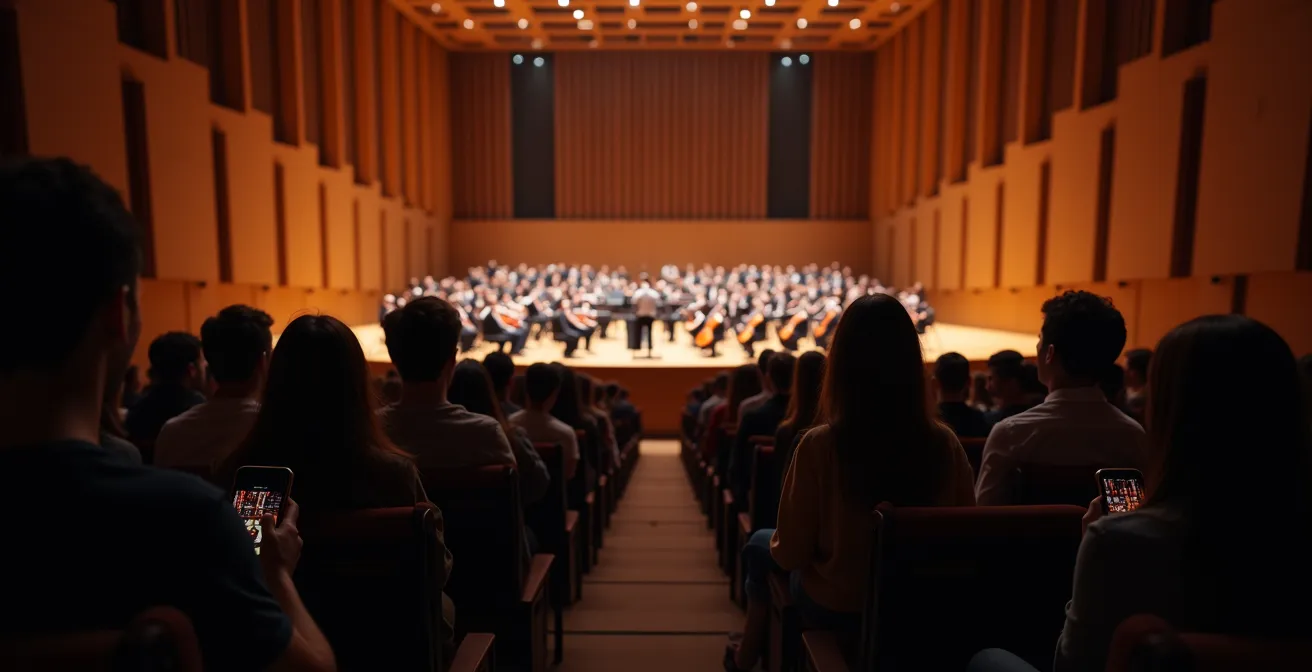
Contrary to popular belief, saving the symphony orchestra isn’t about ditching Beethoven for Harry Potter; it’s about a radical internal transformation of the institution itself.
- This involves diversifying revenue streams beyond unstable ticket sales, which have struggled to recover post-pandemic.
- It also means using structural changes, like blind auditions and more inclusive programming, to build a truly representative ensemble that reflects modern audiences.
Recommendation: The key for any orchestra manager is to treat innovation not as a marketing gimmick, but as a core operational principle, from the conductor’s podium to the design of the concert hall itself.
As an orchestra manager, I see the same scene play out in concert halls across the country: a sea of silver hair, a loyal but aging audience. The persistent question on every board member’s lips is, “How do we get young people in the doors?” The common answers are always trotted out: program more film scores, get on TikTok, offer cheaper tickets. While these tactics have their place, they are merely scratching the surface of a much deeper challenge. They are temporary fixes for a systemic issue.
The survival of the modern symphony orchestra doesn’t hinge on simply changing the playlist. It demands a fundamental re-engineering of the entire institutional machine. This means looking beyond the stage and into the very structures that govern how we are funded, how we hire our musicians, how our conductors lead, and even the physics of the spaces in which we perform. The challenge isn’t just to make classical music *appealing* for a night; it’s to make the orchestra an *essential* and *relevant* cultural institution for a new generation.
This is the tightrope we walk: honouring a rich tradition while aggressively pursuing a sustainable future. It’s a process of evolution, not revolution. To truly understand this transformation, we must dissect the orchestra layer by layer, from the financial pressures in the back office to the interpretive choices made on the podium. This article will guide you through that dissection, revealing how deep, structural changes—not surface-level gimmicks—are the real key to the symphony’s continued vibrancy.
For those who prefer a more visual and auditory immersion into musical innovation, the following video from the DeepBlue orchestra showcases the kind of dynamic, technology-infused performance that is pushing the boundaries of the traditional concert format.
To navigate the complex world of orchestral innovation, this article explores the key pillars of this transformation. The following summary outlines the journey we will take, from the hard numbers of funding to the subtle art of musical interpretation.
Summary: Charting the Course for the Modern Orchestra
- Public Grants vs Private Donors: Who Pays for the 80 Musicians on Stage?
- Waving the Baton: What Does the Conductor Actually Do During the Concert?
- Why Listening to Mahler in a Gym Does Not Work: The Physics of Concert Halls?
- Movies with Live Orchestra: Is This the Gateway Drug to Classical Music?
- Behind the Screen: How Blind Auditions Changed the Gender Balance in Orchestras?
- The Impact of Arts Council Cuts on Experimental Theatre Productions
- The Sweet Spot: Where to Sit for the Best Sound in a Victorian Theatre?
- How Do Conductors Interpret the Same Score So Differently?
Public Grants vs Private Donors: Who Pays for the 80 Musicians on Stage?
The romantic image of an orchestra is one of pure artistic expression, but the reality for any manager is a spreadsheet. The financial model of the symphony orchestra has always been a delicate ecosystem, balancing ticket revenue, public funding, and private philanthropy. However, this ecosystem is under unprecedented strain. The old model of relying on a stable subscription base is no longer tenable. Post-pandemic, many orchestras are facing a harsh reality; a 25% drop in ticket sales between the 2019 and 2023 seasons was a wake-up call for the entire industry. This shortfall can’t be covered by simply raising prices, which would only further alienate potential new audiences.
This financial pressure is the primary driver of innovation. It forces us to rethink our entire revenue structure. We are moving towards a diversified model that looks more like a modern media company than a 19th-century institution. This includes more aggressive individual donor campaigns, corporate sponsorships tied to specific community-outreach programs, and digital subscription models. The goal is to create multiple, resilient streams of income so that a dip in one area doesn’t threaten the entire enterprise. It’s about building a financial foundation robust enough to support artistic risk-taking.
This diversification of funding is directly linked to the diversification of programming. To attract a broader base of donors and attendees, we must offer a product that speaks to a broader community. This shift is already showing results, as observed by one of the industry’s leading figures.
I really do attribute this largely to the astonishing way orchestras have changed and adapted their programming in recent years. We’ve seen more diversity in programming in the last few years than we did in the previous decade.
– Simon Woods, Wallace Foundation Interview
Ultimately, paying for 80 highly skilled musicians on stage requires a creative and resilient financial strategy. The era of relying solely on ticket sales and a few wealthy patrons is over. The future belongs to orchestras that can build a broad coalition of support, grounded in a mission that is both artistically excellent and socially relevant.
Waving the Baton: What Does the Conductor Actually Do During the Concert?
From the audience’s perspective, the conductor can seem like an enigmatic figure, their dramatic gestures a mystery. Is it just about keeping time? The reality is far more complex. The conductor is the orchestra’s CEO, artistic director, and chief interpreter, all rolled into one. During a performance, their primary role is to unify 80 individual musicians into a single, cohesive musical entity. They shape the dynamics (loud and soft), tempo (speed), and phrasing, ensuring that the composer’s vision—filtered through their own interpretive lens—is realized.
This section explores the conductor’s role as both a leader and an artist. The conductor’s expressive body language is a live communication system, signaling everything from a subtle change in mood to a thunderous crescendo. It’s a role that demands immense musical knowledge, psychological acuity, and physical stamina.
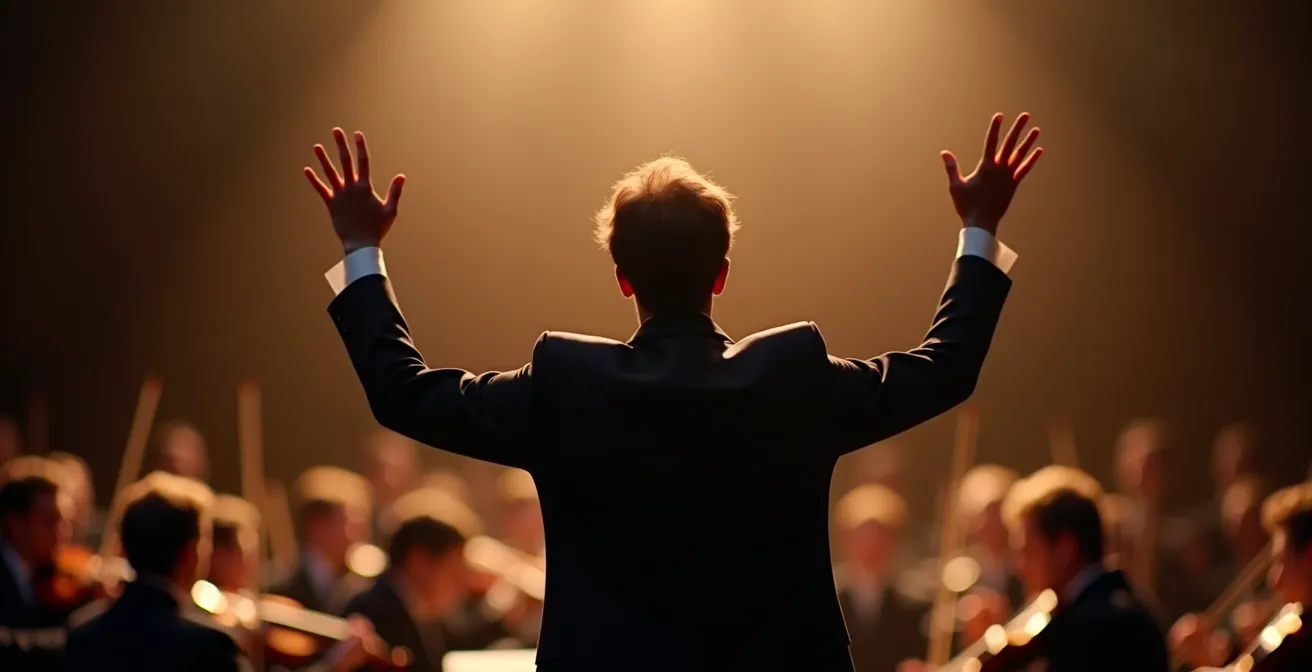
In the context of innovation, the conductor’s role is evolving. They are no longer just guardians of a static tradition. Today’s most successful conductors are also chief advocates for relevance. They are actively involved in programming, community outreach, and championing new works. They understand that their leadership extends beyond the podium. This is exemplified by pioneers like Marin Alsop, who broke barriers not just with her gender but with her commitment to education and contemporary music, making history in 2007 as the first woman appointed music director of a major American orchestra, the Baltimore Symphony.
The conductor is the ultimate storyteller. By choosing how to balance the sections, when to push the tempo, or when to allow a moment of breathtaking silence, they craft a unique narrative from a familiar score. This interpretive act is at the heart of the live classical music experience and is a key part of what makes each performance an unrepeatable event.
Why Listening to Mahler in a Gym Does Not Work: The Physics of Concert Halls?
We often talk about programming and performers, but one of the most critical, and often invisible, elements of the orchestral experience is the room itself. A concert hall is not just a container for sound; it is an instrument in its own right. The unique, immersive quality of live orchestral music is a direct result of complex acoustic physics, an “acoustic contract” with the audience that simply cannot be replicated through headphones or in an acoustically untreated space like a gymnasium.
The acoustics of a great hall are defined by a delicate balance of key properties. Reverberation time (RT60), the time it takes for sound to decay by 60 decibels, is crucial. Too short (like in a heavily carpeted room), and the music sounds dry and thin. Too long (like in a cavernous cathedral), and the details become a muddy blur. For the complex textures of a Mahler symphony, a reverberation time of around 2 seconds is ideal, allowing the sound to bloom without losing clarity. A gym, with its hard, parallel surfaces, creates “flutter echo” and standing waves, which are disastrous for musical texture.
Furthermore, qualities like acoustic warmth (the richness of bass frequencies) and clarity (the ability to distinguish individual instruments) are meticulously engineered through the shape of the hall and the materials used—curved wooden panels, diffusing surfaces, and angled balconies. This is why organizations like the Boston Symphony Orchestra invest millions in their venues; they understand the hall is their most important instrument. You wouldn’t ask a violinist to play on a child’s toy; you can’t ask an orchestra to perform Mahler in a space built for basketball.
As we innovate with new concert formats, we must not break this acoustic contract. The profound, full-body experience of being enveloped in sound is our unique value proposition. Any new venue or format, whether in a warehouse or an outdoor amphitheater, must be approached with acoustic integrity first and foremost. To compromise on sound quality is to compromise the very essence of what we offer.
Movies with Live Orchestra: Is This the Gateway Drug to Classical Music?
The “Live to Film” concert format, where an orchestra performs the score live while the movie plays on a big screen, has become one of the most visible and successful strategies for attracting new audiences. From a manager’s perspective, these events are a godsend for ticket sales. They bring in crowds who might never consider attending a traditional classical concert. But the critical question is: are they a one-time novelty, or can they be a genuine “gateway” to a deeper engagement with the orchestra?
The data suggests the potential is enormous. Research from the Royal Philharmonic Orchestra shows that audiences for film music concerts rose to 30% of those surveyed, demonstrating a clear market appetite. These concerts demystify the orchestral experience. They provide a familiar visual and narrative framework (*Star Wars*, *Jurassic Park*), allowing the listener to focus on the power and emotion of the music without feeling intimidated by unfamiliar repertoire or concert hall etiquette. It’s a shared, almost communal experience that taps into powerful nostalgia.
However, simply programming a film concert is not a strategy in itself. The real work lies in building a “gateway pipeline” to convert these first-timers into repeat customers and, eventually, core subscribers. This requires a sophisticated understanding of audience motivation and a deliberate pathway for their next steps. It means capturing their contact information at the film concert and immediately following up with curated offers for other accessible programs, like a concert of “Greatest Classical Hits” or a program featuring a charismatic guest artist.
Your Action Plan: Turning Film Fans into Future Subscribers
- Identify Target Segments: Recognize that not all new attendees are the same. Data shows 42% of first-timers are drawn to pop music collaborations, while 34% prefer a live-to-film concert. Tailor your follow-up marketing accordingly.
- Create a “Next Step” Offer: Immediately after their film concert experience, offer a small discount or priority access to a thematically related but more traditional concert. Frame it as “If you loved the music of John Williams, you’ll be thrilled by the power of Holst’s ‘The Planets’.”
- Bridge the Repertoire Gap: Program concerts that explicitly bridge the gap. For instance, a program called “From Hollywood to Vienna” could feature film scores alongside the classical works that inspired them.
- Gather Feedback: Use post-concert surveys to ask new attendees what they enjoyed and what they’d like to see next. Use this data to inform future programming, creating a feedback loop that builds loyalty.
- Leverage the Core Audience: Remember that your long-standing fans are also important. For them, traditional repertoire remains the biggest draw, with 52% opting for these concerts. Ensure your season has a balanced diet of innovation and tradition to keep everyone engaged.
Film concerts are not a magic bullet, but they are an incredibly effective entry point. By treating them as the top of a strategic funnel rather than a standalone event, we can use them to cultivate the next generation of classical music lovers.
Behind the Screen: How Blind Auditions Changed the Gender Balance in Orchestras?
One of the most significant internal transformations in the orchestral world over the past 50 years has been the adoption of the “blind audition.” By placing a screen between the auditioning musician and the judging committee, orchestras moved towards a true meritocracy. This single structural change had a dramatic and positive impact on gender balance, increasing the proportion of women in top U.S. orchestras from under 5% in 1970 to nearly 40% in the 2000s. It proved that systemic change, baked into the institution’s mechanics, is far more powerful than simple good intentions.
This history is a vital lesson as we confront the next wave of diversity challenges. While we have made strides with performer representation, the focus is now shifting to what is being performed. The repertoire itself remains overwhelmingly dominated by long-deceased European men. Attracting a younger, more socially conscious audience requires programming that reflects the diversity of the world we live in. This is not about tokenism; it is about artistic and institutional relevance.
However, progress is slow and uneven. The Women’s Philharmonic Advocacy’s latest data reveals that works by women still represent a small fraction of programming; for the 2023-2024 season, the Philadelphia Orchestra is at 12.12% and the Chicago Symphony is at a mere 7.14%. This disparity is a significant barrier to connecting with new audiences.
The imperative for change is not just ethical; it’s existential. Younger generations are drawn to institutions that share their values of equity and inclusion. As one advocate powerfully puts it, the old model is simply not sustainable.
Young audiences are actively working to dismantle systems of injustice and oppression that no longer serve them. Playing works by dead, white men are not going to speak to their interests, motivations, or passions.
– Sarah Baer, Women’s Philharmonic Advocacy Annual Report
The lesson from blind auditions is clear: if we want to change the outcome, we must change the system. This means setting explicit diversity goals for programming, commissioning new works from a wider range of composers, and telling new stories that resonate with the audiences we hope to attract.
The Impact of Arts Council Cuts on Experimental Theatre Productions
While this article focuses on orchestras, we operate within a larger arts ecosystem that is facing universal pressures. A look at our colleagues in experimental theatre provides a sobering case study of what happens when public funding diminishes. When arts councils are forced to make cuts, it’s often the most innovative, experimental, and boundary-pushing work that is first on the chopping block. Funders tend to retreat to “safe bets”—established classics that are perceived as less risky. This creates a vicious cycle of artistic conservatism, stifling the very innovation needed to attract new audiences.
Orchestras are not immune to these pressures. The temptation to program only Beethoven and Brahms in tough financial times is strong. Yet, this is precisely the wrong instinct. Our demographic data paints a stark picture: research from the League of American Orchestras shows that Black, Hispanic, and Asian music-lovers each account for less than 10% of orchestra ticket buyers. A “safe” programming strategy that caters only to the existing, aging base is a strategy for managed decline. True safety lies in bold, strategic innovation that expands our audience.
Forward-thinking orchestras are learning this lesson and pioneering new models that blend artistic innovation with community engagement. A prime example is the i-Classics series by the South Netherlands Philharmonic. This initiative intentionally moved outside the traditional concert hall, staging one-hour concerts in unconventional venues. By collaborating with young artistic partners from other disciplines, they were able to break down the formal barriers of the classical experience and create something new, accessible, and exciting. This is not just experimentation for its own sake; it’s a calculated strategy to build relationships with new communities.
The lesson from both theatre and innovative orchestras is the same: in an era of precarious funding, the budget for experimentation is not a luxury; it is a necessity. It is the R&D department of the artistic world. Cutting it to fund another “safe” performance is a short-term solution that mortgages our long-term future.
The Sweet Spot: Where to Sit for the Best Sound in a Victorian Theatre?
The question of “the best seat” has traditionally been answered with a single metric: acoustics. In a classic concert hall, the sweet spot is typically in the center of the orchestra section, about two-thirds of the way back, or in the front of the first balcony, where the direct sound from the stage and the reverberant sound from the hall are in perfect balance. This provides the richest, most detailed listening experience. For the traditional patron, this remains the gold standard.
However, as we work to attract a new generation, the definition of “best” is becoming more complex and subjective. For many younger attendees, the quality of the *social experience* is as important as the quality of the sound. They are not just coming to listen; they are coming to participate, to share, and to feel part of a community. This requires us to rethink how we use our physical space, moving beyond a one-size-fits-all model of seating.
Innovative orchestras are now designing a portfolio of experiences within the same hall, catering to different motivations and price points. This might include on-stage seating for an intensely immersive view, or casual “standing social zones” with bars where patrons can mingle. The rise of “Tweet Seats,” designated areas where audience members are encouraged to share their experience on social media in real-time, is another example of this shift. As the DeepBlue Orchestra notes, this can even become interactive, where ” audiences could communicate and respond to prompts using mobile technology.”
This multi-tiered approach allows us to serve different audience needs simultaneously. The traditionalist can have their perfect acoustic experience, while the “experience seeker” can get an up-close, behind-the-scenes feel, and the young professional can enjoy a great night out that is both cultural and social. The following model illustrates how these new seating concepts break down.
| Seating Type | Price Range | Experience Focus | Target Demographic |
|---|---|---|---|
| Traditional Orchestra Seats | $100-$150 | Optimal acoustics | Traditional patrons |
| On-stage Seating | $75-$100 | Immersive experience | Experience seekers |
| Standing Social Zones | $25-$40 | Social atmosphere | Young professionals |
| Tweet Seats | $30-$50 | Digital engagement | Social media users |
By reimagining the concert hall as a flexible space with multiple experience zones, we can dramatically lower the barrier to entry for new audiences without compromising the core artistic product for our established base.
Key Takeaways
- Financial instability is the primary engine driving orchestras to innovate, forcing a move away from sole reliance on ticket sales.
- True innovation is structural, not cosmetic. Changes in hiring practices (blind auditions) and programming diversity have a deeper impact than one-off marketing events.
- The live, in-person experience is the orchestra’s unique value proposition. This means the acoustic integrity of the performance space and the variety of seating experiences offered are crucial assets.
How Do Conductors Interpret the Same Score So Differently?
If an orchestra is simply playing the notes on the page, why do two performances of the same Beethoven symphony by two different conductors sound so vastly different? This question gets to the very heart of the conductor’s artistic function. A musical score is not a precise set of instructions like a computer program; it’s a blueprint filled with ambiguities. The conductor’s job is to make thousands of micro-decisions to turn that blueprint into a living, breathing performance. This is their interpretive DNA.
As the Redlands Symphony explains, “The conductor develops a vision for how the piece should sound—balancing faithfulness to the composer’s intentions with their own interpretive choices.” This involves deciding the exact tempo, how to shape a melodic line, which instrumental voices to bring to the forefront in a complex passage, and how to manage the flow of tension and release over the course of the entire work. One conductor might favor a fast, fiery interpretation, while another might choose a slower, more lyrical approach. Neither is “wrong”; they are simply different artistic visions.
This interpretive act is the ultimate human element in classical music. In an age of digital perfection and algorithmic playlists, the unique, subjective, and passionate vision of a great conductor is an orchestra’s most powerful differentiator. It’s what makes the audience lean forward in their seats. And this concept of collaborative interpretation is itself being innovated. The YouTube Symphony Orchestra, for example, pioneered an online collaborative model where musicians from around the world auditioned via video and were brought together to perform at Carnegie Hall. This project garnered 15 million views, demonstrating a massive public appetite for new forms of musical creation.
For a new generation of listeners, understanding this interpretive layer is a key to deeper appreciation. It transforms them from passive consumers to active, critical listeners. When you start to recognize the interpretive signatures of different conductors—the fiery energy of a Solti, the intellectual clarity of a Boulez, the rich textures of a Karajan—you are no longer just listening to Beethoven. You are participating in a conversation that spans centuries, a dialogue between composer, conductor, and orchestra.
The future of the orchestra is a collaborative performance, not just on stage, but with its community. The next step is yours: explore the season of your local orchestra, try a new concert format, and attend a pre-concert talk. Become part of the story, and help us write the next movement.