Creative block isn’t a lack of ideas; it’s a disconnection between your mind and body. The solution isn’t to think harder, but to feel more deeply.
- Pure expressionism is a physical process that translates your body’s internal sensations directly onto the canvas, bypassing your inner critic.
- Embracing “bad” art and using unconventional tools intentionally reduces technical control, forcing a more honest and spontaneous creative flow.
Recommendation: Shift your goal from creating a “good product” to engaging in a “truthful process.” The art will follow.
You stand before the canvas, brush in hand, feeling… nothing. You have the skills, the training, the time, but the connection is gone. Your work feels stiff, technical, a hollow echo of what you want to express. This is the classic creative block, but its common description as a “lack of ideas” is misleading. It’s not a failure of imagination; it’s a breakdown in communication between your emotional core and your creative hands. The impulse is there, but it’s trapped behind a wall of self-criticism, technical habits, and the paralyzing pressure to create something “good.”
The standard advice—”just start,” “try a new medium”—often fails because it treats the symptom, not the cause. You’ve likely been told to seek inspiration from other artists, only to fall into the trap of comparison. This article takes a different path. It’s a coaching session designed to help you reconnect with the source of all authentic art: your own raw, unfiltered emotional and physical experience. We’re not talking about a style you can copy; we’re talking about a state you can access.
The guiding principle is this: true expressionism is a somatic practice. It’s about learning to translate your body’s internal landscape—the tightness in your chest, the warmth in your belly, the nervous energy in your hands—directly into marks, colors, and forms. This is about bypassing the analytical brain and allowing the body to speak. We will explore how physical movement becomes emotional weight, why your personal color language trumps universal symbolism, and how to embrace the liberating power of making “bad” art.
This guide is structured to walk you through a complete cycle of emotional and creative release. From the explosive energy of action painting to the quiet contemplation of post-creative integration, each section builds on the last, offering you a holistic framework to dissolve your creative block and foster a sustainable, deeply personal artistic practice.
Summary: How to Access Pure Expressionism to Overcome Creative Block?
- Action Painting: How Physical Movement Translates to Emotional Weight on Canvas?
- Why Blue Doesn’t Always Mean Sadness in Expressionist Art?
- Constructive Feedback: How to Critique Art That is Purely Emotional?
- When Does Expressionism Become Therapy and Stop Being Art for the Market?
- Brushes vs Knives vs Hands: Which Tools Encourage the Most Freedom?
- Social Prescribing: How Doctors are Using Pottery Classes to Treat Anxiety?
- The Post-Theatre Blues: Why Do You Feel Empty After a Great Performance?
- Why “Bad” Art Making is Better for Your Brain Than Good Art Viewing?
Action Painting: How Physical Movement Translates to Emotional Weight on Canvas?
The first step in breaking free from technical stiffness is to get out of your head and into your body. Action Painting is the ultimate expression of this principle. It’s not about painting a picture of an emotion; it’s about the act of painting being the emotion itself. The canvas becomes an arena for a physical event, where every drip, splash, and gesture is a direct record of your body’s movement. This is the essence of somatic translation: turning a felt, physical sensation into a visible mark.
Before you even pick up a tool, engage in somatic exercises to connect with your internal state. Try two minutes of full-body shaking to release tension, or stomping movements to ground yourself in feelings of frustration. Perform expansive arm sweeps synchronized with deep breathing to access joy. These actions prime your nervous system, allowing you to approach the canvas with an emotion that is already present in your body, waiting to be discharged. The goal is to let the body lead and the mind follow, observing without judging.
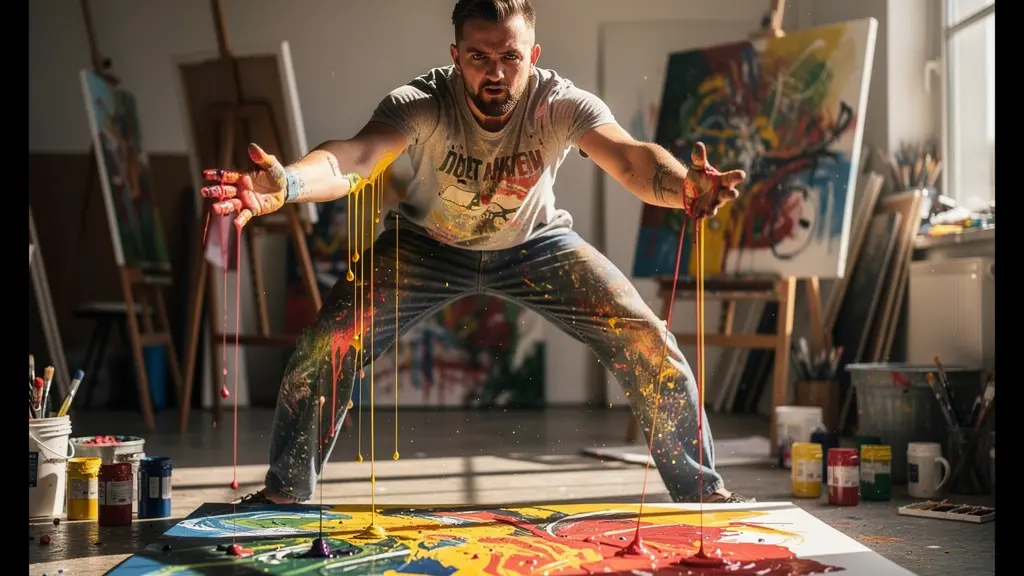
As you can see, the entire body is the tool. The artist isn’t just using their wrist; they are using their core, their legs, their breath. This whole-body engagement is what infuses the work with authentic energy. This approach is not only creatively liberating but has profound well-being benefits. In fact, comprehensive studies show that art therapy, which often employs such expressive methods, helps in reducing anxiety and depression symptoms by up to 73% for many individuals.
Think of the final painting not as the objective, but as the byproduct—the emotional residue of a physical performance. Your focus shifts from “what should I paint?” to “what does my body need to express right now?” This question bypasses the critical mind and connects you directly to the visceral, non-verbal part of yourself where the most powerful art originates.
Why Blue Doesn’t Always Mean Sadness in Expressionist Art?
Once you begin to trust your body’s movements, the next layer of creative liberation is to deconstruct the rigid rules of color. We are taught a universal color code from childhood: red is anger, blue is sadness, green is envy. For an expressionist, these are useless clichés. Your goal is not to communicate a generic emotion but to express a highly specific, personal truth. The meaning of a color is not in the tube; it’s in your history, your body, and your application.
The pioneers of expressionism demonstrated this powerfully. In his famous study, Franz Kline’s stark black and white compositions showed that the raw energy of his bold, gestural brushstrokes conveyed more emotional information than any color could. Similarly, Willem de Kooning’s work proved that the aggressive, layered application of paint created an emotional intensity that was born from the process of making, not from pre-decided color associations. The way a color is applied—scraped, smeared, dripped, or layered—radically changes its emotional resonance.
To break free from color conventions, start building your own personal emotional color dictionary. Don’t link colors to abstract emotions; link them to concrete, sensory memories. Does a specific cerulean blue remind you of your grandmother’s kitchen wall, evoking a sense of nostalgic comfort? Does a sharp vermillion make your chest feel expansive or tight? Document the physical sensations each color evokes. Test chromatic dissonance by intentionally painting a familiar subject with “wrong” colors to see what new feelings emerge. This practice makes color an act of personal discovery rather than a tool for public communication.
Ultimately, a color in your painting is not just a hue; it’s a repository of personal experience. When you choose a color not because of what it “should” mean but because of what it means to you, your work gains a layer of authenticity and emotional complexity that cannot be faked. This is how you move from illustrating feelings to truly embedding them in the fabric of your art.
Constructive Feedback: How to Critique Art That is Purely Emotional?
As you delve deeper into a process-based, emotional practice, a new fear can emerge: “If this is just my raw feeling, how can anyone critique it? Is it even ‘good’?” This is where we must redefine the purpose of feedback. In expressionist work, critique isn’t about judging the outcome against an external standard of beauty or skill. It’s about helping the artist clarify their own intent and understand the impact of their emotional translation. The critic’s job is not to say “this is good,” but to ask, “what happened here?”
The great art critic Harold Rosenberg provided the foundational mindset for this approach when he first described Action Painting. His words offer a powerful lens through which to view both the creation and critique of expressive work:
The canvas was an arena in which to act. The actions and means for creating the painting were seen, in action painting, of a higher importance than the result.
– Harold Rosenberg, The American Action Painters essay, 1952
If the action is more important than the result, then feedback must focus on the action. The Liz Lerman Critical Response Process offers a brilliant framework for this. It’s a structured conversation that removes judgment and empowers the artist. The first step involves responders simply sharing “Statements of Meaning,” describing what was evocative or surprising to them. This gives the artist pure data about what was received. Only after the artist has asked their own specific questions and responders have asked neutral, clarifying questions, is an opinion offered—and only with the artist’s explicit permission.
This model shifts the power dynamic. Instead of passively receiving judgment, you, the artist, are actively guiding the inquiry. You learn to ask better questions of yourself and your work, such as “Where in the process did I feel most connected?” or “Which part of the painting feels like a risk?” instead of the paralyzing “Is it good?”. This approach to feedback transforms a moment of potential shame into an opportunity for profound self-discovery and a deeper understanding of your own unique creative process.
When Does Expressionism Become Therapy and Stop Being Art for the Market?
This is a crucial question for any artist working from a place of deep emotion. The line between a therapeutic process and a marketable art object can feel blurry, and the pressure to be one or the other can be paralyzing. The simple answer is this: the distinction lies entirely in your intention. Art-making is therapeutic when the primary goal is the artist’s own healing, processing, and well-being. It becomes art-for-the-market when the primary goal shifts to communicating an experience to an external audience.
Both are valid, but they are not the same. The therapeutic power of art is undeniable; a comprehensive review found that 78% of individuals with mental health issues showed considerable improvement after engaging in art therapy. This is the power of “process as product” in its purest form. The act of creation itself is the healing outcome. When you are in this mode, you have no obligation to make the work coherent, pleasing, or understandable to anyone but yourself. This is your sacred space for messy, unfiltered, “bad” art.
Art for an audience, however, involves an act of translation. It requires a degree of craft and conscious decision-making to shape your raw emotional material into a form that can be received and felt by another person. This doesn’t mean compromising your authenticity. It means editing. It means choosing which parts of your story to tell and how to tell them with enough clarity and structure that they resonate beyond your own nervous system. A great expressionist work isn’t just a raw scream; it’s a scream that has been masterfully shaped to make the listener feel the artist’s lungs burn.
It’s vital to know which mode you are in. Being unclear about your intention leads to frustration. You try to sell a page from your private visual journal and wonder why no one connects with it, or you censor your therapeutic process with concerns about marketability and feel creatively stifled. The key is to consciously separate the two practices, at least initially. Give yourself radical permission for the private, therapeutic work, knowing it is the fertile ground from which your public work will eventually, and more powerfully, grow.
Action Plan: Auditing Your Expressive Intent
- Points of Contact: List all the ways you currently express emotion in your work. Is it through color, gesture, subject matter, or texture? Be specific.
- Collection: Gather five of your recent pieces. For each, write down the dominant emotion you remember feeling while creating it, not what you think the piece conveys.
- Coherence: Compare your intended feeling (from step 2) with the final visual. Where is there a disconnect? Where is the translation seamless? This isn’t about judgment, but about identifying patterns.
- Memorability & Emotion: For each piece, identify one mark or area that feels uniquely “you” and one that feels generic or habitual. What is the difference in how you made them?
- Integration Plan: Based on your audit, set one clear intention for your next session. Example: “I will focus on translating the physical sensation of anxiety through sharp, fast marks,” or “I will use only colors that connect to a specific joyful memory.”
Brushes vs Knives vs Hands: Which Tools Encourage the Most Freedom?
The tools you use are not neutral. They are extensions of your body, and they carry inherent biases. A fine-tipped brush encourages control and detail. A large, stiff-bristled brush encourages bold, sweeping gestures. To truly unlock expressive freedom, you must consciously choose tools that disrupt your habits and force you to work more intuitively. The most liberating tool is often the one you are least skilled with.
This strategy of intentional de-skilling is about bypassing the muscle memory of your “good” technique. Using a palette knife instead of a brush forces you to work with planes of color rather than lines. It resists fine detail and promotes thick, textural impasto marks. Painting with your hands is even more direct. It removes the final barrier between you and the canvas, providing immediate tactile feedback and connecting you to the primal, childlike joy of smearing paint. There is no control, only response.
Jackson Pollock’s journey is the ultimate case study in this. His revolutionary drip and pour technique, developed from 1947 onwards, was a radical abandonment of traditional tools. By using sticks, hardened brushes, and directly pouring from cans onto canvases laid on the floor, he was forced to use his entire body. This method made precise, pre-planned marks impossible. The final image was a direct result of a dance between his body, the force of gravity, and the viscosity of the paint. This de-skilling strategy unlocked a direct channel to his unconscious, proving that giving up control can paradoxically lead to greater expressive power.
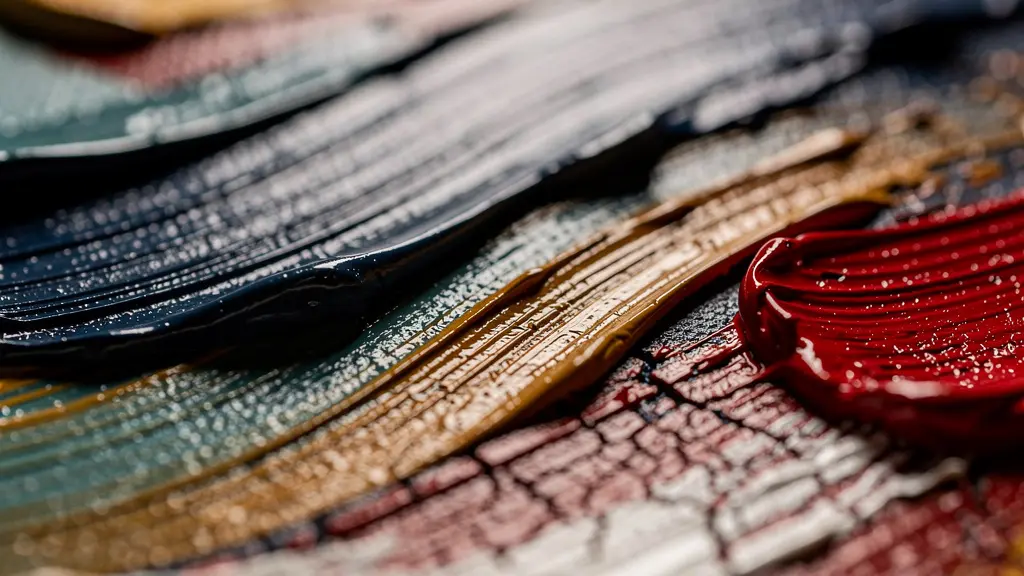
Look closely at the different marks a tool can make. The scrape of a knife, the dab of a brush, the smear of a finger—each has its own voice. Your task as an expressive artist is to experiment, to play, and to find the tools that break your patterns. Don’t ask which tool is “best.” Ask: “Which tool will surprise me the most today?” That surprise is the doorway to your authentic expression.
Social Prescribing: How Doctors are Using Pottery Classes to Treat Anxiety?
The principle of somatic translation isn’t limited to the two-dimensional canvas. Any creative act that requires physical engagement can serve as a powerful tool for emotional regulation. This is the insight behind “social prescribing,” a revolutionary movement in healthcare where doctors prescribe activities like gardening, choir practice, or pottery classes as legitimate treatments for conditions like anxiety and depression. Pottery, in particular, offers a profound, three-dimensional form of action painting.
When you sit at a potter’s wheel, your primary task is to “center the clay.” This is not just a technical instruction; it’s a perfect metaphor for emotional self-regulation. The physical act of applying steady pressure with your hands, feeling the clay resist and then yield, and guiding it to a stable center mirrors the internal process of calming an anxious mind. The clay provides constant, tangible feedback. If you are tense and forceful, the clay will collapse. If you are disconnected and passive, it will fly off-center. You must be present, responsive, and firm but gentle—the very skills needed to manage anxiety.
Case Study: Clay as a Pathway to Grounding
A powerful NHS patient case study from the UK’s social prescribing program illustrates this perfectly. A patient who had been heavily medicated for 14 years for anxiety found profound relief in pottery classes. She explained that learning to center clay became a metaphor for centering herself emotionally. The physical feedback loop of working with the material provided a tangible form of anxiety regulation that medication could not. Two years later, she was working full-time, advocating for mental health, and had sold over 100 artworks. For her, art wasn’t just helpful; it was life-altering.
This demonstrates that the principles of expressionism—physical engagement, process over product, and direct sensory feedback—are universal. Whether you are throwing paint at a canvas or shaping clay on a wheel, you are engaging in a dialogue with your own nervous system. You are learning to ground yourself not through intellectual analysis, but through tangible, physical action. This is the healing power of making, and it is accessible to everyone, regardless of perceived “talent.”
The Post-Theatre Blues: Why Do You Feel Empty After a Great Performance?
Have you ever finished an intense, wonderful creative session and, instead of feeling elated, felt a strange sense of emptiness or melancholy? This is the “post-theatre blues,” a phenomenon well-known to performers but familiar to all creative people. It’s the emotional hangover that follows a peak experience. You have poured your energy, focus, and emotion into your work, existing in a state of heightened connection. When the session ends and you return to “normal” life, the abrupt transition can feel like a loss.
This feeling is a sign that your creative process is working. You have successfully channeled a huge amount of emotional and psychic energy. The problem isn’t the expenditure; it’s the lack of a proper “cool down” or closing ritual. Just as an athlete stretches after a race to prevent injury, an artist needs a process to transition out of the vulnerable, open state of deep creativity and back into the everyday world. Ignoring this can lead to burnout or an aversion to starting the next session, as your subconscious learns to fear the emotional crash.
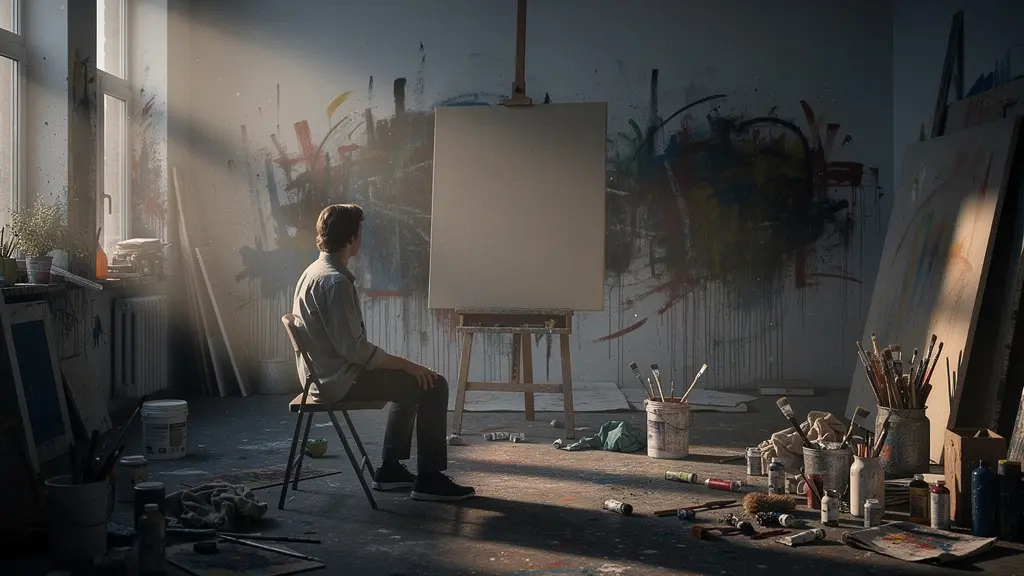
The key is to create a simple, repeatable studio closing ritual. This isn’t about evaluating the work; it’s about honoring the process and signaling to your nervous system that the session is complete. It can be as simple as methodically cleaning your brushes, changing out of your “studio clothes,” or journaling for five minutes about what emerged during the session without judgment. Taking a short walk can help physically move you from one mindset to another. The specific actions matter less than the consistency. Even a simple gratitude statement—”Thank you for what came through today”—acknowledges the creative process, not the outcome.
This ritual creates a container for your creative energy. It helps you integrate the experience, process the emotional residue, and close the loop, so you can return to your life feeling replenished, not drained. Research confirms the power of this; one study found that even just 45 minutes of creative activity significantly lowered stress levels, but without a closing ritual, the transition back can be jarring. This practice transforms the end of a session from an abrupt drop-off into a gentle, respectful conclusion.
Key takeaways
- True expression is a physical act of translating the body’s sensations, not just illustrating emotions.
- De-skilling your practice with unfamiliar tools or “wrong” colors is a powerful strategy to bypass the inner critic and unlock authenticity.
- The goal is not to make “good” art, but to engage in a truthful process; the quality of the art is a byproduct of the quality of the connection.
Why “Bad” Art Making is Better for Your Brain Than Good Art Viewing?
In our culture, we are trained to be expert consumers of art. We visit museums, scroll through feeds, and learn to appreciate the “good” art of masters. But here is a radical truth for anyone struggling with a creative block: passively viewing masterful art can be more intimidating than inspiring. For your brain and your creative spirit, the act of making your own “bad” art is infinitely more beneficial.
This isn’t just a coaching platitude; it’s backed by neuroscience. When you view a piece of art, your brain’s reward and appreciation circuits light up. But when you make art, something far more complex happens. Neuroscience research demonstrates that the act of making art activates a rich network engaging motor skills, complex problem-solving, memory, and sensory feedback loops all at once. You are not just seeing; you are doing, feeling, and thinking in a holistic, integrated way that viewing alone cannot replicate.
A fascinating study powerfully illustrates this “process over product” principle. Researchers found that creativity—not intelligence or other personality traits—was a significant factor in decreasing mortality risk in older men. The key was the physical act of creating. Another study compared participants who practiced making “bad” art (like drawing with their non-dominant hand or creating intentionally ugly self-portraits) to those who simply viewed masterworks. The “bad” art makers showed improved stress levels and more robust brain activity. The conclusion is clear: the brain benefits come from the struggle, the problem-solving, and the sensory engagement of making, regardless of the aesthetic quality of the outcome.
This is the ultimate permission slip. Your goal, especially when blocked, is not to create a masterpiece. It is to engage your brain and body in the rich, messy, and deeply restorative process of creation. Give yourself the gift of making terrible art. Be clumsy. Be chaotic. Make something no one else needs to see. In doing so, you are not only rewiring your brain for creativity but also starving your inner critic of its primary fuel: the fear of not being good enough.