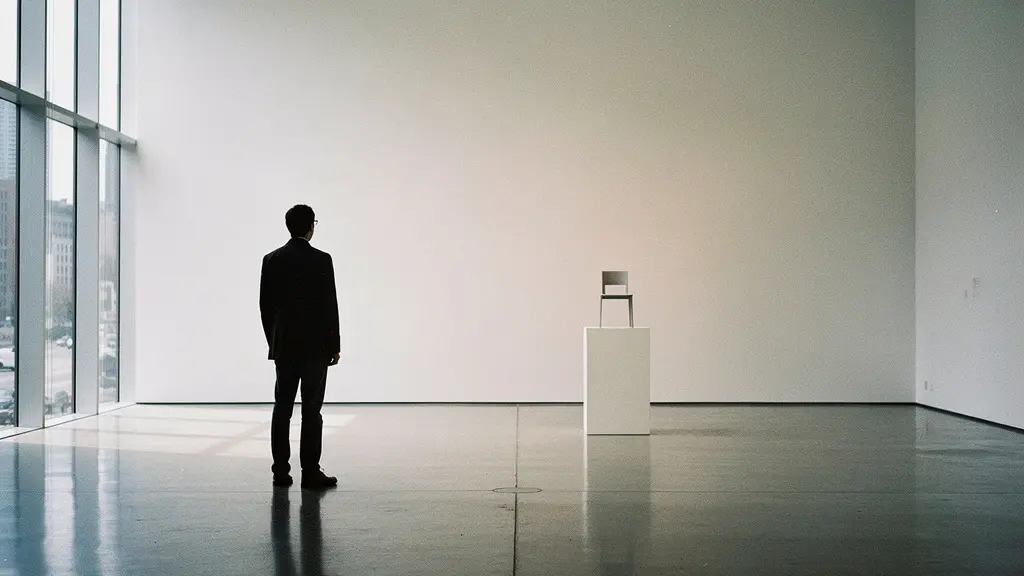
Contrary to popular belief, you don’t need an art history degree to ‘get’ conceptual art; you just need to change the question you’re asking.
- The artwork’s value isn’t in the physical object, but in the chain of ideas it triggers.
- Art that seems “bad” or like a “failure” often plays a crucial role in pushing boundaries and sparking new movements.
Recommendation: To unlock its meaning, shift your focus from asking “What am I seeing?” to “What is this artwork doing?”.
You’ve been there. You walk into a stark, white gallery room and are met with… a pile of bricks. Or a single, unmade bed. A wave of intellectual insecurity washes over you. “Am I supposed to like this? Is this a joke I’m not in on?” You’re not alone in this feeling. For decades, conceptual art has intimidated casual museum-goers, making them feel like they lack a crucial piece of knowledge to unlock its secrets.
The common advice is to simply “read the wall text,” but that often feels like reading a manual for a device you don’t know how to turn on. It reinforces the idea that understanding is reserved for academics who know the secret handshake. This approach misses the point and robs you of a potentially profound experience. What if the key wasn’t about possessing pre-existing knowledge, but about developing a new way of looking?
This guide offers a different path. We’re going to dismantle that feeling of insecurity by providing a practical toolkit of questions. The goal is to shift your perspective from that of a passive, confused viewer to an active, curious investigator. Instead of asking what the art *is*, you will learn to ask what it *does*—to the room, to the institution, and most importantly, to your own assumptions.
By exploring the origins, controversies, and intentions behind this often-misunderstood field, you’ll gain the confidence to engage with even the most challenging works, not as puzzles to be solved, but as conversations to be joined.
For those who prefer a visual introduction, the following video provides an excellent overview of the case for conceptual art, setting the stage for the ideas we will explore in detail.
This article is structured to build your confidence step-by-step. We will move from the foundational principles of conceptual art to its most debated applications, equipping you with the mental tools needed to form your own informed opinions.
Summary: A Practical Guide to Engaging with Conceptual Art
- Duchamp’s Urinal to Emin’s Bed: Why Do Objects Become Art?
- When Experimentation Fails: Can Bad Art Still Be Important?
- Interactive Art: What Happens When the Audience Refuses to Play Along?
- Collecting Ideas: How Do You Own a Concept Without a Physical Object?
- Gimmick or Genius: How to Spot Authentic Conceptual Depth?
- Climate Anxiety in Art: Is It a Trend or a Movement?
- Are Immersive Van Gogh Exhibits Ruining the Appreciation of Originals?
- How to Access Pure Expressionism to Overcome Creative Block?
Duchamp’s Urinal to Emin’s Bed: Why Do Objects Become Art?
The journey into conceptual art almost always begins with a single, provocative object: Marcel Duchamp’s *Fountain* (1917), a porcelain urinal he signed “R. Mutt.” This act wasn’t about craftsmanship; it was a powerful question posed as a statement. Duchamp forced the art world to ask: Does art have to be made by the artist’s hand? Can a simple declaration turn an everyday object into art? The answer, it turned out, was yes. This gesture established the core tenet of conceptualism: the idea is the machine that makes the art.
This principle was later crystallized by artist Joseph Kosuth, who famously stated, “All art (after Duchamp) is conceptual (in nature) because art only exists conceptually.” This means the object you see—the urinal, the bed, the pile of bricks—is merely the physical echo of the real artwork, which is the idea itself. The object becomes a trigger, a catalyst for a line of inquiry. Its “job” isn’t to be beautiful, but to make you think about the very definition of art, value, and context.
So, how does this transformation from a mundane object to a valuable artwork actually happen? It’s not magic; it’s a process involving a “trinity” of forces: the artist’s declaration, the institution’s validation, and the public’s discussion. Understanding this framework is the first step to feeling less intimidated and more like an insider.
Your Checklist: How an Object Transforms into Art
- Artist’s Declaration: Find the artist’s stated intent. What question or idea did they propose by placing this specific object in an art context?
- Institutional Validation: Consider how the gallery or museum setting alters the object’s meaning. The white walls and hushed tones are not neutral; they actively bestow the status of “art”.
- Discursive Confirmation: Observe the critical conversation. What are critics, historians, and the public saying? This dialogue, whether positive or negative, solidifies the work’s place in art history.
- Question the Power-Space: Analyze how the institutional context actively bestows value and authority. Why is this object here and not in a landfill? The gallery’s choice is part of the work.
- Apply the Speech Act Concept: Understand the artist’s declaration as performative. Like saying “I do” at a wedding, the act of declaring the object “art” in the right context makes it so.
By using this lens, you can start to see these objects not as baffling artifacts but as evidence of a specific, revolutionary idea being tested in public.
When Experimentation Fails: Can Bad Art Still Be Important?
One of the biggest hurdles in appreciating conceptual art is the nagging feeling that some of it is just… bad. The execution might seem clumsy, the idea half-baked, or the result underwhelming. This judgment is not only natural, it’s often correct. However, in the world of conceptual art, a “failure” isn’t always a dead end. In fact, some of the most important moments in art history were born from what was initially deemed a failure.
This idea is called productive failure: an ambitious concept that, even if flawed in its execution, opens up a vital new conversation or path of inquiry. It’s the difference between a bad joke (which simply falls flat) and a fascinating but flawed experiment (which inspires others to try again and do it better). These works are important not for what they are, but for what they make possible. They are the essential, messy, and often frustrating steps of innovation.
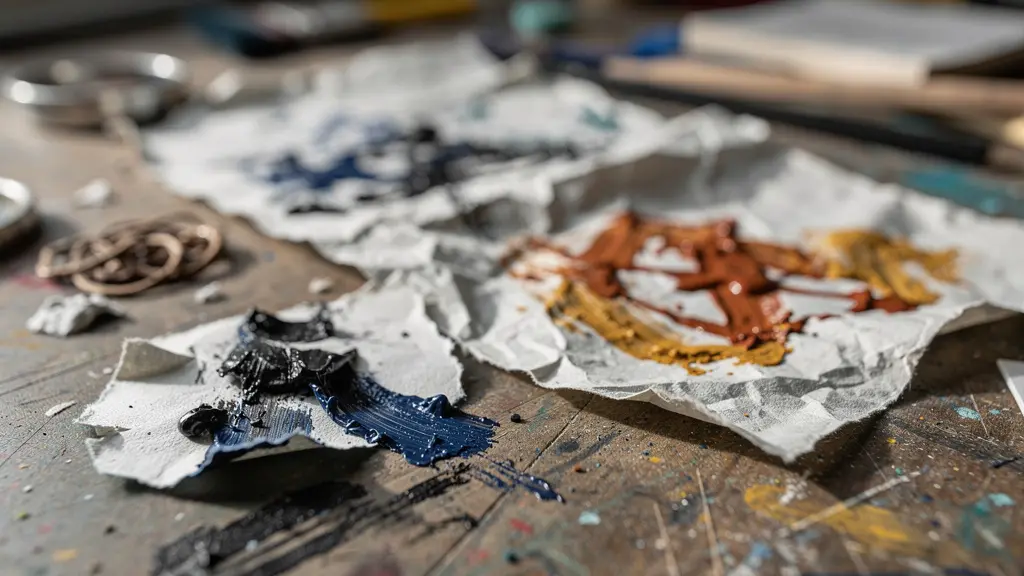
This process of trial and error is inherent to creative exploration. As the image above suggests, the path to a breakthrough is often paved with discarded attempts and material tests. A prime historical example of this is the infamous Salon des Refusés.
Case Study: The Salon des Refusés – When ‘Failed’ Art Sparked a Revolution
In 1863 Paris, the official Salon, the most prestigious art exhibition in the world, rejected thousands of artworks. Emperor Napoleon III, facing outcry, established the “Salon des Refusés” (Salon of the Rejects) to display them. This included works by Édouard Manet, Camille Pissarro, and other future luminaries. Initially, the public and critics mocked these pieces as incompetent “failures.” However, as a catalyst for artistic conversation, the exhibition was a resounding success. It challenged the rigid academic conventions of the time and directly paved the way for Impressionism and the birth of modern art. It proved that work dismissed by the establishment can be essential for advancing art history.
So, the next time you encounter a piece that seems unsuccessful, ask a different question: not “Is this good?” but “What new conversation might this failure be starting?”
Interactive Art: What Happens When the Audience Refuses to Play Along?
Conceptual art often breaks the “do not touch” rule of traditional museums, inviting or even demanding audience participation. You might be asked to take a piece of candy from a pile (Félix González-Torres), follow a stranger (Vito Acconci), or add your own wish to a tree (Yoko Ono). This can be liberating, but it can also be a source of significant anxiety. In fact, research on museum visitor behavior shows that 73% of gallery visitors report anxiety about “doing it wrong” when encountering participatory art. What if you don’t want to participate? Does your refusal break the artwork?
The answer depends entirely on the artist’s intent. Not all interactive art has the same “job.” Understanding the two primary modes of participation can help alleviate this anxiety and reveal a deeper layer of meaning. Some works are an open invitation, while others are a kind of behavioral trap designed to expose social norms.
This distinction is crucial for understanding your role as a viewer. The following table breaks down these two different intentions.
| Open Invitation Art | Behavioral Trap Art |
|---|---|
| Purpose: Co-creation and collective experience | Purpose: Reveal uncomfortable truths about behavior |
| Example: Yoko Ono’s Wish Tree | Example: Surveillance-based installations |
| Audience role: Active collaborator | Audience role: Unwitting subject |
| Non-participation impact: Incomplete but valid | Non-participation impact: Statement of resistance |
| Social dynamic: Invitation to connect | Social dynamic: Exposure of social norms |
In the case of “Open Invitation” art, your non-participation simply means you’ve declined the offer; the work remains an invitation for others. However, with “Behavioral Trap” art, your refusal is actually a form of participation. If an artwork uses surveillance cameras to project your image without consent, choosing to walk away or cover your face is a powerful act of resistance—and that resistance becomes part of the work’s meaning. You are not breaking the art; you are completing its circuit by demonstrating a conscious choice.
Therefore, your choice—whether to engage or to abstain—is always a valid response. You are never “doing it wrong”; you are simply defining your role in the performance the artist has staged.
Collecting Ideas: How Do You Own a Concept Without a Physical Object?
If the “real” artwork is the idea, a fascinating question arises: how can someone buy, sell, or own it? This challenge has led to one of conceptual art’s most radical innovations—divorcing the artwork from a unique physical object. It forces us to reconsider what ownership means, transforming the collector from an “owner” of a thing into a custodian of an idea. The work of Sol LeWitt is the quintessential example of this principle in action.
LeWitt was famous for his expansive wall drawings. However, he rarely drew them himself. Instead, the artwork consists of a set of precise instructions and a signed certificate of authenticity. The collector buys the rights to these instructions, which are then executed by trained drafters directly onto a wall. The drawing might be painted over after an exhibition, ceasing to exist physically, but the owner still possesses the “artwork”—the right and the instructions to create it again.
This system fundamentally changes the nature of art collection. It’s more like owning the musical score to a symphony than owning a single, definitive recording. The physical manifestation is temporary and variable, but the core concept is permanent and authentic. This approach has proven remarkably prescient, anticipating the logic of today’s digital assets like NFTs, where ownership is tied to a certified token rather than a physical object.
Case Study: Sol LeWitt’s Wall Drawings – Owning Instructions as Art
Sol LeWitt’s wall drawings exist primarily as detailed certificates that can be executed by anyone, even after his death. As an example of dematerialized art, museums like MoMA own several LeWitt pieces that exist only as documents until they are “activated” through installation. A collector who purchases one doesn’t receive a finished drawing but a notarized certificate and architectural plans. This system makes the collector a “custodian” responsible for maintaining the conceptual integrity of the piece across different installations. The value lies not in the paint on the wall but in the certified, limited-edition idea itself, a model that creates scarcity and value for an infinitely replicable concept.
This shift from object to certificate redefines art as a living blueprint, an idea that can be brought to life, retired, and resurrected, all while remaining securely “owned.”
Gimmick or Genius: How to Spot Authentic Conceptual Depth?
This is perhaps the most pressing question for any viewer of conceptual art: “Is this brilliant or is it just a gimmick?” The line can feel blurry, and the fear of being duped by a shallow, one-line joke masquerading as profound art is real. While there’s no magic formula, you can develop a critical framework to help distinguish between a work with genuine conceptual depth and one that relies on a superficial stunt. It comes down to asking a few targeted questions about the work’s function and form.
A gimmick is like a punchline: once you “get it,” the experience is over. It doesn’t invite further thought. A work of genius, however, operates like a generative question. It sparks a chain of new questions in your mind that linger long after you’ve walked away. It opens a door rather than closing one. An artist who is truly exploring an idea will often have a consistent line of inquiry that runs through their entire body of work, whereas a gimmicky piece can feel like an opportunistic, one-off attempt to shock or grab attention.
Another key test is the relationship between the idea and the form. In a powerful conceptual work, the chosen medium feels inevitable—it’s the only conceivable way that specific idea could have been expressed. In a gimmicky piece, the form often feels arbitrary, chosen primarily for shock value rather than for its resonance with the concept. To develop this critical eye, you can apply three simple tests.
- The Generative Question Test: Does the work close down on itself like a one-liner, or does it open a chain of questions that persist after viewing? A deep work makes you reconsider something you took for granted.
- The Medium-to-Message Resonance Test: Why this specific form for this idea? In genius work, the medium feels essential and intertwined with the message. In gimmicks, it can feel random or purely shock-driven.
- The Coherence Test: Does this concept connect to the artist’s broader body of work? Look for evidence of a consistent, long-term investigation versus what might be a one-off attempt to follow a trend.
By arming yourself with these questions, you can move beyond the simple “I like it” or “I don’t like it” and begin to articulate *why* a work resonates with you—or why it feels hollow.
Climate Anxiety in Art: Is It a Trend or a Movement?
The principles of conceptual art are not confined to historical examples; they are powerful tools for understanding contemporary art. Today, one of the most visible subjects is the climate crisis. We see countless artworks depicting melting glaciers, rising sea levels, and dystopian futures. This raises a crucial question: is this a meaningful artistic movement or just a trendy topic? Using a conceptual lens, we can look past the surface-level subject matter and analyze the *approach* the artist is taking.
The key distinction lies in whether the art is merely *illustrating* the problem or if it is *embodying* it in its very structure and materials. Illustrative art shows you a picture of climate change, like a documentary photograph or a painting of a wildfire. It operates on an external, observational level. Systemic art, on the other hand, integrates the issue into its core. The “concept” is not just the topic of climate change, but a deeper critique of the systems—including the art world’s own complicity—that contribute to it.
This might involve an artist who forgoes traditional, often toxic, art materials in favor of creating new, biodegradable or even carbon-negative mediums. Or it could be an artist like Olafur Eliasson, whose work often incorporates renewable energy systems, making the artwork itself a functional part of the solution, not just a commentary. Differentiating between these approaches allows us to gauge the depth of engagement.
The table below clarifies the difference between art that simply points to the problem and art that becomes part of the systemic solution.
| Illustrative Climate Art | Systemic Climate Art |
|---|---|
| Depicts effects (melting ice, floods) | Integrates issue into materials/process |
| Documentary approach | Material innovation (biodegradable, carbon-negative) |
| External observation | Internal critique of art system |
| Traditional mediums | New sustainable mediums |
| Example: Paintings of disasters | Example: Olafur Eliasson’s renewable energy works |
This systemic approach is where conceptual art’s legacy shines. It proves that an idea-driven practice can move beyond representation to become a form of direct action and innovation.
Are Immersive Van Gogh Exhibits Ruining the Appreciation of Originals?
In recent years, “immersive” digital art experiences, particularly those featuring artists like Van Gogh, have exploded in popularity. These shows project famous paintings onto massive walls, floors, and ceilings, enveloping the viewer in a swirling, animated spectacle set to music. They are an undeniable commercial success, but they have also sparked a heated debate: are these experiences a gateway to art appreciation or are they a commercialized distraction that “ruins” the real thing?
A conceptual framework helps us move beyond this binary and see that these are not competing experiences, but entirely different things with different “jobs.” The original painting in a museum possesses what the philosopher Walter Benjamin called an “aura.” It is a unique object that has a specific history; it existed in the same time and space as the artist. The texture of the paint, the cracks in the canvas, and its sheer physical presence connect us directly to the artist’s hand. Its job is to provide a historical and material connection to an artifact.
The immersive exhibit, by contrast, has no aura. It is an infinitely reproducible digital file. It has no original object to connect with. Its “job” is entirely different: to provide a sensory and emotional immersion. It uses the artwork not as an artifact to be revered, but as raw material for a new, contemporary experience. It prioritizes feeling over historical fact and envelopment over close-looking. One is about contemplation and authenticity; the other is about entertainment and spectacle.
Neither is inherently better or worse; they are simply designed to fulfill different human needs. To say the immersive show ruins the original is like saying a movie adaptation ruins the book. For many, the movie is the entry point that inspires them to read the book. Similarly, an immersive show can spark an initial curiosity that leads someone to a museum to seek out the quiet, powerful presence of the original painting for the very first time.
The real question is not whether one is “ruining” the other, but whether we can appreciate both for the distinct experiences they are designed to provide.
Key Takeaways
- Focus on the ‘job’ of the artwork—what it’s designed to do—not just its appearance.
- See “failed” experiments as productive steps in a larger artistic conversation that pushes boundaries.
- Distinguish between art that invites co-creation and art that sets a “behavioral trap” to critique social norms.
How to Access Pure Expressionism to Overcome Creative Block?
While this article has focused on how to *view* conceptual art, its principles can also be a powerful tool for overcoming your own creative blocks. The central idea of conceptualism—privileging the idea over the execution—can be flipped on its head to unlock creativity. When you feel stuck intellectually, unable to come up with a “good idea,” you can use your body and physical action to generate ideas for you. This approach, rooted in a concept known as embodied cognition, bypasses the critical, judgmental part of your brain.
Instead of trying to think your way out of a block, you act your way out. The process is simple: start with a physical task, no matter how mundane or strange, and let the meaning or concept emerge from the action itself. This is the ultimate way to get out of your own head. Don’t think, just do. This might mean drawing the physical shape of your anxiety with your non-dominant hand, or making marks on a page that respond only to a piece of music, not to any visual judgment. The goal is to let the body lead the mind.
This method was pioneered by artists who sought to break free from the constraints of traditional art-making and the pressure to have a brilliant idea before starting. The work of Bruce Nauman is a landmark example of this process in action, proving that sometimes the most profound concepts are discovered through simple, repetitive physical acts.
Case Study: Bruce Nauman’s Body-Based Conceptual Practice
In his late 1960s studio films, Bruce Nauman demonstrated embodied cognition in its purest form. In works like *Walking in an Exaggerated Manner Around the Perimeter of a Square*, he used simple, repetitive physical actions to bypass his own intellectual barriers and generate content. His guiding rationale was a radical act of self-permission: “If I was an artist and I was in the studio, then whatever I was doing in the studio must be art.” This freed him from creative paralysis by removing the pressure for a premeditated concept. This approach, which starts with physical action rather than intellectual planning, allows the body’s movements and limitations to become the source of the idea itself, a method still used by contemporary artists to dissolve creative blocks.
The next time you’re in a gallery, armed with these new questions and frameworks, you are no longer an outsider. You have the tools to engage. You have permission to be curious, to be critical, and even to be unimpressed. Go start a conversation—with the art, and with yourself. You might be surprised at what you discover.