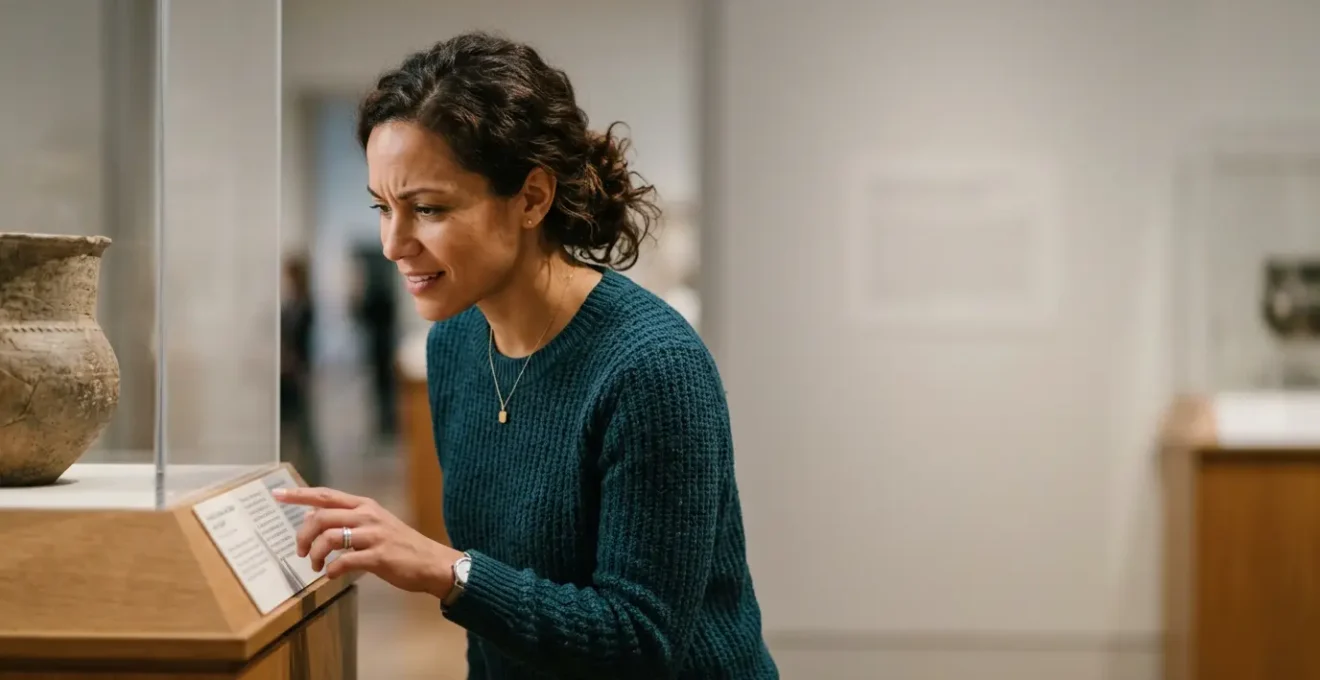
The biggest mistake in museum writing isn’t making labels too long—it’s making them too demanding for too little emotional or intellectual reward.
- Effective labels treat visitor attention as a precious currency, aiming to minimize cognitive load while maximizing emotional connection.
- Moving from a “facts-first” approach to a “feelings-first” narrative creates deeper, more memorable engagement for a wider audience.
Recommendation: Shift your role from an information provider to an experience designer. Your goal isn’t to be read; it’s to be felt and remembered.
We’ve all seen it. The beautifully researched, impeccably detailed wall text, the product of months of work, completely ignored. Visitors drift past, their eyes glazing over, scanning for something—anything—that will grab their attention for more than a fleeting moment. As curators and writers, it’s a familiar and frustrating pain point. We pour our expertise into crafting a narrative, only to see it become part of the background, a “wall of text” that visitors are conditioned to avoid.
The conventional wisdom for fixing this problem is a list of well-meaning but generic platitudes: “Keep it short,” “tell a story,” “avoid jargon.” While not wrong, this advice barely scratches the surface. It tells us *what* to do but fails to explain *why*. It doesn’t address the fundamental tension between academic rigor and public accessibility, or how to create an experience that resonates with a seven-year-old and a Ph.D. holder simultaneously.
But what if the real problem isn’t the length of our text, but its lack of return on investment? The true key lies in a shift of perspective: we must stop writing to inform and start designing experiences that strategically manage visitor cognitive load. This means treating a visitor’s attention as a finite currency. Every word must earn its place by delivering a proportional emotional or intellectual payoff. An effective label is not just a block of information; it is a deliberate intervention designed to spark curiosity and forge a memorable connection.
This guide moves beyond the basics to explore how to put this principle into practice. We will deconstruct the process, from questioning who gets to tell the story to leveraging technology and understanding the cognitive science behind why some exhibits resonate and others fall flat. It’s time to transform passive reading into active, memorable engagement.
To navigate this transformation, this article breaks down the essential strategies for creating museum labels and experiences that capture and hold visitor attention. The following sections will guide you through the core principles of modern, effective museum interpretation.
Summary: A Guide to Writing Museum Labels People Will Actually Read
- Who Tells the Story: How to Rewrite Imperial History in Local Museums?
- Touch Screens or Real Objects: Which Creates a Better Memory of the Visit?
- Facts vs Feelings: Using Personal Stories to Connect Visitors to Big History?
- Augmented Reality: Can Phone Apps Replace Traditional Guidebooks?
- The Dual Layer: How to Create Exhibits That Engage 7-Year-Olds and Ph.D.s?
- Wall Text Length: When Does Too Much Information Kill the Visual Experience?
- The Learning Deficit: Why Audio Guides Might Hinder Your Observation
- How to Experience the British Museum’s Quietest Rooms Before the Crowds Arrive?
Who Tells the Story: How to Rewrite Imperial History in Local Museums?
Before a single word of a label is written, the most fundamental question must be asked: who holds the authority to tell this story? For generations, museums have presented history from a singular, often colonial, perspective. This approach not only silences other voices but also presents an incomplete and distorted narrative. To write labels people actually read and connect with, the narrative itself must be authentic, inclusive, and honest. This is the core of decolonization in museums.
As The Word 360 Editorial Team notes in “Decolonizing Museums: Rethinking Cultural Narratives”:
Decolonization challenges who gets to tell history, whose knowledge is considered valid, and who gets to see their culture represented with dignity.
– The Word 360 Editorial Team, Decolonizing Museums: Rethinking Cultural Narratives
This isn’t about erasing history; it’s about enriching it. It means actively seeking out and collaborating with community members, especially Indigenous and descendant communities, to co-create interpretations. It involves transparently acknowledging the often-problematic provenance of artifacts and using labels to discuss not just the object’s original function, but also its journey to the museum. This process transforms a static object into a dynamic testament to a more complex, and ultimately more truthful, history. By ceding some institutional authority, museums gain a far more valuable asset: community trust and a story that resonates with a broader audience.
Case Study: The Museum of Us Decolonizing Initiatives
The Museum of Us in San Diego serves as a powerful example of this work in action. The institution has implemented a comprehensive decolonizing framework that includes a Colonial Pathways Policy and robust protocols for community co-curation. As part of their ongoing decolonizing initiatives, the museum works directly with Indigenous peoples to steward and repatriate cultural items according to community wishes. Their labels now include Indigenous languages and perspectives, and they practice “transparent provenance storytelling” that acknowledges how objects were acquired, even through means that were legal but unjust. This commitment is integrated across all levels of the museum, ensuring BIPOC representation in decision-making and fundamentally shifting who gets to tell the story.
By asking “who tells the story,” we move from a monologue to a dialogue, creating a richer, more engaging experience for every visitor.
Touch Screens or Real Objects: Which Creates a Better Memory of the Visit?
In the rush to modernize, museums often turn to digital interactives as a solution for visitor engagement. Touch screens promise novelty and control, but do they create a more lasting impact than the quiet contemplation of a real object? The answer lies in understanding how our brains form memories. Our minds are not passive recorders; they learn and remember through physical experience, a concept known as embodied cognition. The simple act of looking, walking around an object, and imagining its texture or weight forges a much stronger neural pathway than tapping on a flat glass screen.
This physical connection is vital in a world of shrinking attention spans. With the average visitor’s focus on a single element lasting a mere 8.25 seconds, according to a 2024 study, the sensory richness of a real artifact offers a powerful anchor for attention. The subtle cracks in a ceramic pot, the faded ink on a manuscript, or the heft of a stone tool provide a depth of information that a digital facsimile cannot replicate. These details trigger curiosity and an emotional response, offering a much higher “return on investment” for the visitor’s limited attention currency.
As the image above suggests, there is an innate human desire to connect with the authentic. While screens can be excellent tools for providing supplementary information, they should not replace the core experience. The most effective exhibits use digital tools to augment, not supplant, the real object. They might provide context or reveal hidden details, but they always lead the visitor’s eye—and mind—back to the tangible piece of history in front of them. The goal is to facilitate a memorable, multi-sensory encounter that a screen alone can never provide.
Facts vs Feelings: Using Personal Stories to Connect Visitors to Big History?
Museums are repositories of facts, dates, and data. But visitors are not. They are emotional beings who connect with the world through narrative. A label that lists the dimensions, material, and origin of a Civil War-era rifle might be accurate, but it’s also forgettable. A label that tells the story of the 19-year-old soldier who carried it, his fears written in a letter home, transforms that same object into a powerful conduit for empathy. This is the crucial shift from a fact-based to a feelings-based interpretation.
As curator Adina Langer explains, this approach is not about sacrificing accuracy for sentimentality. Instead, it’s about using emotion as a gateway to deeper learning. In her work on “Storytelling in Museums,” she notes, ” Visitors identify with personal narratives because they help to create emotional connections that lead to deeper and broader curiosity.” When a visitor feels a connection to an individual from the past, they become more invested in understanding the larger historical context. The story of one person becomes a memorable anchor for the “big history” surrounding them.
This strategy is highly effective at managing cognitive load. A story is a naturally intuitive structure for the human brain; it’s easier to process and retain than a disconnected list of facts. By framing information within a personal narrative, we lower the mental effort required from the visitor while dramatically increasing their emotional ROI. They leave not just knowing more, but feeling more—and that feeling is what makes an experience stick.
Case Study: The National September 11 Memorial & Museum’s Narrative Framework
The 9/11 Memorial & Museum masterfully employs personal stories to interpret an event of overwhelming scale. Instead of focusing solely on timelines and statistics, the museum’s curators built the experience around a comprehensive oral history initiative. They collected thousands of first-person testimonies from survivors, first responders, and victims’ families. These deeply personal narratives are carefully woven throughout the exhibition, connecting individual artifacts—a pair of glasses, a work ID, a final voicemail—to the human beings who owned them. This approach makes the history accessible and profoundly human, transforming visitors from passive observers into empathetic witnesses who carry the memory of these stories with them.
Augmented Reality: Can Phone Apps Replace Traditional Guidebooks?
As museums grapple with how to engage a digitally native audience, augmented reality (AR) has emerged as a promising, if sometimes gimmicky, tool. The question is no longer *if* technology has a place in the gallery, but *how* it can be used to deepen the visitor experience rather than distract from it. A poorly designed app can pull a visitor out of the moment, their face buried in their phone. But a well-designed AR experience can do the opposite: it can make the invisible visible and foster a profound sense of “embodied presence.”
The key is to use AR not as a replacement for the guidebook, but as a magic lens. Instead of delivering text-heavy descriptions, the most effective AR apps superimpose historical context directly onto the real world. Imagine pointing your phone at a Roman ruin and seeing a full reconstruction of the original building, or viewing a skeleton and seeing an animated overlay of how that creature moved. This approach enhances observation rather than hindering it. It respects the visitor’s primary focus—the artifact or space in front of them—while adding a “wow” factor that provides a significant intellectual and emotional payoff.
With museum attendance still recovering— data from the 2024 Annual Survey of Museum-Goers shows that 33% of U.S. adults visited a museum in the past year—innovative approaches like AR can be a powerful draw. The goal is to create an experience so compelling it feels less like reading a guide and more like stepping into history.
Case Study: The Dunhuang Digital Library Cave Embodied AR Experience
The Digital Library Cave project, designed to replicate the famous Mogao Caves, is a groundbreaking example of AR done right. Instead of a passive virtual tour, the project uses high-precision 3D reconstruction and game engine technology to create an immersive, interactive narrative. Visitors engage in role-playing and task-based challenges, transforming them from viewers to active participants. The design prioritizes “embodied engagement,” where the visitor’s own body serves as the medium for cultural interpretation. By synchronizing the digital overlay with environmental stimuli, the experience fosters a deep cognitive and affective connection, turning a museum visit into an unforgettable journey of discovery.
The Dual Layer: How to Create Exhibits That Engage 7-Year-Olds and Ph.D.s?
One of the greatest challenges in museum writing is catering to a vastly diverse audience. How can a single label speak to a child just learning to read, a casual tourist, and a subject-matter expert? The answer is not to “dumb down” the content, but to structure it in layers. This “dual-layer” or multi-layered approach is a strategic way to manage cognitive load and offer different entry points for different levels of interest. It acknowledges that not every visitor wants or needs the same amount of information.
The first layer is the “hook.” This is a short, punchy, and highly visible piece of text—often a question or a surprising fact—designed to grab everyone’s attention. Its language is simple, its font is large, and its purpose is singular: to spark curiosity. The second layer is the core label, a concise paragraph of 50-100 words that provides the essential context. This is for the majority of visitors who want to understand the basics without being overwhelmed.
The final layer is for the “deep divers”—the Ph.D.s and enthusiasts. This in-depth information shouldn’t clutter the main wall text. Instead, it can be accessed via a QR code, a numbered reference to a handout, or a separate text panel. This structure respects the visitor’s time and attention. It empowers them to choose their own level of engagement, ensuring that everyone from the seven-year-old to the seasoned academic can find a rewarding experience.
Action Plan: Designing Multi-Layered Museum Labels
- Hook Layer: Start with an intriguing fact, question, or thought-provoking statement in a large, easily readable font to capture the attention of all visitors.
- Primary Layer: Write the core label, keeping it between 50-100 words. Focus on the single most important idea to ensure maximum readability and engagement.
- Depth Layer: Offer QR codes or numbered references that link to extended secondary text (on an app, website, or dedicated panel) for visitors who want more in-depth information.
- Accessibility Layer: Use large fonts (18-20 points minimum), high-contrast colors, and clear language to accommodate visitors with varying literacy levels and visual abilities.
- Testing Layer: Before finalizing, gather feedback on your labels from a diverse group, including colleagues and visitors of different ages, to ensure clarity and impact.
Wall Text Length: When Does Too Much Information Kill the Visual Experience?
The “wall of text” is the ultimate killer of curiosity in a museum. It creates a high cognitive load before the visitor has even decided to engage. The moment they perceive a label as a dense, scholarly block, they are likely to disengage and move on, preserving their precious attention currency for something more visually accessible. The problem isn’t just that long text is intimidating; it’s that it competes directly with the primary reason the visitor is there: to look at things.
An effective label is a supporting actor, not the star of the show. Its job is to enhance the viewing experience, not overshadow it. As one professional interviewed by MuseumNext wisely pointed out, ” Visitors often skim exhibit labels rather than read them in full. Trimming lengthy labels to a few key sentences not only improved traffic flow but also increased visitor engagement with the display.” This isn’t about dumbing down content; it’s about strategic editing. Every word must serve the goal of driving the visitor’s eyes and mind back to the artifact with renewed interest and understanding.
Furthermore, overly long and academic text can create an environment of exclusion. When the language of a museum feels like it’s only for a select, highly educated few, it alienates a huge portion of the potential audience. This is particularly problematic given that, even in 2024, the museum-going public is not as diverse as it should be. For instance, the 2024 Annual Survey of Museum-Goers revealed that frequent museum visitors remain 84% white (not Hispanic or Latine). Writing accessible, concise, and engaging labels is therefore not just a matter of good design—it is an act of institutional hospitality and a crucial step toward building a more inclusive space.
The Learning Deficit: Why Audio Guides Might Hinder Your Observation
Audio guides seem like a perfect solution: they deliver expert commentary without creating a wall of text. However, cognitive science suggests they may come with a hidden cost. By splitting a visitor’s attention between two competing sensory inputs—listening to a narrator and looking at an object—audio guides can inadvertently create a “learning deficit.” This phenomenon is rooted in the principles of embodied cognition, which posits that our understanding is deeply linked to our physical, sensory experience of the world.
When you are looking at an artifact, your brain is actively engaged in observation: noticing details, making connections, and forming questions. An audio guide interrupts this active process by imposing a passive one. It tells you what to see and what to think, effectively outsourcing your curiosity. This creates a mismatch between your bodily experience (looking) and the information you are receiving (listening), which can prevent deep cognitive engagement. Instead of a rich, personal discovery, the visit can become a sterile, box-ticking exercise.
A 2025 grounded theory study on museum gamification confirmed this link. Researchers found that communication is most effective when environmental stimuli (what you see) match bodily experiences. When there is a disconnect, the brain struggles to map new information onto prior physical interactions, hindering deep understanding. The study revealed that the brain automatically activates related bodily experience memories when encountering new information, which is a process that passive listening can short-circuit. The most profound learning moments in a museum often happen in silence, when the visitor is given the space to simply look, think, and feel.
Key Takeaways
- Shift from Informing to Connecting: Prioritize emotional resonance and narrative over dense facts to lower cognitive load and increase memorability.
- Honor the Object: Use text and technology as tools to enhance observation of the physical artifact, not as replacements for it.
- Design for Everyone: Employ a layered content strategy to provide multiple entry points, allowing visitors to choose their own depth of engagement.
How to Experience the British Museum’s Quietest Rooms Before the Crowds Arrive?
The principles of managing cognitive load and seeking authentic connection don’t just apply to curators; they apply to visitors, too. In a world-renowned institution like the British Museum, the sheer scale of the collection and the density of the crowds can be overwhelming. A visit can quickly devolve into a frantic rush past highlights, leaving one exhausted rather than inspired. The key to a more meaningful experience is to consciously curate your own visit, transforming yourself from a passive consumer into an active explorer.
This means rejecting the “greatest hits” tour. Instead of making a beeline for the Rosetta Stone or the Parthenon Marbles along with everyone else, make a plan to explore the museum’s less-trafficked galleries first. Rooms dedicated to ancient manuscripts, horology, or regional decorative arts often hold incredible treasures but see a fraction of the foot traffic. Visiting during off-peak hours, such as early weekday mornings, can also dramatically reduce sensory overload. This isn’t about avoiding the masterpieces, but about creating the mental space to appreciate them later, once you’ve found your footing.
The most powerful strategy of all is to practice “slow looking.” Choose a single object and commit to spending 10-15 minutes with it. Look at it from all angles. Notice the details, the materials, the craftsmanship. Let your mind wander and ask questions. This focused observation is a form of cognitive meditation that builds a far deeper and more personal connection than glancing at a hundred objects for ten seconds each. By actively managing your own attention and creating a personal narrative pathway through the museum, you reclaim the experience, ensuring you leave with a few profound memories instead of a blur of fleeting impressions.
By moving beyond the simple delivery of information and focusing on designing a thoughtful, empathetic, and cognitively manageable experience, you can create exhibits that truly connect. Start applying these principles today to transform your labels from words on a wall into catalysts for wonder and discovery.