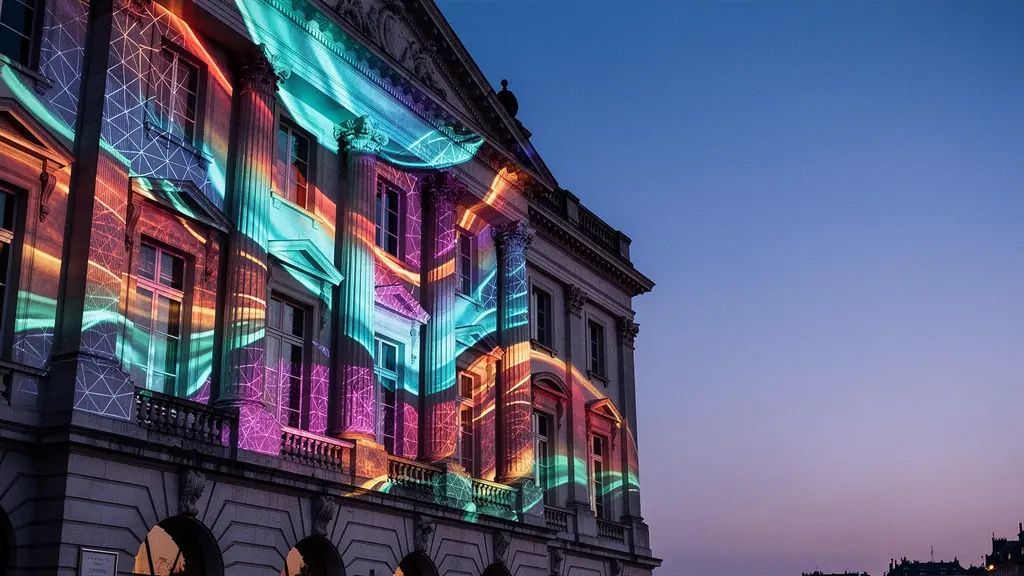
Contrary to popular belief, projection mapping isn’t just a light show; it’s a form of narrative alchemy that redefines a building’s purpose and economic value.
- Success depends less on projector brightness and more on mastering non-linear storytelling and understanding the legal canvas you’re working on.
- The most impactful installations are often temporary, leveraging psychological principles like FOMO to create lasting collective memory.
Recommendation: Shift your focus from creating a spectacle to architecting an experience. The true ROI lies in the story you tell, not just the images you project.
A building stands silent, a static monolith of brick and glass. We see it, we register its function, and we move on. But what if that facade is not an endpoint, but a canvas? What if architecture itself could become a dynamic storyteller? This is the fundamental promise of video mapping, a discipline that goes far beyond simply projecting images onto a surface. It’s a practice of luminous choreography, where light, code, and narrative converge to breathe life into the inanimate.
Most discussions about projection mapping get caught up in the technical arms race: more lumens, higher resolutions, bigger surfaces. While the technology is a critical enabler, it’s merely the grammar of a new visual language. The real art lies in the poetry. The common approach focuses on creating a momentary “wow” factor, a fleeting spectacle that fades as quickly as the lights go down. This perspective misses the core opportunity: to forge a deep, emotional connection with an audience and fundamentally alter their perception of a space.
But if the key isn’t just spectacle, what is it? The true power of architectural projection lies in mastering a unique form of narrative alchemy. It’s about understanding that a building has its own history and character, and that a projection is not an overlay but a dialogue. This guide deconstructs this process. We will explore the legal frameworks that define your canvas, the specific software and hardware choices that serve your story, the ethical responsibilities of painting with light, and the narrative structures that turn a static building into a living, breathing story.
This article provides a comprehensive overview for event planners, architects, and creators looking to harness this technology. It breaks down the essential components, from legal prerequisites to the future of immersive business models, to help you move from practitioner to true creative technologist.
Summary: How Video Mapping Turns Static Buildings Into Living Narratives
- Copyright on Facades: Do You Need Permission to Project onto a Public Building?
- MadMapper vs Resolume: Which Software is Best for Architectural Mapping?
- Lumens per Square Meter: How to Calculate Projector Power for Outdoor Events?
- Looping Stories: How to Write a Script That Has No Beginning or End?
- Light Pollution: How to Balance Spectacle With Ecological Responsibility?
- Pop-Up Parks: Why Temporary Installations Often Have More Impact Than Permanent Ones?
- Indoor Culture: How to Spend a Wet Weekend in Manchester Without Being Bored?
- How Immersive Digital Installations Are Changing the Museum Business Model?
Copyright on Facades: Do You Need Permission to Project onto a Public Building?
Before a single photon is cast, a creative technologist must first understand the legal fabric of their canvas. Projecting onto a building is not simply a technical act; it’s an interaction with property, intellectual and physical. The primary legal doctrine to navigate is the Freedom of Panorama, which governs the right to create and distribute derivatives of works, like buildings, located in a public space. However, its application is a treacherous global patchwork.
While many assume public buildings are “fair game,” the reality is far more complex. For instance, German law is relatively permissive regarding temporary projections on public facades. In stark contrast, French law is highly restrictive; the iconic night-time illumination of the Eiffel Tower is a copyrighted work, and unauthorized commercial reproductions are forbidden. This legal ambiguity is a critical risk for any project. A comprehensive analysis reveals that while around 80% of countries have some form of Freedom of Panorama, only 35% explicitly allow commercial use of such derivative works, including projections.
Legal precedents further muddy the waters. The 2022 German case involving the wrapped Reichstag established that even temporary installations might not qualify for panorama exceptions if they are deemed to create a new, distinct work. Beyond copyright, artists must secure practical permissions. This involves negotiating with building owners, who may have their own branding or usage restrictions, and obtaining permits from municipal authorities, who regulate public safety, light levels, and event timing. Ignoring either the legal theory or the practical logistics can lead to costly fines and project shutdowns.
MadMapper vs Resolume: Which Software is Best for Architectural Mapping?
Once the legal canvas is secured, the choice of software becomes the central decision in defining your workflow and creative potential. The two dominant forces in the industry, MadMapper and Resolume, are often compared, but they are designed with fundamentally different philosophies. This isn’t a question of which is “better,” but which is the right tool for the specific narrative you aim to tell. Choosing the software is choosing your creative approach.
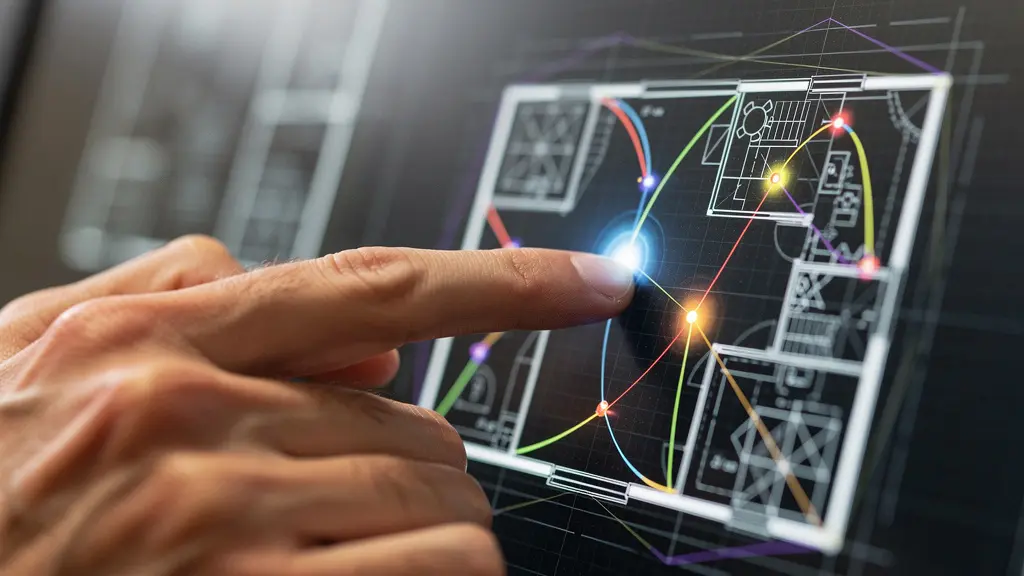
MadMapper is the architect’s tool. It excels at precision, pre-planned installations where every pixel must align perfectly with complex geometry. Its strength lies in its advanced 3D calibration, spatial scanning, and meticulous control over masks and surfaces. It is the ideal choice for permanent museum exhibits or detailed architectural showcases where the content is rendered and mapped with painstaking accuracy ahead of time. Resolume Arena, conversely, is the performer’s instrument. Born from the world of VJing, its power lies in real-time performance and improvisation. With an intuitive interface and a vast library of live effects, it’s built for festivals, concerts, and events where content needs to be mixed, triggered, and manipulated on the fly in sync with music or other live elements.
The following table, based on an in-depth analysis of their features, breaks down their core differences to guide your decision.
| Feature | MadMapper | Resolume Arena |
|---|---|---|
| Primary Focus | Precision architectural mapping | Live performance & real-time VJ |
| Resolution Support | Up to 16K video | 8K maximum |
| Interface | Complex, professional-grade | Intuitive, drag-and-drop |
| Best For | Pre-mapped installations, museums | Concerts, festivals, live shows |
| Pricing (2024) | $449 one-time or $39/month | $899 one-time |
| 3D Mapping | Advanced 3D calibration & scanning | Basic 3D support |
| Real-time Effects | Limited | Extensive (100+ built-in) |
| DMX/Lighting Control | Full LED & DMX integration | DMX & Artnet support |
Lumens per Square Meter: How to Calculate Projector Power for Outdoor Events?
With a legal framework and a software toolkit, the next challenge is purely physical: overcoming ambient light. In outdoor projection mapping, the projector’s power, measured in lumens, is in a constant battle with streetlights, moonlight, and the general glow of the urban environment. Insufficient brightness will result in a washed-out, ghostly image, utterly failing to create an immersive experience. Calculating the required lumens is not guesswork; it’s a science of surface, distance, and environment.
The primary goal is to achieve a sufficient contrast ratio—the difference between the brightest white and the darkest black. For impactful outdoor shows, a ratio of at least 15:1 is recommended. Several factors influence this calculation. The projection surface itself is critical; a dark, porous brick facade can require up to 40% more lumens than a smooth, white marble one to achieve the same perceived brightness. The size of the projection surface and the level of ambient light are the other key variables. For large-scale projects, such as city skyscrapers, industry standards indicate that projectors with a power of at least 20,000 lumens are required to make a significant visual impact.
Failing to properly calculate your power needs is one of the costliest mistakes in event production. An underpowered projector is useless, while an overpowered one is a waste of budget. The following checklist provides a structured method for determining your needs accurately.
Your 5-Step Projector Power Calculation Guide
- Measure your projection surface area in square meters (length × height).
- Assess ambient light levels with a light meter; aim for a contrast ratio of at least 15:1 against the un-projected surface.
- Factor in the surface material and color; dark or rough surfaces require significantly more power.
- Apply the formula: Required Lumens = Surface Area (m²) × Target Lux (brightness) ÷ Projector Efficiency Factor.
- Add a 20% lumen buffer for atmospheric conditions like haze or humidity and projector lamp age.
Looping Stories: How to Write a Script That Has No Beginning or End?
The technical aspects—legal, software, hardware—are merely the vessel. The soul of a projection mapping experience is its story. But architectural projections defy traditional linear narrative. An audience won’t arrive at a specific start time and stay until the credits roll. They drift in and out. The narrative must therefore be a perfectly looping system, engaging a viewer instantly, rewarding them for staying, and feeling complete no matter when they leave. This requires abandoning the three-act structure in favor of cyclical or modular forms.
The goal is to create a sense of ‘luminous choreography’ that feels both continuous and satisfying at any point in its cycle. Instead of a single plot, think in terms of themes, evolutions, and motifs. The building itself is the main character; the projection is its changing emotional state or a window into its hidden stories. This shift in thinking is crucial for creating content that feels native to the medium. The following structures are proven methods for building these seamless narrative loops:
- The Thematic Vignette: This approach involves creating several short, self-contained mini-stories (60-90 seconds) that share a common visual or emotional theme. They can be played in any order, creating a varied experience for viewers who stay longer, while each vignette provides a complete emotional arc on its own.
- The Evolving State: Here, a single, continuous scene is designed to slowly transform over a longer period (e.g., 10-15 minutes). A facade might slowly ‘grow’ digital vegetation, ‘erode’ over time, or transition through seasons. The changes are so gradual that there is no obvious loop point, creating a mesmerizing, ambient experience.
- The Rondo Form (A-B-A-C-A): Borrowed from music, this structure establishes a central, recurring visual theme or “chorus” (A). This main sequence returns between different narrative episodes or “verses” (B, C). This creates natural, satisfying return points and a strong sense of cohesion.
Mastering this non-linear scripting is what separates a mere light show from true narrative alchemy. It’s about designing a story that lives and breathes in public space, accessible and meaningful from any temporal viewpoint.
Light Pollution: How to Balance Spectacle With Ecological Responsibility?
As creators who paint with light, we hold a significant responsibility to the night. While our goal is to captivate and inspire, we must also be acutely aware of our environmental footprint, specifically light pollution. The unconstrained use of high-powered projectors contributes to skyglow, which disrupts ecosystems, affects human health, and erases our connection to the stars. A truly masterful projection is not the brightest, but the most precise—one that achieves its artistic goals with minimal collateral impact.
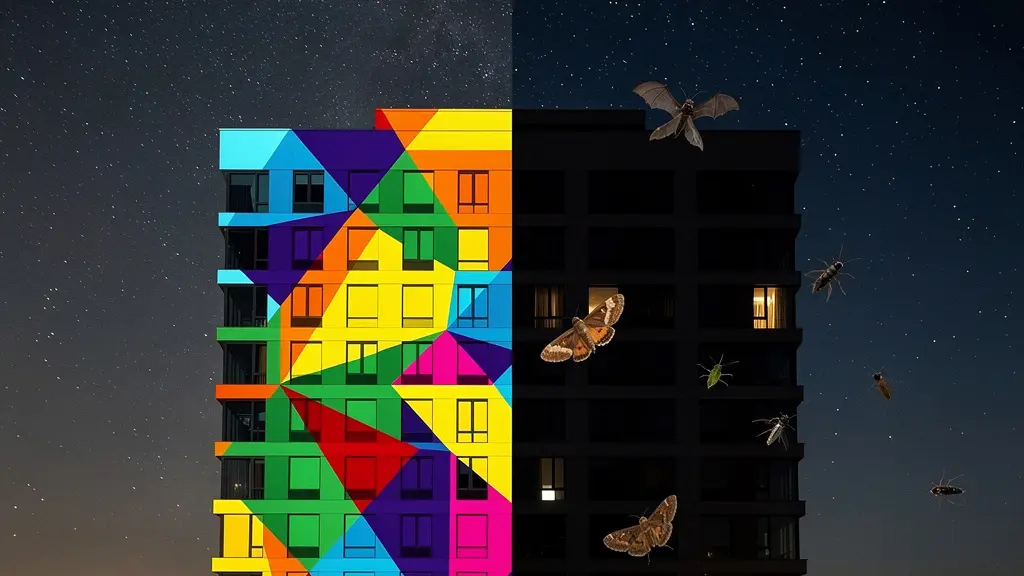
The scale of the problem is immense; recent research in Nature reveals that 83% of the global population lives under light-polluted skies. This isn’t just an aesthetic loss. It has severe consequences for nocturnal wildlife, particularly insects and migratory birds, whose navigation and life cycles are disrupted by artificial light. The role of a creative technologist, therefore, extends to being an ecologist of the night. This means employing techniques like precision mapping, where light is confined strictly to the architectural surfaces, with sharp cutoffs to prevent spill into the sky or surrounding habitats. It also involves considering the show’s duration and timing to avoid peak nocturnal activity.
Advanced strategies are being explored, such as spectral tuning. For example, some studies have examined using red light, as it scatters less in the atmosphere. However, even this is not a simple solution. Research shows that many nocturnal species can still detect red wavelengths, and its ecological effects are not fully understood. The most effective approach remains a commitment to using only as much light as necessary, exactly where it is needed. Balancing spectacle with stewardship is not a compromise; it’s a mark of sophisticated and responsible design.
Pop-Up Parks: Why Temporary Installations Often Have More Impact Than Permanent Ones?
In a world saturated with digital content, permanence is no longer a guarantee of impact. Paradoxically, the fleeting, ephemeral nature of a temporary projection mapping installation can generate a more profound and lasting collective memory than a permanent architectural feature. This phenomenon is rooted in human psychology and the economics of attention. A limited-time event creates urgency and a powerful sense of Fear Of Missing Out (FOMO), transforming a passive viewing into an active, must-share community experience.
This psychological driver is what separates a building from an event. A permanent statue can be seen anytime, but a two-night projection show becomes a cultural moment. As one research team noted, this temporary quality is key to creating a powerful social effect.
The limited-time nature of a projection show creates ‘collective effervescence’ and FOMO, generating a more intense community experience and social media footprint.
– Event Psychology Research Team, Urban Installation Impact Study 2024
This principle of “ephemeral permanence”—where a temporary event creates a lasting legacy—is a powerful strategic tool for cities, brands, and institutions. It turns a location into a destination and generates a surge of social media activity and press coverage that far outweighs the investment in a permanent fixture.
Case Study: USC Village Opening
For the opening of its new complex, the University of Southern California commissioned a five-minute projection mapping show on several buildings, synchronized to music from its orchestra. Despite its brief run, the event attracted tens of thousands of spectators and generated more social media engagement in a single night than the permanent architectural features of the village did in the following months. It demonstrated how a carefully crafted, ephemeral experience can become a cornerstone of collective memory and institutional identity.
Indoor Culture: How to Spend a Wet Weekend in Manchester Without Being Bored?
While grand outdoor spectacles on skyscrapers capture the public imagination, some of the most innovative and intimate narrative work is happening indoors. Moving the canvas inside removes the formidable challenges of ambient light, weather, and scale. This controlled environment allows for far greater detail, subtlety, and audience immersion. For a creative technologist, an indoor space is a laboratory where the rules of light and space can be completely rewritten.
The advantages are significant. Technical specifications show that indoor projection mapping requires as much as 75% less lumen power than an equivalent outdoor project, while simultaneously achieving up to three times higher detail and resolution. This makes it more accessible and allows for richer, more textured visual storytelling. This has given rise to a new wave of cultural destinations that use projection as their primary medium, moving beyond the facade to envelop the entire visitor experience. These venues offer compelling alternatives for cultural engagement, especially in cities known for their less-than-ideal weather, like Manchester.
The applications for indoor projection are diverse and rapidly expanding, creating entirely new genres of cultural experience:
- Immersive Art Spaces: Venues like those pioneered by teamLab create “borderless” worlds where digital artworks flow between rooms and interact with visitors, turning the audience into part of the installation.
- Digitally-Enhanced Museums: Institutions are now using projection mapping to bring static artifacts to life, overlaying historical context, animations, or reconstructions directly onto objects and displays.
- Mapped Theatre and Stage Design: Live performance is being transformed by stages that can change environments in an instant, with real-time projections synchronized to the actors’ movements and the narrative’s emotional arc.
- Post-Industrial Art Venues: Warehouses and old factories, with their vast, dark interiors and textured surfaces, have become perfect canvases for large-scale, deeply immersive installations that blend industrial grit with digital poetry.
These indoor applications represent a shift from projection as an event to projection as an environment—a new frontier for narrative design.
Key Takeaways
- Projection mapping’s success is measured by narrative impact, not just technical spectacle.
- The most powerful installations are often ephemeral, using psychology to create lasting memories.
- Mastering the medium requires a blend of legal knowledge, technical skill, storytelling craft, and ecological responsibility.
How Immersive Digital Installations Are Changing the Museum Business Model?
Perhaps the most profound impact of projection mapping is not on the buildings themselves, but on the business models of the institutions they house. The rise of immersive digital installations, powered by this technology, is catalyzing a fundamental shift in the cultural sector. Museums are evolving from being static repositories of objects to dynamic platforms for experiences. This transformation is not just artistic; it is deeply commercial, unlocking new revenue streams and redefining what it means to be a cultural destination in the 21st century.
The traditional museum model relies on ticket sales for viewing a permanent collection, with supplemental income from gift shops and cafes. The immersive digital art model, however, is event-driven and experience-focused. It creates a high-demand, Instagrammable “destination experience” that can support premium and dynamic pricing, exclusive timed-entry tickets, and high-margin corporate event rentals. The artwork is no longer a passive object to be observed, but an active environment to be inhabited.
Case Study: The teamLab Borderless Economic Model
The teamLab Borderless Digital Art Museum in Tokyo is a prime example of this new paradigm. With an environment built almost entirely from projection mapping, it creates a world where “artworks move out of rooms freely… and intermingle.” This experience-centric approach transformed its revenue model. By shifting from collection to event, the museum unlocked new income streams including premium timed entries and corporate event rentals costing upwards of $50,000 per evening. Attracting 2.3 million visitors annually, it has proven the immense commercial viability of the digital-first, experience-driven museum.
This paradigm shift shows that projection mapping is not merely a new tool for artists, but a strategic asset for cultural institutions seeking relevance and financial sustainability in a competitive attention economy. It allows them to sell not just an entry ticket, but a unique, shareable, and unforgettable memory.
By mastering the blend of technology, narrative, and strategy, you can begin to harness projection mapping not as a fleeting light show, but as a powerful tool for creating meaningful and transformative experiences. The next step is to apply these principles to your own context and start architecting your first narrative.