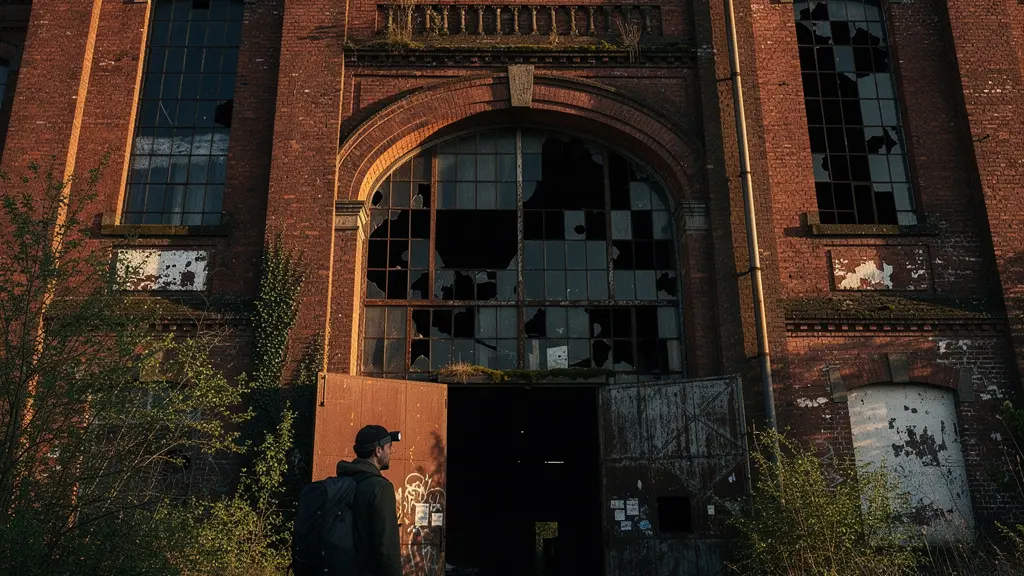
The belief that urban exploration is safe because trespass is a civil matter is a dangerous oversimplification. The true legal and physical risks arise from a web of associated criminal offences and hidden site hazards.
- Simple trespass is not a criminal offence, but it can lead to civil action, including costly injunctions against ‘persons unknown’.
- The real danger is committing secondary crimes like Criminal Damage (even by breaking a rotten floorboard) or Theft (taking a ‘souvenir’).
- Invisible hazards like structural collapse and asbestos are a far greater threat than security guards, with HSE statistics revealing a stark reality of asbestos-related fatalities.
Recommendation: Shift your mindset from simply ‘not getting caught’ to conducting a thorough legal and safety risk assessment before ever stepping foot on site. This guide provides that framework.
The allure of urban exploration, or ‘urbex’, is undeniable. It’s a chance to step into a time capsule, to document the beauty of decay, and to see a side of history hidden from public view. For thrill-seekers and photographers alike, the pull of an abandoned asylum or a derelict Victorian mill is a powerful one. The common mantra within the community is that “trespass is a civil matter, not a criminal one,” which often fosters a false sense of security. While technically correct in its simplest form, this statement is the tip of a very large and hazardous iceberg.
As a legal advisor specialising in property law, I must stress that focusing solely on the civil nature of trespass is a critical error. It ignores the far more serious risks that accompany any unauthorised entry onto private land. These risks are not just legal; they are physical, ethical, and can have consequences that extend far beyond being asked to leave by a security guard. The line between a civil wrong and a criminal offence is incredibly thin, and it can be crossed unintentionally through actions that seem harmless at the time. Furthermore, the most significant dangers are often invisible, silent, and potentially lethal.
The purpose of this guide is not to deter exploration but to reframe it. Instead of relying on simplistic mottos, a responsible explorer adopts a framework of risk assessment. This involves understanding the subtle legal tripwires, from aggravated trespass and criminal damage to the increasing use of civil injunctions by property owners. It requires a practical knowledge of identifying structural weaknesses and the life-threatening presence of materials like asbestos. This is not about a set of rules; it’s about building the expertise to make informed decisions that protect your safety, your freedom, and the very heritage you aim to document.
This article will dissect the key areas of risk and provide a clear framework for navigating them. We will move from identifying physical dangers and understanding the real damage of taking ‘souvenirs’ to the practicalities of gearing up correctly and de-escalating confrontations, all through the lens of legal and personal safety.
Summary: A Legal Advisor’s Guide to UK Urban Exploration Risks
- Rotting Floors and Asbestos: How to Spot Invisible Hazards in Derelict Mills?
- Why Taking a Souvenir From an Abandoned Asylum Damages the Community?
- How to Use Satellite Maps to Find Abandoned Sites Without Begging for Coordinates?
- Respirators and Boots: What Gear Is Essential for Asbestos-Ridden Sites?
- Caught on Site: How to De-escalate a Confrontation With Security Guards?
- Privacy Laws in the UK: What Can You Legally Photograph on the Street?
- Pop-Up Parks: Why Temporary Installations Often Have More Impact Than Permanent Ones?
- How Manchester’s Architecture Blends Victorian Red Brick With Modern Glass?
Rotting Floors and Asbestos: How to Spot Invisible Hazards in Derelict Mills?
Before considering any legal implications, the foremost risk in any derelict structure is to your personal safety. These sites are not maintained; they are actively decaying, and their environments can be treacherous. Two of the most pervasive and deadly threats are structural instability and asbestos contamination. A floor that appears solid can conceal rotten joists, and the air you breathe could contain microscopic, carcinogenic fibres. The danger of asbestos is not historical; HSE statistics reveal there were 2,218 mesothelioma deaths in 2023 alone, a direct consequence of past exposure.
To a layperson, these hazards are often invisible. You cannot see the structural weakness of a beam or smell asbestos in the air. This is why a methodical approach to hazard identification is not optional, it’s a prerequisite for survival. The principle is to assume every surface is compromised until proven otherwise and that the air in any pre-2000s building is contaminated. This mindset shifts the focus from capturing the perfect photo to ensuring you can walk out safely.

The image above highlights the friable, cotton-like texture of damaged asbestos insulation, a state where it is most dangerous as fibres are easily released into the air. Spotting this, or other tell-tale signs like damaged pipe lagging, sprayed coatings, or ceiling tiles, is a non-negotiable red flag. Your primary ‘gear’ in this context is knowledge and caution, backed up by appropriate personal protective equipment (PPE), which we will discuss later.
Action Plan: On-Site Hazard Identification
- Visual Inspection: Actively look for damaged ceiling tiles, deteriorating pipe lagging, or flaky sprayed coatings, which are common asbestos-containing materials (ACMs) in buildings constructed before 2000.
- Floor Integrity Test: Before stepping onto any questionable floor, especially on upper levels, tap it firmly with a long, sturdy pole. A hollow, soft, or ‘dull’ sound can indicate underlying rot or structural weakness. Never trust a floor’s surface appearance.
- Atmospheric Awareness: Pay close attention to smells. A sweet or musty odour is a strong indicator of significant mould growth, while sharp chemical smells could point to leftover industrial residue. Both can pose respiratory risks.
- Structural Stress Indicators: Learn to read the building. Look for large, ‘stepped’ cracks in brickwork, noticeable sagging in rooflines, or walls that are visibly bowed. These are signs of extreme structural stress and potential imminent collapse.
- Escape Route Planning: From the moment you enter, always identify and maintain at least two clear and accessible exit paths. Never explore deep into a structure, especially basements, without a clear way out and ensuring adequate ventilation.
Ignoring these preliminary checks is not adventurous; it’s reckless. The legal consequences of trespass pale in comparison to the life-altering health consequences of a fall or asbestos exposure.
Why Taking a Souvenir From an Abandoned Asylum Damages the Community?
The classic urban explorer’s motto is “take nothing but pictures, leave nothing but footprints.” While well-intentioned, it often fails to explain the severe legal and ethical consequences of ignoring this rule. Taking a ‘souvenir’—be it an old bottle, a patient file, or a piece of peeling wallpaper—is not a harmless act of preservation. In the eyes of the law, it is theft. This single action is what can transform a civil trespass issue into a criminal investigation. If you are found on a property without permission and in possession of an item from that property, the legal argument shifts from you being a curious photographer to a potential burglar.
The damage, however, goes far beyond your personal legal risk. It creates a “chain of culpability” that destroys these sites for everyone. When explorers post photos or videos, even without sharing locations, they can inadvertently advertise a site’s vulnerability. If these posts feature items being handled or removed, it signals to less scrupulous individuals that the location is an easy target for looting. This escalation from exploration to criminal stripping is a well-documented phenomenon within the urbex community.
Case Study: How ‘Harmless’ Exploration Leads to Criminal Looting
A member of the prominent UK urban exploration forum, 28DaysLater.co.uk, shared a cautionary tale about their own property. After a group of explorers documented the location in videos, it attracted unwanted attention. The property was subsequently targeted by burglars who systematically stripped it of valuable architectural features and items. This led to three arrests and significant damage, completely ruining the site for any future legitimate historical documentation. The case demonstrates how the seemingly minor act of souvenir-taking by initial explorers can directly precipitate serious property crimes, destroying the very heritage they claimed to appreciate.
This is why the ‘leave no trace’ principle is paramount. It’s a matter of legal self-preservation and a duty to the community and to the history of the site itself. By taking an item, you are not ‘rescuing’ it; you are contributing to a cycle of destruction and increasing the likelihood of landowners taking more aggressive measures, such as immediate demolition or pursuing harsh legal action against all explorers, responsible or not.
Ultimately, true preservation lies in photographic and historical documentation, not in the physical removal of artifacts. Each item left in its place maintains the integrity of the scene for the next person to document and for the historical record.
How to Use Satellite Maps to Find Abandoned Sites Without Begging for Coordinates?
A core tenet of the responsible urbex community is the strict policy against sharing locations or “coordinates.” This practice is in place to protect fragile sites from vandalism, looting, and over-exposure. Therefore, the art of finding locations—often termed “digital archaeology”—is a fundamental skill for any serious explorer. It relies on research, patience, and a keen eye for the visual signatures of decay, using publicly available tools like Google Maps and historical records.
The process is more akin to detective work than a simple search. It begins with identifying a region of interest, perhaps known for a specific industry like textiles or mining, and then meticulously scanning satellite imagery for tell-tale signs. This method is not just about finding a building; it’s about understanding its history and context before you even consider a visit. This research phase is also a critical part of your legal and safety assessment, as it can reveal information about ownership, security, and the building’s structural history.
Effective digital archaeology involves looking for anomalies in the landscape. A factory with a completely overgrown car park, a large manor house with sections of collapsed roofing visible from above, or industrial complexes with no vehicle tracks over multiple years are all strong indicators of abandonment. Combining these visual clues with historical data elevates the process from guesswork to targeted research.
- Start by comparing current satellite views with historical imagery available in tools like Google Earth Pro. This time-lapse feature can pinpoint the exact period a building fell into disuse.
- Look for specific visual signatures of dereliction: heavily overgrown vegetation reclaiming parking lots and pathways, caved-in roofs, and a consistent absence of vehicles or activity over several years.
- Cross-reference potential sites with local council planning portals. Search for past planning applications, demolition notices, or heritage listings related to the address to confirm its status and history.
– Look for faint “desire paths” visible on satellite imagery. These are small, unofficial trails worn into the ground by previous visitors, often leading from a public road to an access point. – Utilize the historical data in Google Street View. By ‘travelling back in time’ at the roadside, you can often watch a building’s decline over the years, from an active business to a boarded-up shell, which helps verify its abandoned state.
This patient research ensures that when you do find a location, it is through your own merit and with a foundational understanding of what you are about to explore, which is far more rewarding than simply being handed coordinates.
Respirators and Boots: What Gear Is Essential for Asbestos-Ridden Sites?
While the previous sections have focused on identifying risks, this one concerns tangible mitigation. When entering any structure built before the year 2000, the assumption must be that asbestos is present. According to Health and Safety Executive (HSE) estimates, asbestos could be in approximately 310,000 non-domestic premises across the UK. Therefore, your personal protective equipment (PPE) is not an accessory; it is a critical life-preservation system. The right gear is the only thing standing between you and incurable latent health conditions.
The most crucial piece of equipment is a respirator. A simple paper dust mask or surgical mask is utterly insufficient against asbestos fibres. You need a respirator rated P3 (or FFP3 in disposable form). This rating ensures it can filter the microscopic asbestos particles that can lodge in your lungs. Equally important are sturdy, hard-soled boots, preferably with steel toe caps and midsole protection. Derelict sites are littered with sharp objects, exposed nails, and unstable flooring, and a simple misstep can lead to a serious injury far from help.
The level of PPE required should be directly proportional to the perceived risk of the site. A well-ventilated, modern warehouse may require a lower level of protection than a decaying industrial site known for its use of asbestos insulation. Understanding these tiers of risk is essential for gearing up appropriately.
| Risk Level | Site Type | Essential PPE | Exposure Limit |
|---|---|---|---|
| Level 1 – Low | Well-ventilated warehouses | P2 dust mask, sturdy boots, gloves | Under 0.01 f/ml |
| Level 2 – Medium | Industrial sites with suspected asbestos | P3/FFP3 respirator, disposable coveralls, safety boots | 0.01-0.1 f/ml |
| Level 3 – High | Known asbestos contamination | Full-face respirator, Type 5/6 coveralls, decontamination kit | Above 0.1 f/ml |
The data in this table, adapted from professional safety standards, illustrates a clear escalation in protective measures. For most urban explorers entering older industrial or institutional buildings, a Level 2 approach should be the minimum standard. This includes a fitted P3/FFP3 respirator, disposable coveralls to prevent fibres from contaminating your clothes and car, and robust safety boots. Investing in this gear is a direct investment in your long-term health.
Remember, the goal is not only to capture the history within these walls but also to ensure you have a healthy future to share those images.
Caught on Site: How to De-escalate a Confrontation With Security Guards?
Despite all precautions, the possibility of being discovered by landowners, caretakers, or security is a real one. This moment is often the one that explorers fear most, and how you handle it determines whether it ends with a simple request to leave or escalates into a police matter. As a legal advisor, my primary advice is this: your goal is de-escalation and immediate compliance, not to argue the finer points of civil trespass law on-site.
Security guards are often just doing their job, which is to secure the property. They are likely to be wary and may assume the worst. Your immediate actions should be geared towards demonstrating that you are not a threat. Arguing, running, or being evasive will only confirm their suspicions that you are there for nefarious purposes like theft or vandalism. Conversely, a calm, polite, and cooperative demeanour can defuse the situation instantly. Remember, they hold the power in this situation; your aim is to leave with the minimum possible fuss.
The key is to proactively address their likely concerns. Show that you are a photographer, that you have not damaged anything, and that you will leave immediately without argument. This approach respects their authority and responsibility while clearly communicating your non-malicious intent. The following protocol provides a clear, step-by-step guide to managing such an encounter.
- Immediate Verbal Response: The moment you are confronted, adopt a polite and apologetic tone. Say something like, “You’re absolutely right, I apologise. I am a photographer documenting the architecture. I will leave immediately.”
- Non-Threatening Body Language: Keep your hands visible and empty. Make your camera prominent, as it is a tool of your trade and explains your presence. Maintain an open, non-confrontational posture. Avoid sudden movements.
- Address Concerns Proactively: State clearly and calmly: “I want to assure you, I haven’t touched or damaged anything, and I haven’t taken anything. I am leaving right now.” This preempts their primary concerns about criminal activity.
- Protocol for Police Encounters: If the police are called, remain calm and compliant. Provide your identification if requested. Explain your purpose (photographic documentation) and show them you are not carrying any tools for forced entry (crowbars, bolt cutters, etc.).
- Never Argue Legality: This is the most critical point. Do not try to ‘educate’ security or police on trespass law. Comply with their instructions first. You can address any legal matters later through the proper channels, not during a tense on-site confrontation.
Your conduct in these few minutes is paramount. A respectful exit ensures you don’t burn bridges and helps maintain a better reputation for the exploration community as a whole.
Privacy Laws in the UK: What Can You Legally Photograph on the Street?
While the act of trespass is the primary legal hurdle for urban explorers, the act of photography itself introduces another layer of legal complexity, particularly concerning privacy. The general rule in the UK is that you can photograph anything you want when you are in a public place. This includes buildings, vehicles, and people. However, this right diminishes significantly when you enter private property, even if that property is derelict. Furthermore, the methods used to capture images can also constitute a form of trespass.
The core legal issue is the expectation of privacy. While a landowner has no expectation of privacy for the exterior of their building as viewed from a public road, the interior is a different matter. Once you cross the boundary onto private land, your right to photograph is no longer absolute. More importantly, recent legal developments have shown that courts are willing to take a firm stance against intrusive methods of exploration and documentation, extending the concept of trespass beyond mere physical entry.
This has been reinforced by the increasing use of civil injunctions by landowners to protect their properties from explorers. These court orders can be sought against “persons unknown,” making it a powerful preventative tool. Breaking such an injunction is contempt of court, a far more serious matter than simple trespass. While Office for National Statistics reports show there are approximately 800 arrests annually for criminal trespass (a specific offence usually related to railways or military sites), the greater and growing risk for most explorers is being targeted by these wide-reaching civil injunctions.
Legal Precedent: The Supreme Court on ‘Persons Unknown’ Injunctions
In a significant case for the urbex community, the Supreme Court in February 2024 confirmed that landowners can obtain injunctions against “persons unknown” to prevent trespass. This legal tool was successfully used by the owners of a Manchester Catholic Seminary against explorers. Crucially, the case established that even using drones to fly over and capture footage of the private property constituted an act of trespass. This precedent, detailed in an analysis by legal firm Higgs LLP, confirms that your liability is not limited to setting foot on the ground; aerial photography over private land for exploration purposes is also legally actionable.
The key takeaway is that your camera does not grant you legal immunity. On private land, your activities are subject to the landowner’s rights, and the courts are increasingly willing to uphold those rights through powerful legal instruments.
Pop-Up Parks: Why Temporary Installations Often Have More Impact Than Permanent Ones?
While the focus of this guide is on the risks of urban exploration, it’s important to understand the motivation behind it. For many, it’s not just about the thrill; it’s about art, history, and preservation through documentation. Abandoned sites are, in effect, temporary, unofficial installations of art and decay. Their beauty is ephemeral, existing only for a finite window between the time a building is closed and the day it is inevitably demolished or redeveloped. This transient nature creates a sense of urgency and cultural significance.
This concept of “transient beauty” is what imbues these spaces with such power. Unlike a permanent museum exhibit, a derelict dance hall or a forgotten factory is a living, evolving piece of social history. The peeling paint, the items left behind, the way nature reclaims the structure—it all tells a story that is unique to that moment in time. The photographers and documentarians who enter these spaces are acting as unofficial archivists, capturing a fleeting chapter of local heritage that would otherwise be lost forever.
This race against time is a powerful driving force for the community. The knowledge that a site could be gone tomorrow lends a profound sense of purpose to the act of documenting it today. This is not an excuse for breaking the law, but it provides essential context for why these places are considered so valuable by those who explore them.
Case Study: The Ephemeral Archive of Edendork Dance Hall
The Edendork Dance Hall in County Tyrone, Ireland, was a vibrant hub of the showband era before it closed its doors over 30 years ago. For decades, it stood in a state of picturesque decay, becoming a pilgrimage site for urban explorers and photographers from across the UK and Ireland. They documented its slow collapse, from the fading glamour of its ballroom to the final stages of structural failure. In 2024, the hall was demolished. The extensive photographic archive created by the urbex community is now the only remaining record of its final years. The temporary, finite nature of the site created a powerful incentive for documentation, resulting in a rich, crowd-sourced history of its decline.
This perspective highlights the cultural tension at the heart of urban exploration: the conflict between the preservation of private property rights and the preservation of undocumented social history.
Key Takeaways
- Your greatest risks are physical (asbestos, collapse) and the potential for secondary criminal charges (theft, damage), not simple trespass.
- Assume any UK building constructed before 2000 contains asbestos and use, at minimum, an FFP3/P3 respirator. Your health is non-negotiable.
- If confronted, your goal is immediate, polite compliance. Do not argue the law. De-escalate and leave. This is your best legal protection.
How Manchester’s Architecture Blends Victorian Red Brick With Modern Glass?
The principles of responsible urban exploration—risk assessment, legal awareness, and ethical documentation—come together in the act of photography itself. For explorers in cities like Manchester, a hub of industrial heritage, the goal is often to capture the poignant juxtaposition of past and present. The city’s landscape is a canvas where the deep red of Victorian brickwork, a testament to its industrial might, stands in stark contrast to the reflective blue of modern glass towers. Documenting this architectural dialogue is a specialised form of photography that requires both technical skill and historical appreciation.
From inside a derelict mill, a broken window becomes a frame, showcasing the new city that has grown up around the decaying giant. The challenge for the photographer is to do more than just take a snapshot of decay; it is to create an image that tells a story about this transition. This involves paying attention to light, composition, and the specific architectural details that define the Victorian era before they are lost forever. It is an act of creating a permanent record of a temporary state.
This form of documentation serves as a powerful argument for the cultural value of exploration. By highlighting the beauty and historical importance of these old structures against the backdrop of modern development, these photographs can raise public awareness and even contribute to conversations about heritage and preservation. To do this effectively requires a methodical approach.
- Frame Juxtapositions: Actively compose shots that place decaying Victorian brickwork in the foreground against modern glass and steel towers visible through broken windows or gaps in the structure.
- Document Specifics: Before they are lost to demolition, photograph unique Victorian features: ornate cast-iron columns, terracotta details, specific brick bonding patterns, and manufacturer stamps on ironwork.
- Use Strategic Lighting: Shoot during the “golden hour” (sunrise or sunset) to use the warm light to enhance the rich tones of the red brick, creating a dramatic contrast with the cool, blue reflections from modern glass buildings.
- Systematic Archiving: Go beyond artistic shots. Methodically photograph small but significant details like maker’s marks, architectural flourishes, and any visible construction dates that provide historical context.
– Create Diptychs or Series: Plan to create pairs of images (diptychs) that show the same viewpoint from inside an abandoned mill looking out at its modern replacement, or a series that tracks the progression of decay.
To put these principles into practice, the next logical step is to develop your own risk assessment checklist for any potential site, covering legal, safety, and ethical considerations before you ever leave home. This preparation is the hallmark of a true explorer.