
Effective heritage preservation hinges on managing visitor impact load, not just visitor numbers.
- Timed ticketing is only a partial solution; true mitigation involves data-driven analysis of visitor behavior and rethinking site aesthetics for resilience.
- Commercial activities like events must be governed by strict, conservation-led protocols to prevent irreversible damage to the archaeological fabric.
Recommendation: Begin by conducting a site-specific ‘impact load’ audit to identify your highest-risk areas and visitor patterns.
The sound is unmistakable. The soft, persistent shuffle of thousands of feet across ancient flagstones. For a heritage site manager, this isn’t the sound of success; it’s the sound of erosion. We are caught in a paradox: the very people who come to appreciate history are, by their sheer volume, contributing to its slow-motion destruction. The common discourse revolves around “overtourism,” a vague term that often leads to simplistic solutions like raising prices or blaming visitors for their behavior. We are told to limit numbers, but our budgets often depend on maximizing them.
This approach misses the core operational reality. The problem isn’t just the number of visitors; it’s the unmanaged impact load they exert on the physical fabric of our sites. This includes footfall concentration, dwell time in sensitive areas, and the cumulative effect of seemingly minor interactions. We are not just guardians of a static past; we are managers of a dynamic environment under constant stress. The key to balancing preservation and revenue isn’t about building higher walls, but about implementing smarter, data-driven systems to manage visitor flow and behavior.
But what if the true solution lies in shifting our perspective? Instead of viewing visitors as a monolithic threat, we can begin to see their presence as a set of quantifiable variables to be managed. This guide moves beyond the platitudes to offer concrete, operational strategies. We will explore how to use data to understand visitor dynamics, redesign commercial activities with preservation as the primary goal, and even challenge long-held aesthetic beliefs to build more resilient sites. This is a framework for managing the physical integrity of heritage sites in an age of mass travel.
This article provides a detailed framework for site managers, moving from high-level strategies to specific, actionable tactics. The following sections break down the critical levers you can pull to protect your site while ensuring its long-term viability.
Summary: A Manager’s Framework for Mitigating Physical Erosion at Heritage Sites
- Timed Ticketing: Does It Really Reduce Wear and Tear on Historic Floors?
- English Heritage or National Trust: Which Membership Offers Better Value for Families?
- Free Labor: Can Heritage Sites Survive Without the Volunteer Army?
- Manicured Lawns vs Wild Meadows: Changing the Aesthetic of History?
- Weddings in Ruins: How to Host Events Without Damaging the Archaeology?
- Friday Late Openings: Are They Really Quieter Than Tuesday Mornings?
- Why Taking a Souvenir From an Abandoned Asylum Damages the Community?
- How Archaeologists Separate Roman Ruins From Victorian Foundations in Cities?
Timed Ticketing: Does It Really Reduce Wear and Tear on Historic Floors?
Timed ticketing is often presented as the silver bullet for overtourism. By controlling the rate of entry, we can theoretically smooth out peak-hour visitor loads and prevent the dangerous crowding that damages both the site and the visitor experience. From an operational standpoint, it’s an effective tool for managing capacity and improving visitor flow at the gate. It allows for predictable staffing levels and can create a more pleasant, less-congested atmosphere. For a site manager, predictable footfall is a significant operational advantage.
However, its effectiveness in reducing physical wear and tear is more nuanced. While it caps the total number of people on-site at any given time, it doesn’t control where those people go. Visitors naturally gravitate towards the most iconic features, creating concentrated pathways of intense erosion. The issue isn’t just the total footfall, but the path concentration. For instance, research from sustainable tourism organizations shows that heavy, concentrated foot traffic at sites like Angkor Wat leads to severe erosion of ancient stone floors and steps, with further damage to carvings from touching.
A timed ticket gets a visitor through the door, but it doesn’t dictate their route or dwell time. They may still spend 90% of their visit in 10% of the site’s area. Therefore, timed ticketing is a powerful first step in managing impact load, but it is not a complete solution. It must be paired with in-site strategies, such as designated pathways, rotating room closures, and interpretative displays that draw visitors into less-frequented areas. It manages the *rate of entry*, but the real work of managing *impact distribution* begins once visitors are inside.
English Heritage or National Trust: Which Membership Offers Better Value for Families?
The question of which organization offers better value is a common one for visitors, but for site managers, it reveals a fundamental divergence in conservation philosophy. Understanding these different approaches is crucial, as the model an organization follows dictates its entire operational strategy, from visitor management to revenue generation. The choice isn’t just about what’s best for a family day out; it’s about defining what “preservation” truly means for a specific site.
English Heritage typically focuses on the preservation and presentation of historic buildings and monuments, often in a state of ruin. The philosophy is one of stabilization—arresting decay and presenting the site as an archaeological snapshot. The visitor is often an observer of a moment frozen in time. In contrast, the National Trust frequently manages “living heritage,” including landscapes, working estates, and furnished houses. Their approach involves active use and a blend of nature and culture, where the property continues to evolve.
This philosophical split has direct consequences for managing physical erosion. An English Heritage site might prioritize hard-wearing, non-invasive pathways around fragile ruins, with a focus on archaeological integrity. The National Trust might need to balance the preservation of a historic interior with the wear and tear from thousands of visitors walking through furnished rooms. The comparative table below outlines these distinct operational mindsets, which is a useful framework for any site manager defining their own conservation strategy.
| Aspect | English Heritage | National Trust |
|---|---|---|
| Primary Focus | Historic buildings and monuments | Buildings, landscapes, and nature |
| Conservation Philosophy | Preservation and presentation of ruins | Living heritage with active use |
| Visitor Management | Timed ticketing at major sites | Capacity limits and pre-booking |
| Educational Programs | Archaeological workshops | Nature and heritage combined |
Ultimately, there is no single “better” model. The right approach depends on the site’s specific nature—its physical fabric, its history, and its intended purpose. A manager of a ruined abbey has different priorities than one managing a stately home. Analyzing these models helps us clarify our own objectives: are we preserving a ruin for study, or are we managing a living space for experience? The answer determines our entire visitor management plan.
Free Labor: Can Heritage Sites Survive Without the Volunteer Army?
For many heritage sites operating on thin margins, the volunteer army seems like the bedrock of their existence. From guiding tours to tending gardens and assisting with conservation cleaning, their contribution is immense and often indispensable. Without this “free labor,” many smaller sites would simply cease to function. The value they bring in terms of passion, community engagement, and sheer manpower is undeniable. However, from a site manager’s perspective, relying on volunteers introduces a complex set of risks and management challenges that directly impact the physical preservation of the site.
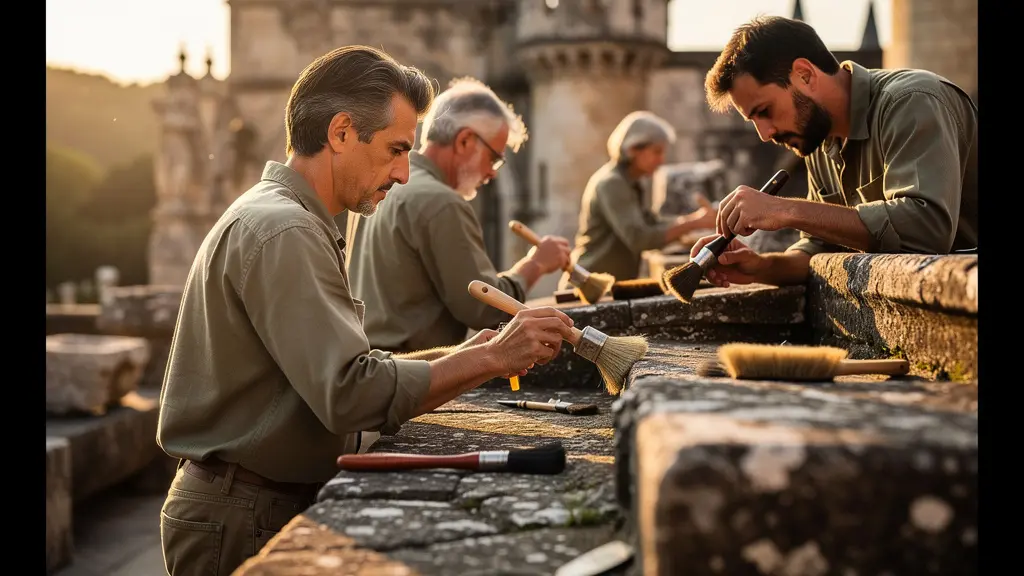
The core issue is that goodwill does not equal expertise. An untrained but enthusiastic volunteer can inadvertently cause more damage than a dozen careless tourists. Using the wrong cleaning agent on stone, brushing a fragile textile too vigorously, or improperly handling an artifact can lead to irreversible harm. This is where the concept of diminishing returns becomes critical. As economic analysis reveals that over-reliance on unmanaged resources can increase conservation costs, the same principle applies to volunteer labor. Without a robust framework for training, supervision, and task delineation, the risk of damage can outweigh the benefit of free work.
Effective volunteer management transforms “free labor” into a structured, valuable asset. This requires a significant upfront investment in creating clear roles, providing comprehensive training on conservation ethics and techniques, and ensuring constant supervision by professional staff. Volunteers should support, not replace, the work of trained conservators. Their roles should be carefully designed to minimize contact with the most fragile elements of the site. A well-managed volunteer program is a powerful force for preservation and community building; a poorly managed one is a liability waiting to happen.
Manicured Lawns vs Wild Meadows: Changing the Aesthetic of History?
The pristine, manicured lawn is a powerful aesthetic expectation at many historic estates and castles. It evokes a sense of order, grandeur, and human control over nature. For a site manager, however, this green carpet represents a significant and continuous drain on resources—water, fuel for mowing, and staff hours. More importantly, it is an ecological desert that can be surprisingly fragile under the pressure of high footfall. Compacted soil, worn-out turf, and mud patches are the familiar battlegrounds in the fight to maintain this artificial ideal.
This is where we must consider a strategic “aesthetic recalibration.” Shifting from manicured lawns to managed wild meadows is not an act of neglect; it is a sophisticated conservation strategy. Wild meadows are more resilient to foot traffic, with deep-rooted native grasses and plants that recover more quickly. They drastically reduce maintenance costs and resource consumption. Furthermore, they enhance biodiversity, creating a richer ecological habitat that can itself become part of the visitor experience.
This shift directly addresses the site’s carrying capacity—its finite ability to absorb visitor activity without irreversible damage. While large crowds cause physical damage through foot traffic that erodes pathways and pollutes ecosystems, a more robust landscape can better absorb that impact. The challenge is not horticultural; it’s psychological. It requires managing visitor expectations and educating them that a wild meadow is not a sign of a site being “let go,” but a deliberate choice for long-term sustainability. It’s about presenting a different, more authentic kind of beauty—one that is in harmony with both history and ecology.
Weddings in Ruins: How to Host Events Without Damaging the Archaeology?
Commercial events, particularly weddings, are a vital revenue stream for many heritage sites. They offer a way to monetize the unique atmosphere and beauty of the location, directly funding the conservation work we need to do. However, hosting a hundred celebrating guests on a two-thousand-year-old mosaic floor is an exercise in high-stakes risk management. The potential for damage from stiletto heels, spilled wine, heavy equipment, and vibrations from music is immense. The goal is what can be termed conservation-led commerce: designing events where preservation is the primary, non-negotiable constraint.
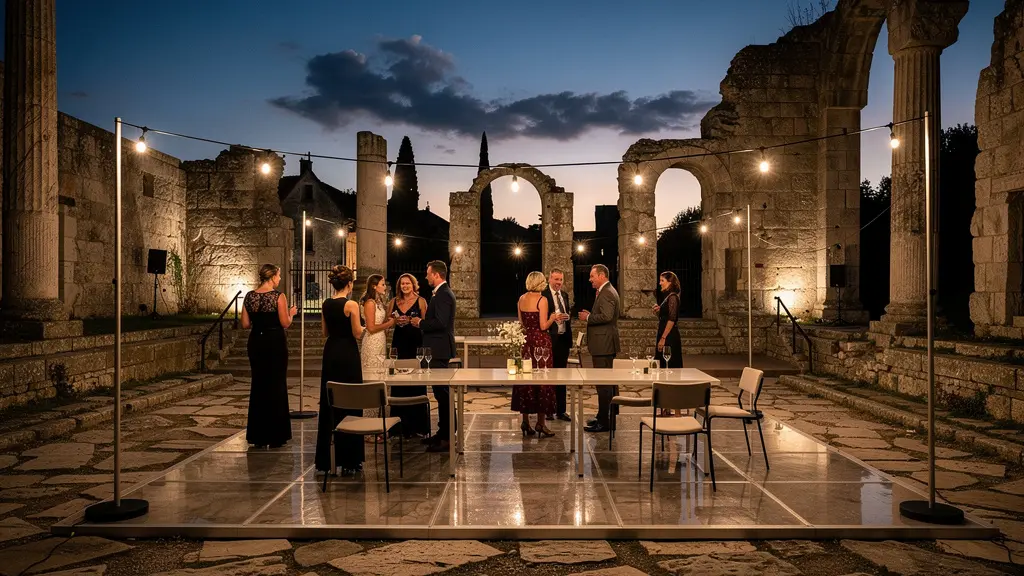
This requires a proactive, not reactive, approach. Instead of simply hoping for the best, a site manager must implement a rigid set of protocols that all clients and vendors must adhere to. This includes specifying approved areas for guest access, mandating temporary protective flooring in high-traffic zones, and setting strict limits on the type and volume of sound equipment. It also means building a network of “heritage-aware” suppliers who understand the unique constraints of working in a sensitive environment. The revenue from one event can be instantly negated by the cost of repairing a single act of carelessness.
The key is to integrate preservation costs and rules directly into the commercial offering. A mandatory “preservation levy” can be added to every event fee, transparently earmarking funds for conservation. Offering alternative, low-impact experiences, like digital projections or intimate gatherings in less fragile areas, can also generate revenue without compromising the site’s integrity. By establishing a clear and uncompromising framework, we can ensure that events serve our conservation mission, rather than undermining it.
Your Pre-Event Archaeological Protection Checklist
- Restrict high-heel footwear on ancient floors to prevent micro-fractures and indentations.
- Install temporary, non-abrasive protective flooring for all high-traffic event areas, from walkways to dance floors.
- Limit the placement and volume of acoustic equipment to prevent structural damage from low-frequency vibrations.
- Require all clients to use certified heritage-aware vendors who understand and agree to site protection protocols.
- Implement a mandatory preservation levy as a percentage of all event fees to directly fund conservation work.
Friday Late Openings: Are They Really Quieter Than Tuesday Mornings?
The traditional wisdom for avoiding crowds is to visit on a weekday morning. For a site manager, however, the picture is far more complex than simple footfall numbers. A “quiet” Tuesday morning filled with energetic school groups can exert a different, and sometimes more damaging, type of impact load than a “busy” Friday evening attended by adults. Understanding visitor flow dynamics requires looking beyond the raw numbers to analyze visitor demographics, behavior, and dwell time.
The reality of visitor numbers often defies expectations and official recommendations. For example, UNESCO monitoring data reveals that while a site like Machu Picchu has a recommended daily limit, visitation during peak season can regularly reach double that number. This highlights the pressure to accommodate demand. Late openings are one strategy to spread this load, but they introduce an entirely new set of risk factors. An adult visitor on a Friday night is less likely to run and touch everything, but more likely to lean against a fragile wall while holding a glass of wine. The security and lighting challenges are also completely different.
A data-driven approach is essential. By analyzing visitor behavior during different time slots, we can identify specific risks and implement targeted mitigations. The following table provides a simplified impact analysis, comparing the typical risks associated with different visitor cohorts. This is the kind of granular detail a manager needs to make informed decisions about opening hours and staffing.
| Factor | Tuesday Mornings | Friday Late Openings |
|---|---|---|
| Visitor Demographics | School groups, elderly tourists | Adults, couples, after-work visitors |
| Primary Risks | High-energy touching, running | Drink spills, leaning on walls |
| Lighting Impact | Natural light only | Artificial lighting heat/UV damage |
| Security Challenges | Standard monitoring | Low-light surveillance difficulties |
| Dwell Time | Constant movement, broad distribution | Longer stays in specific areas |
The conclusion is clear: there is no universally “quieter” time. Each time slot has a unique risk profile. A successful site manager doesn’t just count heads; they analyze behavior. By understanding the different types of impact load associated with each demographic, we can tailor our management strategies—from the placement of security staff to the type of flooring protection—to effectively mitigate damage around the clock.
Why Taking a Souvenir From an Abandoned Asylum Damages the Community?
The impulse to take a small souvenir—a piece of peeling paint, a doorknob, a fragment of tile—from a historic site can seem harmless. For abandoned or derelict locations like old asylums or factories, it might even feel like “rescuing” a piece of forgotten history. This perception is profoundly damaging. From a preservation perspective, every object removed is a word torn from a historical document. It permanently corrupts the archaeological record and makes it impossible for future visitors, researchers, or the local community to understand the site as it was.
This act of removal privatizes public history. A single object in a private collection is stripped of its context, its story lost. The cumulative effect of thousands of such small thefts is the slow erasure of a place’s identity. As one research team notes, this diminishes the experience for everyone who follows.
Taking an object makes it impossible for future researchers to understand the site in its full context. Taking a souvenir for a private collection privatizes a piece of public history, diminishing the collective experience for all future visitors.
– Heritage Conservation Research Team, The Ethics of Urban Exploration and Heritage Preservation
As site managers, our role is to reframe this narrative. We must educate visitors that the most valuable way to “take” a piece of the site with them is through non-extractive means. High-quality photography, sketching, or contributing to digital archives are powerful alternatives. We can actively encourage this by creating designated “photo points” or promoting hashtags for sharing images. By championing digital documentation over physical removal, we empower visitors to become partners in preservation. They get their souvenir, and the site’s integrity remains intact for the community and for posterity.
Key takeaways
- Effective site management prioritizes measuring and mitigating ‘impact load’ over simply counting visitor numbers.
- Revenue generation through commercial events must be governed by ‘conservation-led’ protocols, with preservation as the primary constraint.
- Challenging visitor aesthetic expectations, such as preferring wild meadows to manicured lawns, is a valid strategy for building ecological and physical resilience.
How Archaeologists Separate Roman Ruins From Victorian Foundations in Cities?
In historically dense urban environments, the ground beneath our feet is a palimpsest. A single site can contain Roman walls, a medieval cellar, and Victorian plumbing, all layered on top of one another. The question of how to preserve this complex record is one of the greatest challenges in heritage management. Often, tourism and commercial development create pressure to showcase the most “marketable” layer—typically the most ancient, like Roman ruins—at the expense of everything that came after.
This is where the concept of a site’s “cumulative biography” becomes essential. This approach, gaining traction among modern archaeologists and conservators, argues that a site’s value lies in its entire history of use and adaptation. A Victorian factory built on a Roman foundation isn’t a contamination of the “pure” history; it is a vital chapter in the site’s ongoing story. To privilege one era over another is to tear pages from the book. The manager’s role shifts from uncovering a single past to curating the story of an evolving place.
Case Study: Venice’s Multi-Layered Preservation Challenge
Venice is a prime example of managing a cumulative biography under extreme pressure. The city faces a compound threat from rising sea levels (a modern problem), geological sinking (a long-term issue), and the intense wear-and-tear from millions of annual visitors. The city’s response demonstrates a multi-layered approach: the MOSE project’s massive sea barriers tackle the environmental threat, while the 2021 ban on giant cruise ships addressed a major source of overtourism-related damage. This shows the complex balancing act between preserving multiple historical layers, accommodating tourism, and integrating modern infrastructure, all necessary to keep the city’s biography alive.
Modern archaeological techniques allow for this more nuanced understanding. Non-invasive methods like ground-penetrating radar can map subterranean layers without excavation. Chemical analysis of mortar can distinguish between different construction periods. This data allows managers to make informed decisions about what to expose, what to protect, and how to interpret the site’s full, complex story for the public. Our job is not to create a historically sterile theme park of one chosen era, but to preserve the rich, messy, and fascinating biography of the site for future generations to read.
By shifting from a mindset of visitor restriction to one of active impact management, you can begin to implement these strategies and build a more resilient, sustainable future for the heritage in your care. The first step is to start gathering the right data to understand your site’s unique pressures.
Frequently Asked Questions on How Mass Tourism Erodes the Physical Fabric of Heritage Sites?
How do archaeologists date different historical layers?
Modern techniques include chemical analysis of mortar to identify unique ‘recipes’ from different eras, optically stimulated luminescence (OSL) to date when brick was last exposed to light, and ground-penetrating radar (GPR) for non-invasive investigation.
Who decides which historical layer is more valuable to preserve?
This involves complex ethical choices where archaeologists, heritage committees, and local communities must balance the significance of different periods. Tourism often incentivizes preserving the most ‘spectacular’ layers, potentially sacrificing others.
What is the ‘cumulative biography’ approach to heritage sites?
Rather than isolating one historical period, this approach views Victorian modifications to Roman ruins as vital chapters in the site’s story, presenting the complete palimpsest of human history rather than privileging a single era.