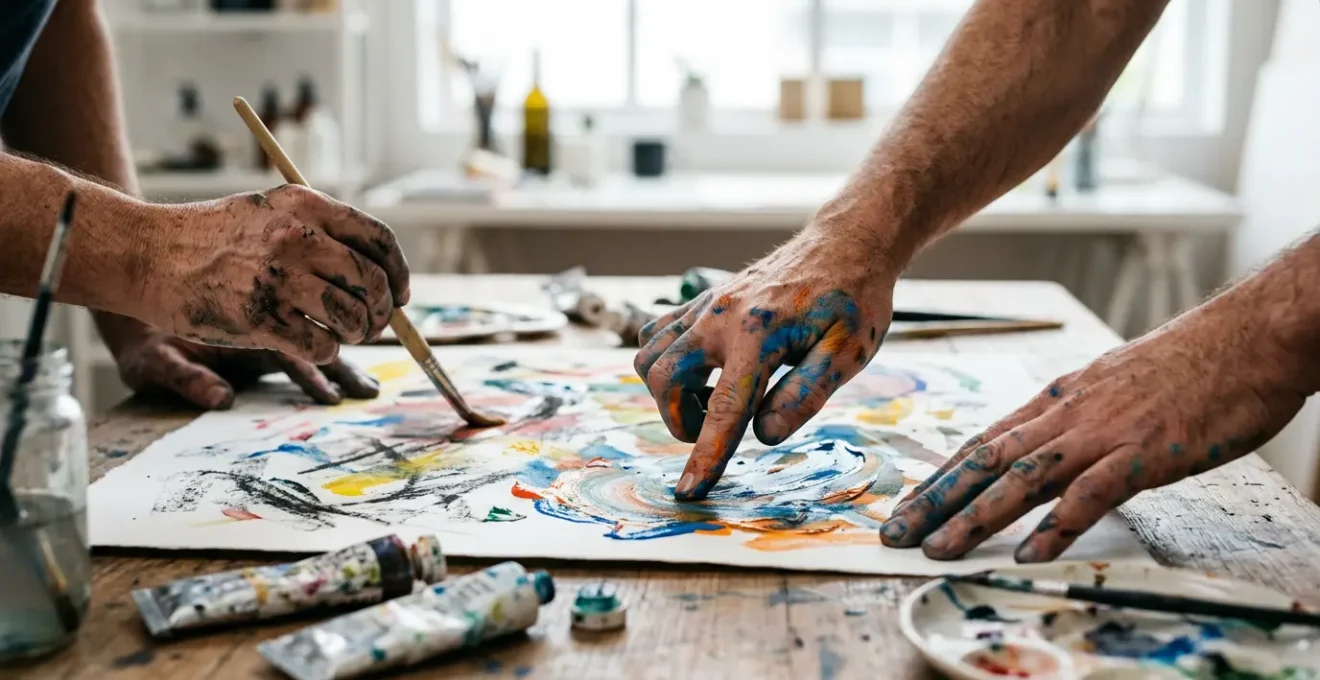
Contrary to popular belief, the greatest mental health benefits of art don’t come from appreciating a masterpiece, but from the messy process of making your own “bad” art.
- Engaging in creative acts, regardless of skill, is a powerful neurological workout that actively reduces stress and builds cognitive resilience.
- The focus on process over product silences the brain’s self-critical Default Mode Network (DMN), allowing for genuine expression and emotional release.
Recommendation: Embrace low-stakes, sensory-rich activities like doodling or pottery not to create a product, but to give your brain the restorative workout it needs.
There’s a common story many of us tell ourselves: “I’m just not the creative type.” We admire art in museums, scroll through beautiful designs online, and conclude that creation is a gift reserved for the talented few. For the rest of us, the path to stress relief seems to lie in consumption, not creation. We’re told to go for a walk, listen to music, or look at something beautiful. The prevailing wisdom suggests that simply being a spectator of beauty is enough to calm a frayed mind. This approach positions art as a passive experience—a beautiful vista to be observed from a safe distance.
But what if this perspective misses the most potent benefit art has to offer? What if the true antidote to burnout and anxiety isn’t found in silently viewing a perfect painting, but in the clumsy, imperfect, and joyful act of making something yourself? The fear of the blank page or the lump of clay often stems from the pressure to create something “good”—a product worthy of external validation. This article challenges that very notion. We will explore the powerful, science-backed reality that the neurological and psychological rewards of art come from the *process*, not the final product. It’s in the doing, the experimenting, and even the “failing” that our brains find relief and build resilience.
This guide will walk you through the mechanisms that make active, imperfect art-making a superior tool for mental wellness. We’ll examine how activities like pottery and group singing are being prescribed by doctors, how to overcome the fear of starting, and why even your “bad” art is profoundly important for your brain.
Summary: The Power of Process: Why Making Art Rewires Your Brain for Calm
- Social Prescribing: How Doctors are Using Pottery Classes to Treat Anxiety?
- The Sketchbook Fear: How to Start Drawing Without Judging Every Line?
- Community Choirs vs Shower Singing: Why Doing It Together Boosts Serotonin?
- Beyond Night School: Where to Find High-Quality Creative Workshops for Adults?
- The 15-Minute Rule: How to Fit Creativity Into a Burned-Out Schedule?
- When Does Expressionism Become Therapy and Stop Being Art for the Market?
- When Experimentation Fails: Can Bad Art Still Be Important?
- How to Access Pure Expressionism to Overcome Creative Block?
Social Prescribing: How Doctors Are Using Pottery Classes to Treat Anxiety?
The idea of making art as a health intervention is moving from a wellness trend to a recognized clinical strategy. A growing movement known as social prescribing sees healthcare professionals referring patients to non-clinical, community-based activities to improve their mental and physical health. Instead of another pill, a doctor might prescribe a pottery course, a gardening club, or a community choir. This approach acknowledges that health is deeply intertwined with social connection and meaningful activity, not just the absence of disease.
The evidence backing this is compelling. For instance, an extensive 2025 study analyzing UK nationwide data on social prescribing found it leads to tangible improvements, including a 3.31-point increase in mental wellbeing and a 1.57-point decrease in anxiety symptoms among nearly 20,000 participants. Activities like pottery are particularly effective because they involve haptic feedback—the direct, sensory engagement of touch. The feeling of cool, wet clay yielding under your fingers is a powerful grounding mechanism that pulls you into the present moment.
This sensory engagement acts as a form of mindfulness, quieting the ruminating mind by focusing its attention on the physical task at hand. It’s a direct, non-verbal way to regulate the nervous system. The focus shifts from anxious thoughts about the future to the immediate experience of shaping and creating. This is the core of the therapeutic benefit: it’s not about making a perfect vase, but about the restorative neurological workout that happens during the process.
The Sketchbook Fear: How to Start Drawing Without Judging Every Line?
For many, the most significant barrier to creating art is the “sketchbook fear”—the paralysing dread of a blank page coupled with an overactive inner critic that judges every mark. We believe that a drawing must look like “something” and that every line must be confident and correct. This product-oriented mindset turns a potentially joyful activity into a performance, triggering anxiety rather than relieving it. To overcome this, we must reframe drawing not as an act of representation, but as a simple motor-sensory exercise.
At its core, drawing is a physical process of eye-hand coordination. It’s about your brain telling your hand to move, and your eyes tracking that movement. It’s a neurological workout, not a test of talent. Research into the mechanics of drawing highlights this intricate dance. As noted in a study on eye-hand interactions, the eye and pen are tightly coupled, with the gaze leading the hand by a fraction of a second. This is a complex feedback loop happening in real-time. Thinking about drawing in these mechanical terms helps to lower the stakes. You are not “failing at art”; you are simply practicing a coordination skill, like learning to ride a bike.
To start, give yourself permission to make “bad” drawings. Try these exercises to silence your inner critic:
- Contour Drawing: Pick an object and draw its outline without looking at your paper. The goal is to train your eye to see, not to create a pretty picture.
- Timed Sketches: Set a timer for 60 seconds and draw anything in front of you as quickly as possible. The time constraint forces you to abandon perfectionism.
- Use Your Non-Dominant Hand: This immediately removes any expectation of a polished result and connects you with a more playful, experimental part of your brain.
The goal is to accumulate mileage, not masterpieces. Every line, no matter how wobbly, is a successful repetition in your brain’s neurological gym.
Community Choirs vs Shower Singing: Why Doing It Together Boosts Serotonin?
Singing alone in the shower feels good, and science confirms it: singing, in general, is known to reduce levels of cortisol, the stress hormone. However, something uniquely powerful happens when we sing with other people. The benefits are amplified, moving beyond simple stress reduction into the realm of profound social connection and emotional synchrony. This is why community choirs are such a cornerstone of social prescribing programs—the collective act of creating harmony has a measurable impact on our brain chemistry.
The key difference lies in hormones like oxytocin, often called the “bonding hormone.” While singing alone can make you feel better, research published in Psychology of Music reveals that only group singing leads to significant increases in oxytocin. This neurochemical surge fosters feelings of trust, empathy, and connectedness with those around you. It’s the biological mechanism behind the feeling of being part of something larger than yourself. This experience is further deepened by a phenomenon known as behavioral synchrony.
As researchers from Nature’s *Scientific Reports* explain, this synchrony is not just psychological but physiological. They observe:
When people sing in unison, their heartbeats accelerate and decelerate simultaneously. Synchronized behavior between individuals in a dyadic joint activity increases cooperation, liking and rapport.
– Nature Scientific Reports research team, Study on physiological and behavioral synchrony
In essence, singing together physically attunes individuals to one another, creating a powerful sense of unity and dissolving feelings of isolation. The shared vulnerability of using your voice in a group, combined with the physiological alignment of breath and heartbeat, creates a potent cocktail for mental well-being that solo singing simply cannot replicate.
Beyond Night School: Where to Find High-Quality Creative Workshops for Adults?
Once you’re inspired to start, a new challenge arises: finding the right environment to explore your creativity. Many adult education classes focus on technical mastery and producing a polished “final piece.” While excellent for aspiring professionals, this product-oriented approach can intimidate beginners and reinforce the very anxieties we’re trying to escape. For therapeutic benefits, the goal is to find a workshop that champions process-oriented creativity, where exploration and self-expression are valued more than technical perfection.
The language used in a workshop’s description is often the biggest clue to its philosophy. A class promising to help you “master watercolor techniques” will have a very different atmosphere from one that invites you to “explore color and emotion.” The first is about an external standard of quality; the second is about your internal experience. To find a truly supportive and non-judgmental space, you need to become a savvy consumer, looking for keywords that signal a focus on process and wellness.
To help you distinguish between a pressure-filled class and a nurturing one, use this framework to vet potential workshops. It will help you identify spaces where you can feel safe to experiment, play, and make “bad” art without fear of judgment.
Your Vetting Checklist: Finding a Process-Oriented Workshop
- Look for Process-Oriented Keywords: Seek out descriptions using words like ‘experimentation,’ ‘play,’ ‘discovery,’ ‘exploration,’ ‘self-expression,’ ‘sensory experience,’ or ‘mindfulness.’ These signal a focus on the journey, not the destination.
- Identify Product-Oriented Red Flags: Be cautious of workshops that heavily emphasize ‘mastery,’ ‘perfection,’ ‘technique refinement,’ ‘exhibition-ready,’ or ‘professional standards.’ These can create undue pressure.
- Seek Therapeutic and Wellness Language: Prioritize listings that mention ‘stress management,’ ‘art for wellness,’ ‘creative self-care,’ ‘non-judgmental space,’ or explicitly state ‘all skill levels welcome.’
- Value Community-Focused Indicators: Words like ‘shared vulnerability,’ ‘supportive environment,’ ‘collaborative,’ or ‘building connection’ suggest an emphasis on the collective experience over individual performance.
- Check the Instructor’s Philosophy: If possible, read about the instructor. Do they have a background in art therapy, wellness coaching, or community arts? Their philosophy is key to the workshop’s atmosphere.
The 15-Minute Rule: How to Fit Creativity Into a Burned-Out Schedule?
One of the most common obstacles to starting a creative habit is the feeling of being completely overwhelmed and burned out. The thought of dedicating hours to a new hobby can feel exhausting. The solution is to lower the barrier to entry so drastically that it feels almost effortless. This is the power of the 15-Minute Rule: commit to just 15 minutes of a creative activity each day. It’s a small, manageable chunk of time that bypasses the resistance of a depleted mind.
This isn’t just a psychological trick; it’s rooted in neuroscience. Your brain doesn’t need a three-hour painting session to reap the rewards. Even brief periods of creative engagement can trigger significant changes in brain activity. A landmark 2017 study in The Arts in Psychotherapy found that just 45 minutes of activities like coloring, doodling, and free drawing led to increased blood flow to the medial prefrontal cortex. This area is the brain’s “reward center,” associated with pleasure and positive feelings. A short burst of doodling is, quite literally, a way to reward your own brain.
The key is consistency over duration. A 15-minute daily practice builds a habit and creates new neural pathways far more effectively than a single, longer session once a month. This “creative snack” can be anything:
- Scribbling with crayons while listening to music.
- Arranging stones you found on a walk into a pattern.
- Taking one interesting photo with your phone.
- Writing three sentences in a journal.
The goal is not to produce anything of value to others, but to engage your senses and give your brain a small, restorative break from its usual patterns of stress and rumination.
When Does Expressionism Become Therapy and Stop Being Art for the Market?
A crucial distinction must be made between art made for an audience and art made for oneself. The former operates on an external locus of evaluation: “Is this good? Will people like it? Can I sell it?” The latter, which is the foundation of art’s therapeutic power, is driven by an internal locus of evaluation: “Does this feel right? Does this express what I’m feeling? Is this process helping me?” When creative expression shifts from a product for the market to a process for the self, it becomes a form of personal therapy.
Art therapy as a formal discipline is built on this principle. The goal is not to create aesthetically pleasing objects but to use the creative process to work through emotional and psychological challenges. It’s about developing frustration tolerance when the clay collapses, practicing impulse control with messy paints, and building self-esteem by creating something without judgment. The art object is merely a byproduct of the therapeutic journey.
Case Study: Internal Evaluation as the Key to Mental Health Benefits
A recent 2024 ethnographic study published in PubMed powerfully illustrates this divide. Researchers followed individuals with severe mental illness participating in community art groups for a year. They found that therapeutic benefits—like improved mood and reduced anxiety—emerged specifically when participants were engaged in art-making driven by their own internal sense of ‘rightness’ and personal meaning. In contrast, when the focus shifted to external validation or creating something for a potential market, these benefits diminished. The study concluded that protecting the creative act from commercial pressures is essential for its healing function.
This doesn’t mean you need a formal therapist to benefit. You can adopt this mindset yourself by consciously separating your creative time from any expectation of an outcome. This is your space. The work you do here is not for your Instagram feed or a gallery wall. It is a visual and tactile conversation with yourself. By removing the audience, you give yourself the freedom to be truly expressive, messy, and authentic—which is where the healing begins.
Key Takeaways
- The act of making art, regardless of skill, is a neurological workout that strengthens the brain’s reward center and reduces stress hormones.
- Prioritizing the “process” over the “product” is essential for silencing the inner critic and unlocking therapeutic benefits.
- Even 15 minutes of daily creative engagement is enough to produce measurable positive changes in brain activity and mood.
When Experimentation Fails: Can Bad Art Still Be Important?
In a culture obsessed with success and perfection, the idea of “failure” is terrifying. We avoid activities where we might not excel, and this is especially true in art. But in the context of process-oriented creativity, the concept of failure is meaningless. If the goal is to engage your senses and give your brain a workout, then every attempt is a success. A drawing that looks nothing like its subject or a pot that collapses on the wheel is not a failed product; it is simply data from a successful experiment.
Every creative act, successful or not, activates a complex network of brain regions. It engages the somatosensory cortex (touch and sensation), motor areas (planning and movement), and visual centers. As neuroscientists explain, this is like exercise for the mind; we must stretch and challenge these neural muscles to keep them healthy. A “bad” drawing is just as effective at providing this neurological workout as a “good” one. The brain doesn’t judge the aesthetic quality of the final image; it just responds to the stimulation of the process.
This is not just a comforting thought; it’s backed by research. A pivotal 2016 study in the Journal of the American Art Therapy Association compared the health outcomes of experienced artists with those of non-artists after a creative session. The results were clear: there were no differences in the mental health benefits received. Skill level was entirely irrelevant to the neurological and psychological rewards. This is profound because it democratizes creativity completely. The benefits are available to anyone willing to pick up a pencil, regardless of talent or training.
How to Access Pure Expressionism to Overcome Creative Block?
So, you’re convinced. You’re ready to embrace the process, but you sit down to draw and your mind goes blank. Or worse, the voice of your inner critic is screaming so loudly you can’t even make a mark. This is creative block, and it’s often linked to a specific brain state. Neuroscience research reveals it’s associated with an overactive Default Mode Network (DMN). The DMN is the brain’s “idle” state—it’s active when we’re ruminating, worrying, daydreaming, and thinking about ourselves. It’s the neurological home of the self-conscious inner critic.
To overcome this, you need to deliberately disrupt the DMN and activate the brain’s Task-Positive Network, which is focused on present-moment, sensory experience. “Pure expressionism” techniques are powerful tools for this. They are simple, constraint-based exercises designed to bypass analytical thought and force your brain into a state of doing. By making the task so strange or fast, you don’t give the DMN a chance to engage. This dynamic interaction, where you externally force a shift from the ruminating network to the task-focused one, is the secret to breaking through a block.
Try these DMN-disrupting techniques to access a state of pure, non-judgmental expression:
- Eyes-Closed Drawing: Put on some music, close your eyes, and let your hand move across the page in response to the sound. The goal is to feel the movement, not see the result.
- Impossibly Short Timers: Set a timer for 30 seconds and try to fill a page with marks. The urgency short-circuits the part of your brain that wants to plan and perfect.
- Material Swapping: Use an unfamiliar tool. If you usually use a pencil, try using an ink-dipped stick or your fingers. The novelty forces your brain to focus on the new sensory information rather than on its preconceived ideas of what a drawing should be.
These aren’t tricks to help you make “good” art. They are scientifically grounded methods to shift your brain state, silence your inner judge, and reconnect with the pure, simple joy of making a mark.
To start your journey into process-oriented creativity, the first step is simply to begin. Choose one small, 15-minute activity today, and approach it with curiosity instead of expectation. Your brain will thank you for it.