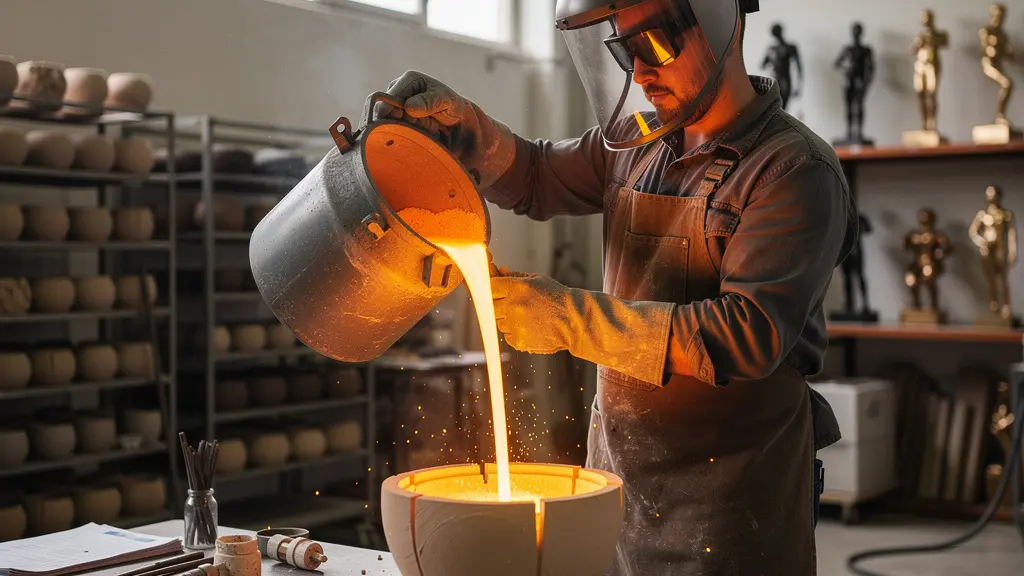
Bronze’s enduring value isn’t just its weight, but the months-long, elemental transformation that no modern replica can fake.
- The lost-wax process is an unforgiving, multi-month commitment of intense labor and risk, destroying the original model to create an eternal copy.
- The sculpture’s final color (patina) is a separate art form, literally painted with fire and chemicals, not applied like a simple coat of paint.
Recommendation: To truly appreciate a bronze, learn to distinguish its cold, metallic touch and chased seams from the warm, dull feel of a resin copy.
In a world of 3D printing and synthetic resins, it’s a fair question for any collector or art student: why does an ancient, notoriously difficult, and expensive material like bronze still dominate the world of fine art sculpture? The common answers—that it’s traditional, durable, and heavy—barely scratch the surface. They miss the soul of the material, the trial by fire that separates a true bronze from its modern look-alikes. These modern alternatives offer speed and economy, but they are merely producing copies. Bronze casting is about transmuting an artist’s fragile vision into something nearly eternal.
The real reason for its gold-standard status lies not in the metal itself, but in the unforgiving, alchemical process it demands. It’s a craft that can’t be rushed, a dialogue between artist, fire, and chemistry that takes months to complete. From the searing heat of the furnace to the controlled corrosion of the patina, every step imbues the final piece with a history and material honesty that cheaper, faster methods can only imitate. The process doesn’t just create a shape; it forges an artifact.
This guide takes you past the gallery label and into the heat of the foundry. We will explore the brutal elegance of the lost-wax method, the chemistry behind “painting with fire,” and the critical differences that separate a timeless masterpiece from a clever fake. You’ll learn not just what bronze is, but why it commands such reverence and what it means to care for a piece of history designed to outlast us all.
For those who prefer a visual introduction, the following video offers a compelling look into the intricate and fiery world of the lost-wax bronze casting process, a perfect complement to the detailed explanations that follow.
To navigate this deep dive into the art and science of bronze, this guide is structured to walk you from creation to conservation. The following sections break down each critical aspect of bronze’s journey from molten metal to treasured artifact.
Table of Contents: The Alchemist’s Art of Bronze Casting
- The Lost-Wax Process: Why Does It Take 3 Months to Cast One Figure?
- Chemical Patinas: How Artists Control Green, Blue, and Brown Hues?
- Bronze Disease: How to Spot the Pale Green Powder That Eats Metal?
- Cold Cast Resin vs Hot Cast Bronze: How to Tell the Difference by Touch?
- Installing Bronze at Home: Do You Need a Reinforced Plinth?
- Reading the Dirt: How Do You Know Which Layer is Roman and Which is Medieval?
- The Patina Debate: When Does Cleaning an Object Remove Its History?
- Why Reversibility is the Golden Rule of Modern Conservation?
The Lost-Wax Process: Why Does It Take 3 Months to Cast One Figure?
The three-month timeline isn’t an exaggeration; it’s a testament to a brutal, meticulous process where there are no shortcuts. It begins with the artist’s original sculpture, often in fragile clay or wax. This is the “positive,” and it’s the only time this exact form will exist. We create a flexible silicone mold around it, which is then used to cast a hollow wax replica—the “wax positive.” This isn’t the final sculpture; it’s a ghost of the original, a transient copy we spend weeks perfecting, chasing away seam lines and refining details. This wax figure is the heart of the “lost-wax” method, because it is destined for sacrifice.
Next comes the ceramic shell. For weeks, we dip the wax model into a silica slurry and coat it with sand, letting it dry for a day or two before repeating the process. It takes 7-10 ceramic shell layers, each requiring 24-48 hours of drying time, to build a shell strong enough to withstand the ordeal to come. Once the shell is ready, it’s placed in a kiln. The wax melts out—the “lost wax”—leaving a hollow, hardened ceramic mold. This mold is the negative space, the precise void that will soon become the sculpture.
The climax is the pour. We heat the bronze, an alloy of copper and tin, to a searing 1200°C (2192°F). At this temperature, the molten metal is a radiant, dangerous liquid. We pour it into the heated ceramic shell, a moment of intense focus where any mistake can be catastrophic. After it cools—a process that can take hours or days depending on size—we break the ceramic shell away with hammers, revealing the raw, rough bronze casting within. The final weeks are spent cutting off sprues, welding pieces together, and meticulously “chasing” the surface to match the original model’s texture. The artist’s original work is destroyed, but its soul is now immortalized in metal.
Chemical Patinas: How Artists Control Green, Blue, and Brown Hues?
A common misconception is that a bronze sculpture’s color is a type of paint. It’s not. The rich greens, deep browns, and even blues are the result of a patina—a thin layer of controlled corrosion that is chemically bonded to the metal’s surface. This is a separate art form, often performed by a specialized patineur. It’s not about covering the bronze, but about awakening the colors sleeping within the alloy. The technique is often called “painting with fire,” and for good reason. We use a torch to heat the bronze surface, creating a canvas that’s receptive to chemical reaction.
The process is pure chemistry in action. As described by professional artists, we heat the metal to around 180-200°F. If a sprinkle of water sizzles and steams away, it’s ready. Then, we apply different chemical solutions with brushes and spray bottles, which react instantly with the hot metal. A solution of ferric nitrate will bloom into rich, transparent browns. Cupric nitrate creates the classic greens and blues associated with aged bronze. Liver of sulfur can produce deep, almost black tones. The artistry lies in layering these chemicals, blending them while managing the temperature to create depth, translucency, and variation that paint could never replicate. This is what gives a bronze sculpture its living, variegated surface.
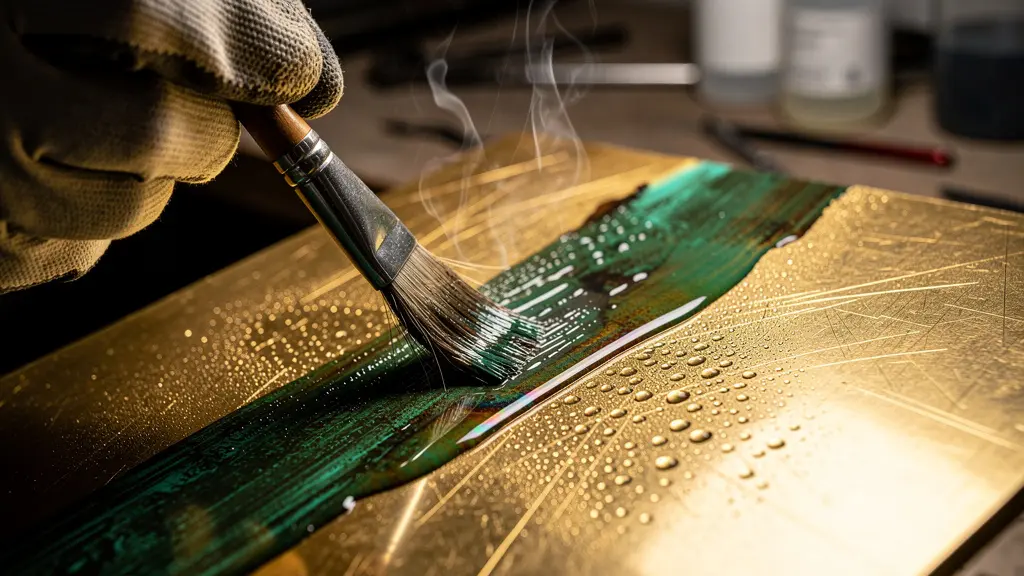
The specific chemical compounds are the patineur’s palette. Each one yields a different family of colors when applied to hot metal, a process that requires both scientific knowledge and an artist’s touch. The following table breaks down some of the most common chemicals used in traditional hot patination.
As this comparative guide to traditional patinas shows, the range of colors is achieved through a precise chemical formulary.
| Chemical | Color Result | Application Method |
|---|---|---|
| Ferric Nitrate | Brown to Red-Brown | Hot (200°F) |
| Cupric Nitrate | Green to Blue-Green | Hot (180-220°F) |
| Liver of Sulfur | Dark Brown to Black | Hot or Cold |
| Bismuth Nitrate | Iridescent Blues/Purples | Hot (180-200°F) |
Bronze Disease: How to Spot the Pale Green Powder That Eats Metal?
While a stable, artist-applied patina is desirable, there is a malignant form of corrosion that every collector should fear: bronze disease. It is not a patina; it is a cancer for the metal. It appears as small, fuzzy, pale green spots on the surface. Unlike the deep, waxy green of a good patina, this green is powdery and can be easily scraped away with a fingernail, revealing a pitted, scarred surface underneath. This is an active, cyclical chemical reaction. Chlorides in the environment (from salt in the air, pollutants, or even oils from human hands) react with the copper in the bronze to form cupric chloride. In the presence of moisture, this converts to hydrochloric acid, which eats more copper, creating more cupric chloride, and the cycle continues, destroying the sculpture from within.
Prevention is a matter of environmental control. The reaction is catalyzed by moisture, which is why conservation experts recommend maintaining a relative humidity between 42-46% for storing bronze artifacts. Anything higher can activate dormant chlorides on the surface and initiate the destructive cycle. If you see that tell-tale pale green powder, you must act immediately to prevent it from spreading. It is contagious to other bronzes and will not stop on its own.
Isolating the piece is the first step, but do not attempt to “clean” it with household products, oils, or waxes. These can trap moisture and chlorides against the surface, making the problem worse. The initial response should be gentle and focused on creating a dry environment. A professional conservator is required for proper treatment, which often involves meticulous removal of the corrosion and specialized chemical treatments to stabilize the metal. Ignoring bronze disease is allowing the history and value of your sculpture to be eaten away, one microscopic pit at a time.
Your First-Aid Checklist for Suspected Bronze Disease
- Isolate the affected piece immediately to prevent cross-contamination.
- Use a soft, dry brush (never metal) to gently remove the powdery green deposits.
- Place the object in a low-humidity environment (ideally below 40% RH) to halt the reaction.
- Document the affected areas with clear photographs for a professional conservator.
- Never apply household cleaners, oils, or waxes, as they can accelerate the damage.
Cold Cast Resin vs Hot Cast Bronze: How to Tell the Difference by Touch?
The most common modern alternative is “cold cast bronze,” a term that is dangerously misleading. It is not bronze. It is a polyester resin mixed with powdered bronze metal, which is then poured into a mold and left to cure. It mimics the look of bronze but possesses none of its essential qualities. For a collector, telling the difference is critical, as a genuine hot-cast bronze is an investment, while a resin copy is a decorative object with a fraction of the value. Fortunately, the difference is a matter of material honesty, and your own senses are the best tools for detection.
The first and simplest test is temperature. Touch the sculpture in a room-temperature setting. A genuine bronze is a massive, thermally conductive piece of metal. It will feel distinctly cold to the touch because it rapidly draws heat away from your hand. A resin sculpture, being a form of plastic, is an insulator. It will feel neutral, room-temperature, or even slightly warm. The second test is sound. Gently tap the sculpture with your fingernail. A true hollow-cast bronze will produce a clear, metallic ‘ping’ or ‘ring’. A resin piece will produce a dull, lifeless ‘thud,’ like tapping on hard plastic.
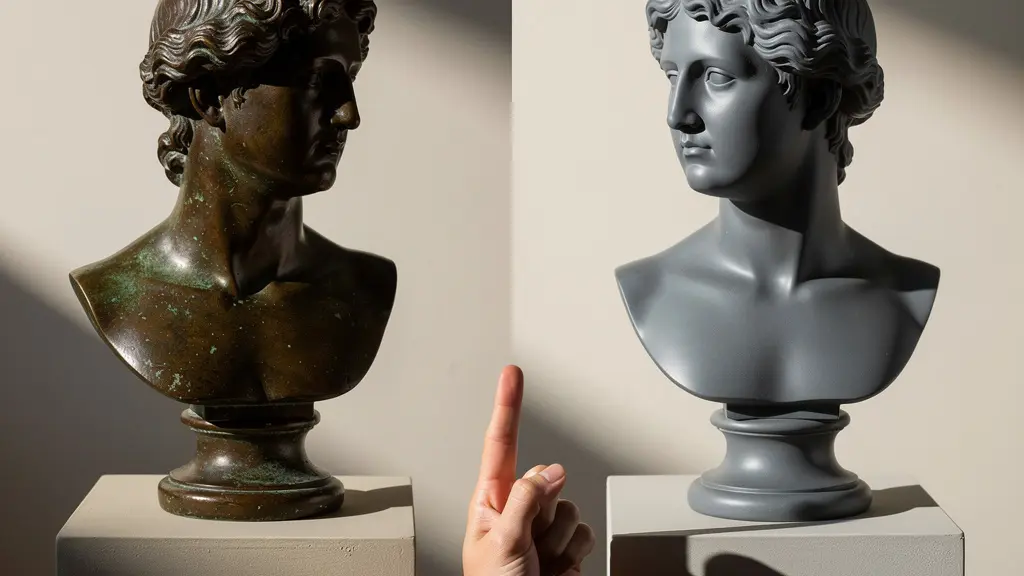
Finally, inspect the details. In a genuine bronze, multiple pieces are often cast separately and then welded together. A master craftsman will “chase” these weld lines, tooling them by hand until they are virtually invisible. A resin piece, by contrast, is usually cast in one or two pieces from a flexible mold. Look for a fine, raised “mold line” or ridge where the parts of the mold met. This is a dead giveaway. The weight can also be deceptive; resin pieces are often filled with sand or another material to give them heft, but the balance will feel different from the specific, engineered weight distribution of a hollow-cast bronze.
These physical tests are fundamental for any buyer, and as this guide for distinguishing bronze from its imitators confirms, the material itself tells the truth.
| Test Method | Genuine Bronze | Cold Cast Resin |
|---|---|---|
| Temperature Test | Feels distinctly cold, draws heat from hand | Feels neutral or warm |
| Acoustic Test (tap with fingernail) | Clear metallic ‘ping’ or ring | Dull plastic ‘thud’ |
| Weight Distribution | Specific hollow-cast balance | Uniform weight or artificial ballast |
| Seam Inspection | Chased welded seams nearly invisible | Visible mold lines or ridges |
Installing Bronze at Home: Do You Need a Reinforced Plinth?
Bringing a bronze sculpture into your home introduces a physical reality that resin copies do not: immense weight. Bronze has a density far greater than stone. This is not a decorative accessory; it is a significant structural load, and underestimating it can lead to damaged floors or, worse, a damaged sculpture. The need for a reinforced plinth or structural assessment depends entirely on the size of the piece and the construction of your home. A small maquette or bust can likely sit on any sturdy piece of furniture, but anything larger requires careful calculation.
According to structural guidelines for sculpture installation, even a modest 3-foot-tall bronze figure can weigh between 150-200 pounds. While a standard residential floor is typically rated to handle this, placing it on a plinth with a 12-inch square base concentrates that load into a single square foot. For life-size or monumental works, the weight quickly escalates. A life-size figure can easily exceed 500 pounds, a load that absolutely requires a structural assessment by an engineer, especially on a suspended wooden floor. They may recommend placing it over a floor joist or adding reinforcement from below.
Professional installation goes beyond simply placing the object. Museums and galleries use specialized mounting techniques to ensure both stability and security. As seen in the Getty Museum’s approach, this often involves using hidden mechanical fasteners. Holes are carefully drilled into the bronze base, which are then secured to the plinth or floor with drop-in anchors or tamper-proof bolts rated for at least three times the sculpture’s weight. For high-value pieces in seismically active areas, sophisticated seismic isolation systems may be incorporated into the plinth. The plinth itself becomes part of the art, often made of materials like black granite or Corten steel, but its primary job is to safely anchor a very heavy, very valuable piece of history.
Reading the Dirt: How Do You Know Which Layer is Roman and Which is Medieval?
When dealing with archaeological bronze, its value is tied not just to the object itself, but to its story—a story often told by the very dirt and corrosion encrusting it. The patina on an ancient bronze is not an artist’s creation but a slow, geological process, a dialogue between the metal and its burial environment over centuries. Distinguishing a genuine Roman patina from a later, 19th-century “revival” finish or an outright forgery is a highly specialized skill. It requires reading the microscopic clues that time leaves behind. The wear patterns, or “skin,” on the high points of a sculpture from centuries of handling are something that simply cannot be faked with a wire brush.
True ancient patinas develop microscopic crystalline structures over millennia of interacting with minerals in the soil. This gives the surface a “waxy” or “gem-like” depth and luster that rapidly applied chemical patinas cannot replicate. The latter often appear flatter, more uniform, and lack the complex, layered history of a genuine specimen. However, visual inspection can be deceiving. The most definitive answers come from scientific analysis.
Modern conservation science provides tools that can see what the naked eye cannot, offering a definitive fingerprint of an object’s past. As the Getty Conservation Institute notes in their analysis of bronze artistry:
X-Ray Fluorescence (XRF) provides a non-destructive elemental ‘fingerprint’ of patina and underlying alloy – Roman patinas show different trace element profiles from soil interaction than 19th-century chemically-induced ones.
– Getty Conservation Institute, Artistry in Bronze: Conservation Analysis
This technology allows conservators to identify the trace elements absorbed from a specific burial environment, effectively confirming the object’s provenance without damaging it. It can distinguish the chemical signature of 2,000 years in Italian soil from a 150-year-old acid treatment in a Parisian workshop. It is the science of reading the dirt, and it is the final word in authentication.
The Patina Debate: When Does Cleaning an Object Remove Its History?
For a conservator, the question is never simply “to clean or not to clean.” The real question is: what are we removing? Is it harmful, active corrosion that threatens the object’s integrity, or is it a stable, historical layer that tells the story of the object’s journey through time? This debate was famously crystallized by the conservation of the Lansdowne Herakles at the Getty Museum. The statue had a dark, uniform “gallery patina” that it had acquired over centuries of being displayed and handled. When conservators cleaned the statue, they removed this dark layer, revealing a mottled, varied surface underneath which they argued was closer to the original Roman appearance.
The decision sparked an international firestorm. Critics argued that the Getty had erased 2,000 years of the object’s history, stripping away the very evidence of its survival through time. The museum countered that they had removed damaging and aesthetically disruptive surface layers to reveal the artist’s original intent. The controversy was a landmark moment, forcing the conservation world to establish clearer protocols. The consensus that emerged is the critical distinction between removing active corrosion (like bronze disease) versus preserving stable, historical patinas.
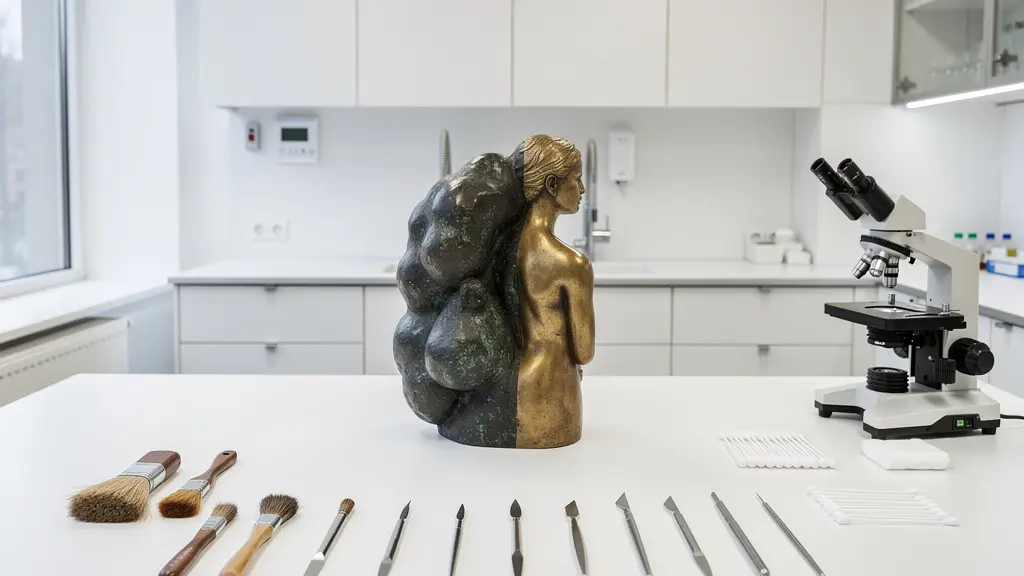
Today, the guiding principle is to preserve as much of the object’s history as is safely possible. Removing a layer of grime that is obscuring detail is one thing; stripping a patina that has been part of the object for centuries is another entirely. It is an act of interpretation that can irrevocably alter the object’s narrative.
This core distinction is the foundation of modern ethical practice, as articulated by Dr. Francesca Casadio, a leading conservation scientist:
The distinction between stable patina and active corrosion is critical – stable patinas are protective and aesthetically valued layers that should be preserved, while active corrosion like bronze disease is destructive and must be treated.
– Dr. Francesca Casadio, Art Institute of Chicago Conservation Department
Key Takeaways
- The 3-month lost-wax process involves sacrificing an original model to create a nearly eternal metal copy, explaining bronze’s high cost and inherent value.
- A sculpture’s patina is not paint; it is a separate art form where chemicals and fire are used to create a “controlled corrosion” that is part of the work itself.
- You can distinguish real bronze from a resin fake by touch and sound: genuine bronze feels cold and has a clear metallic ring, while resin feels neutral or warm and makes a dull thud.
Why Reversibility is the Golden Rule of Modern Conservation?
The most important principle guiding any modern conservator’s hand is reversibility. This golden rule dictates that any treatment applied to an artifact—be it a repair, a protective coating, or a fill for a missing piece—should be fully removable in the future without damaging the original object. Why is this so crucial? It is an act of humility. It acknowledges that our current technology and understanding may not be the final word. Future generations of conservators may have better methods, safer materials, and a deeper understanding of the object. The principle of reversibility ensures that they will have the chance to apply that future knowledge.
A classic example is the repair of a broken bronze. Traditionally, a broken piece might have been repaired with hard solder. While strong, this process permanently alters the original metal alloy at the join and is impossible to undo. Today’s approach is fundamentally different. A conservator will instead use custom-tinted synthetic resin adhesives. These adhesives can be formulated to be incredibly strong, yet they are designed to be dissolved by a specific solvent that will not harm the bronze itself. This means that 50 or 100 years from now, a future conservator can safely take the repair apart to re-do it with a superior technology we can’t yet imagine.
The same principle applies to protective coatings. For outdoor sculptures, a coating like Incralac (an acrylic resin) might be applied to protect against acid rain. For indoor pieces, a thin layer of microcrystalline wax (like Renaissance Wax) acts as a barrier against moisture and fingerprints. Both of these are chosen because they are stable, transparent, and, most importantly, can be safely removed with specific solvents. Every treatment is meticulously documented, so the conservators of tomorrow know exactly what they are dealing with. It is a dialogue with the future, ensuring the object’s story can continue for centuries to come.
Now that you understand the soul of the metal, approach your next gallery visit or potential acquisition not just as a viewer, but as an informed connoisseur. Feel the material, question its history, and appreciate the centuries of artistry it embodies.