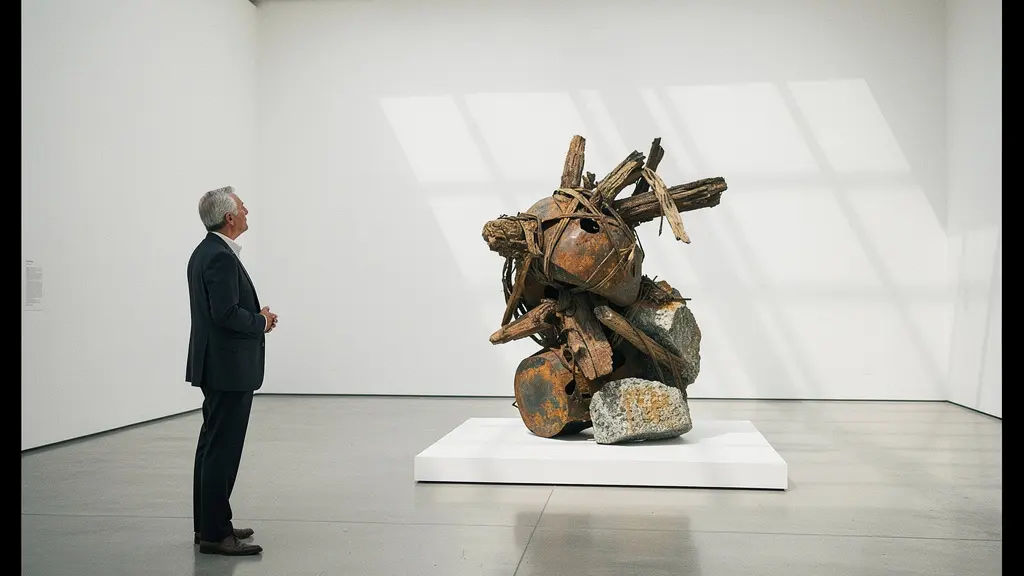
The belief that you need a special kind of intellect to ‘get’ contemporary art is a myth; you actually need a practical toolkit of valuation criteria.
- Authentic conceptual art has “conceptual craftsmanship”—the idea and its physical form are perfectly aligned.
- Value in performance or non-object art is found in its documentation, institutional history, and re-performance rights.
- A smart collection strategy balances high-risk emerging artists with market-proven names, focusing on more than just financial ROI.
Recommendation: Stop trying to find the ‘correct’ answer and start using a structured framework to ask better questions about the work’s context, history, and intent.
For the art lover raised on the technical mastery of the Old Masters or the emotive brushstrokes of the Impressionists, stepping into a contemporary art gallery can feel like entering a foreign country without a map. A pristine white room, a single object on a plinth, a video loop with no clear narrative—it’s an experience that can evoke more intellectual insecurity than aesthetic pleasure. The common refrain, “my kid could have done that,” is often a defence mechanism against a feeling of being excluded from a conversation. Many will tell you it’s “all about the idea,” but this explanation is unsatisfying, leaving you wondering how to judge the quality of one idea over another.
The truth is, the contemporary art world operates on a different set of principles than traditional art. It’s not that skill and beauty have been discarded, but that their definitions have expanded dramatically. Understanding this landscape isn’t about possessing a secret knowledge; it’s about acquiring a new set of analytical tools. It requires shifting your perspective from asking, “Is this beautiful?” to asking, “Is this interesting? Does the form effectively serve the concept? Where does this fit within art history?” This is not about diminishing the classics, but about learning a new language to appreciate the art of our time.
This guide is designed to be your translator. We will move beyond the platitudes and equip you with the practical frameworks that curators, critics, and seasoned collectors use to navigate this complex world. We will start by building your confidence in personal interpretation, then provide a robust checklist to distinguish authentic depth from a mere gimmick. From there, we will deconstruct how value is assigned to ephemeral works and explore the market dynamics that every new collector must understand. By the end, you won’t just ‘look’ at contemporary art; you’ll have a method for seeing it.
This article provides a structured path from initial confusion to confident engagement. The following sections will equip you with the frameworks and insider knowledge needed to decode the contemporary art landscape.
Summary: A Collector’s Field Guide to the Contemporary Art World
- How to Interpret Bold Conceptual Art Without Feeling Intellectual Insecurity?
- Gimmick or Genius: How to Spot Authentic Conceptual Depth?
- How to Judge the Value of a Performance Piece That Leaves No Object?
- Climate Anxiety in Art: Is It a Trend or a Movement?
- The Risk of Buying “Hot” Graduates That Loses 50% of Value in a Year
- Buying Fresh or Buying Proven: Where is the Best ROI for New Collectors?
- Buying from Studios vs Auctions: Where is the Real Support for Artists?
- Frieze London for Beginners: How to Survive the VIP Preview?
How to Interpret Bold Conceptual Art Without Feeling Intellectual Insecurity?
The most significant barrier to enjoying conceptual art is often the fear of “not getting it.” This feeling of intellectual insecurity is a common and valid starting point. The gallery environment can feel sterile and judgmental, and the art itself can seem opaque. The key is to reframe your role from a passive viewer searching for a hidden meaning to an active investigator gathering clues. Your personal response, even if it’s confusion or frustration, is the first piece of evidence. Instead of looking for the “right” answer, start by asking open-ended questions.
As Sarah Urist Green, creator of The Art Assignment, aptly puts it, the goal is to approach art in a way that is both meaningful and accessible. In her work, she emphasizes that the point is to engage, not to have all the answers. She states:
The goal is to demystify art while keeping it fun, light-footed, and approachable.
– Sarah Urist Green, The Art Assignment description
To put this into practice, you can adopt a simple three-step framework for your initial encounter with any piece. This method prioritizes your own perception before outside information colors your view. Start by simply describing what you see, then read the provided text, and finally, connect it to your own experiences. This structured approach builds a foundation of confidence.
This initial investigation should be a personal dialogue with the artwork. There’s no need to perform an academic analysis on the spot. Here is a simple framework to guide your first look:
- The Object: Describe what you are literally seeing, as if to a person who can’t see it. What materials are used? What are the colors, textures, and scale? Be objective and avoid interpretation for now.
- The Context: Now, read the label. What are the artwork’s title, the artist’s name, and the date? Read the wall text or artist’s statement. This is crucial context, providing clues to the artist’s intention.
- The Connection: With the objective and contextual information in hand, ask yourself two final questions: “What does this remind me of?” and “How does it make me feel?” Trust these initial associations and emotional responses. They are the bridge between the artwork and your own understanding.
This process transforms a potentially intimidating experience into a manageable, even playful, investigation. It validates your own perspective as the crucial starting point for any meaningful interpretation.
Gimmick or Genius: How to Spot Authentic Conceptual Depth?
Once you’re comfortable with your initial interpretation, the next step is to assess the work’s conceptual integrity. This is where you move from “What do I think?” to “Is this a compelling and well-executed artistic statement?” The fear for many collectors is investing time and money in a piece that is merely a clever one-liner—a gimmick—rather than a work of genuine depth. The key is to look for what can be called “conceptual craftsmanship.” This isn’t about traditional skill like painting, but about how meticulously the artist has aligned their idea with their chosen medium, form, and context.
A genius work of conceptual art creates a resonant harmony between the idea and its execution. Every material, every decision, feels intentional and necessary to convey the concept. A gimmick, by contrast, often feels arbitrary; the idea could have been expressed in any number of ways, and the chosen form lacks a deeper connection. True conceptual depth also opens up new questions, while a gimmick provides a single, closed answer. It invites a sustained conversation rather than a momentary chuckle.
This requires a closer look, moving beyond the initial impression to examine the physical and intellectual construction of the work. It’s an act of connoisseurship, just applied to ideas instead of brushstrokes.

As seen in this close examination, details matter. The texture, the material choices, and the evidence of the process are all part of the work’s language. A work with authentic depth reveals more of itself the longer you spend with it. It has layers of meaning that unfold through research and contemplation. A crucial part of this is understanding how the work dialogues with art history. Genius rarely emerges from a vacuum; it almost always acknowledges, challenges, or expands upon the ideas of those who came before.
Your Authenticity Assessment Framework: 5 Points to Verify
- The Durability Test: Could you discuss the concept and its implications for over 30 minutes? A work of depth will support extended conversation, while a gimmick exhausts itself quickly.
- Conceptual Craftsmanship: Is there a perfect, almost inevitable, alignment between the idea and the medium used? Or could the concept be just as effective as a simple sentence?
- Dialogue with History: Does the work show an awareness of art historical precedents? Research the artist to see if they are engaging with, or consciously breaking from, a known tradition or movement.
- Institutional Validation: Look beyond market hype. Has the artist been featured in significant museum exhibitions, biennials, or academic journals? This indicates critical, not just commercial, acclaim.
- Sustained Engagement: Does the artist explore this concept across multiple works or a whole series? A sustained, career-long engagement with an idea suggests authentic commitment over opportunistic trend-chasing.
How to Judge the Value of a Performance Piece That Leaves No Object?
Performance art presents the ultimate challenge to the traditional collector: how do you value, let alone own, an experience that is ephemeral by nature? When the artist leaves the room and the performance ends, what remains? This question strikes at the heart of what we consider “art” and “value.” The answer lies in shifting the concept of ownership from a physical object to a set of rights, documentation, and a place in history. You aren’t buying a thing; you are becoming a custodian of an idea.
The value of performance art is constructed through a network of associated materials and agreements. This can include limited-edition photographic or film documentation, signed instructions for its re-performance, or relics and props from the original event. Each of these items acts as a carrier of the original work’s aura and authenticity. The market for these works is highly specialized, and not all artists approach it the same way. As Gallerist Robenhagen explains in The Art Newspaper when discussing the work of a performance art pioneer:
Unlike a performance artist such as Tino Sehgal, who sells his performances via verbal instructions, Abramović’s performances are not for sale.
– Gallerist Robenhagen, The Art Newspaper – Marina Abramović buyer’s guide
This distinction is crucial. Some artists, like Tino Sehgal, create works that exist only as an oral transaction, with no physical documentation allowed. Others, like Marina Abramović, retain control of the performance itself but create associated photographic works that become collectible objects in their own right. Understanding the artist’s specific methodology for commodifying their work is the first step in its valuation.
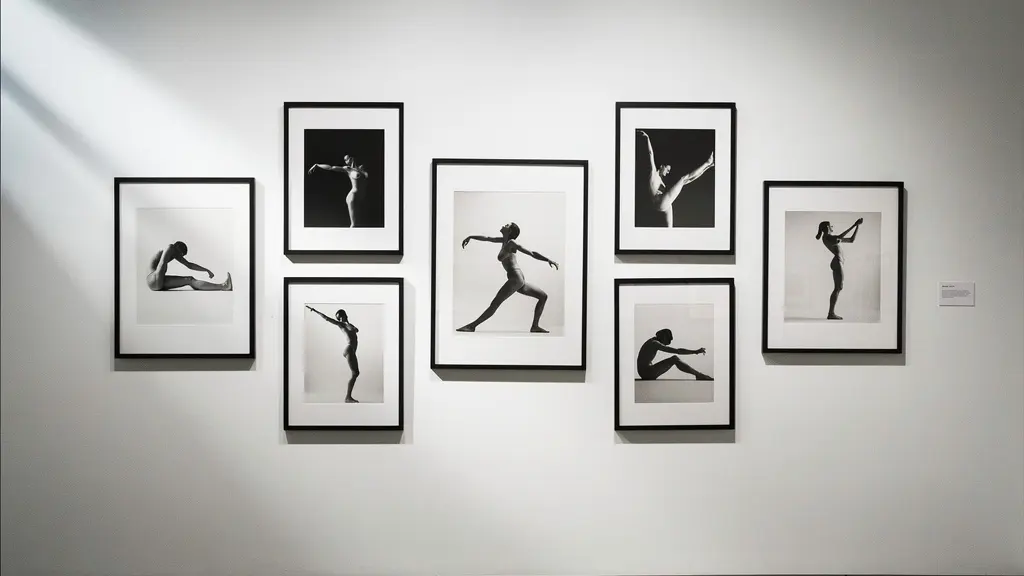
The provenance and exhibition history of a performance are paramount. A performance that has been included in a major biennial or a museum retrospective carries a level of institutional validation that significantly increases its value. The documentation associated with it, like the framed photographs shown here, transforms from mere record-keeping into a collectible artwork. When assessing such a piece, you are evaluating the cultural significance of the original event and the rarity and quality of the artefacts that prove its existence and authenticate its legacy.
Climate Anxiety in Art: Is It a Trend or a Movement?
Walk into any major contemporary art fair today, and you will inevitably encounter works addressing climate change, ecological collapse, and sustainability. From sculptures made of ocean plastic to paintings depicting endangered landscapes, “climate anxiety” has become a powerful visual theme. For a new collector, this raises a critical question: is this a lasting artistic movement reflecting a profound societal shift, or is it a fleeting market trend that gallerists are capitalizing on? The answer, it seems, is a bit of both, and distinguishing between them requires the same critical tools used to assess any conceptual work.
There is no doubt that the concern is genuine and deeply felt by a generation of artists and buyers. Younger collectors, in particular, are driven by values, and they want to see those values reflected in the art they acquire. The art world’s infrastructure is responding to this shift. According to the Art Basel and UBS Global Art Market Report 2025, there is a clear institutional move towards sustainability, with nearly 48% of galleries having integrated eco-friendly practices into their operations. This indicates a structural change, not just a thematic one.
However, wherever there is sincere interest, market opportunism follows. The risk is in acquiring work where the climate theme is merely an aesthetic overlay—a “greenwashing” of otherwise conventional art. The strong work in this category uses the theme not just as a subject but as a core component of its material and concept. For example, an artist who uses reclaimed materials and sustainable processes to create a work about waste has a higher degree of conceptual craftsmanship than an artist who simply paints a picture of a melting iceberg. The former embodies the idea; the latter merely illustrates it.
Therefore, when evaluating art that engages with climate anxiety, apply the authenticity framework. Look for artists who have a long-standing engagement with ecological themes in their practice, not just in the last year. Investigate whether their materials and methods align with the message. Art that engages with themes of sustainability is predicted to grow in popularity, but the works that endure will be those with true conceptual and material integrity, transcending the label of a “trend” to become part of a lasting artistic movement.
The Risk of Buying “Hot” Graduates That Loses 50% of Value in a Year
One of the most intoxicating—and dangerous—arenas for a new collector is the market for “ultra-contemporary” art, typically defined as work made by artists under 40. This is the world of the recent art school graduate whose work is suddenly the talk of the town, with sold-out degree shows and a waiting list at their first gallery exhibition. The potential for astronomical returns is a powerful lure; buying a piece for $5,000 that could be worth $50,000 in two years is the dream. However, this speculative frenzy carries immense risk, and the market for these “hot” artists is notoriously volatile.
This segment of the market, often called “wet paint” because the works are so new, is driven by hype and momentum more than by established critical consensus. When the market is booming, speculation can drive prices to unsustainable levels. When a correction occurs, this is the first segment to feel the pain. Recent data from the first half of 2024 revealed a stark reality check, showing a sharp 31.3% decline in ultra-contemporary art sales value. This highlights how quickly the fortunes of artists anointed as “the next big thing” can turn.
The trap for new collectors is mistaking this initial market heat for long-term value. An artist’s career is a marathon, not a sprint. The most successful artists are those who build their careers slowly and steadily, gaining institutional validation through museum shows and critical support over years, not months. The artist who has a meteoric rise is often at the greatest risk of a subsequent fall, as their price levels may have outpaced their artistic development.
This doesn’t mean you should avoid emerging artists entirely. It means you should approach this market with a venture capital mindset: the risk of loss is high, but the potential for reward is, too. The key is to do your homework. Look beyond the hype. Apply the authenticity framework. Is the artist demonstrating a sustained, serious practice? Or are they producing work that caters to a fleeting trend? A prudent strategy involves allocating only a small portion of your budget to this high-risk category and focusing on artists whose work you believe in conceptually, regardless of the market buzz.
Buying Fresh or Buying Proven: Where is the Best ROI for New Collectors?
Every new collector faces a fundamental strategic choice: should you invest in “fresh” art from emerging artists or “proven” art from established names with a track record? This decision is not just about financial return; it’s about defining your goals as a collector. The “Return on Investment” (ROI) in art collecting is multi-faceted, encompassing financial, cultural, and relational gains. Understanding your personal priorities across these three areas is key to building a collection that is both satisfying and smart.
Market research reveals that collectors are actively engaged in this debate, with data showing a nearly even split in interest: 72% of collectors are drawn to emerging artists for their potential and novelty, while a very similar 69% prefer the stability and prestige of established artists. This shows there is no single “correct” strategy; rather, a balanced approach is often the most successful. A common portfolio allocation suggests a core holding of 70% in proven artists for stability, with up to 30% dedicated to the higher-risk, higher-reward world of emerging talent.
The trade-offs between these two approaches are significant and should be carefully considered. Buying from an emerging artist offers the chance to get in on the ground floor, build a direct relationship with the artist, and potentially shape art history by supporting a new voice. However, it comes with low market liquidity and high financial risk. Conversely, buying a work by an established artist provides instant institutional recognition and a predictable, stable appreciation in value, but with less explosive growth potential and a more transactional relationship.
The following table breaks down the different forms of ROI for each investment type, providing a clear framework for making strategic decisions.
| Investment Type | Fresh/Emerging Artists | Proven/Established Artists |
|---|---|---|
| Financial ROI | High risk, potential 10x returns | Predictable 3-7% annual appreciation |
| Cultural ROI | Building historically relevant collection | Instant institutional recognition |
| Relational ROI | Direct artist relationships, studio access | Established collector networks |
| Market Liquidity | Limited resale options initially | Strong secondary market |
| Portfolio Allocation | Recommended 30% maximum | Core holding 70% |
Buying from Studios vs Auctions: Where is the Real Support for Artists?
Once you’ve decided on an artist, the next question is *where* to buy. The art market is broadly divided into two spheres: the primary market, where art is sold for the first time (typically from the artist’s studio via a gallery), and the secondary market, where art is resold (most visibly at auction houses). For a new collector, understanding the profound differences between these two channels is crucial, not only for your investment strategy but also for understanding your impact on the art ecosystem.
Buying from a gallery on the primary market is the most direct way to support a living artist. A significant portion of the sale price (usually 50%) goes directly to the artist, funding their ability to continue making work. This is a “venture capital” approach to collecting; you are investing in the artist’s future potential. It is also where relationships are built. As data from the Art Basel and UBS report shows, galleries are a key site for discovery, with 44% of gallery buyers in 2024 being new customers. This demonstrates the primary market’s role in nurturing the next generation of both artists and collectors.
The secondary market, dominated by auction houses, serves a different function. Here, you are typically buying works with an established market history. An auction price is a powerful public validation of an artist’s value. While the artist may receive a small percentage via resale rights (depending on the country), the primary financial beneficiaries are the seller and the auction house. This is more of a “blue-chip” investment approach. You aren’t discovering potential; you are buying validated success. An auction record can significantly boost an artist’s career, but it doesn’t provide the foundational support that comes from a primary market sale.
The choice between these channels reflects a collector’s core motivation. Do you see yourself as a patron and talent-spotter, or as an investor acquiring a validated asset? The following table compares the implications of each purchasing decision.
| Aspect | Studio/Gallery Purchase | Auction Purchase |
|---|---|---|
| Financial Support | Direct payment to artist/gallery | Artist receives resale rights (if applicable) |
| Investment Strategy | Venture Capital approach – higher risk | Blue-chip approach – market validated |
| Price Discovery | Fixed pricing, negotiable | Market-driven competitive bidding |
| Relationship Building | Direct artist/gallery connection | Institutional validation |
| Market Impact | Supports primary market | Validates secondary market value |
Key takeaways
- Stop trying to “get” conceptual art and start investigating it with a structured framework focused on context and intent.
- True value lies in “conceptual craftsmanship”—the perfect alignment of an idea with its physical form—not just a clever gimmick.
- A smart collection balances the high risk of emerging artists with the stability of proven names, defining ROI beyond purely financial terms.
Frieze London for Beginners: How to Survive the VIP Preview?
With a foundational understanding of how to interpret art and navigate the market, the final frontier is the major international art fair. Events like Frieze London are the nexus of the art world, where galleries, collectors, curators, and artists converge in a dazzling, and often overwhelming, display of commerce and culture. The VIP Preview day is the most critical moment of the entire event. As noted by luxury guide Villa Pads, “These preview sessions are where the most significant acquisitions often take place, allowing collectors to secure coveted works ahead of the crowd.” Surviving, and thriving, in this high-stakes environment requires a clear strategy.
First, securing access is paramount. VIP status is not something you can buy at the door; it is cultivated through established relationships with participating galleries or by joining high-level museum membership programs. Once you have the pass, timing is everything. Preview slots must be booked the moment registration opens, as there are no waitlists. Your VIP pass grants you re-entry throughout the fair, but that first entry during the preview is your golden opportunity.
Do not wander aimlessly. An art fair is a marathon, not a sprint, and you must conserve your energy. The most effective approach is to divide your time into strategic hours. Arrive with a pre-researched list of your top 5-10 “must-see” galleries and a map of their booth locations. Use the first hour for a full reconnaissance walk of the entire fair without stopping. This allows you to get your bearings, identify other interesting booths, and gauge crowd flow. In the second hour, with your energy at its peak, visit your priority galleries. In the third hour, focus on discovery by exploring the curated sections like “Focus,” which is dedicated to emerging galleries and artists. The final hour can be dedicated to networking in the VIP lounge or at gallery receptions.
This structured approach turns a chaotic experience into a targeted mission. It allows you to see your priority works before they are sold, discover new talent, and make meaningful connections, all while avoiding the burnout that plagues many fair-goers. It is the practical application of all the knowledge you’ve built—using your eye, your framework, and your market understanding in a real-world, high-speed environment.
By moving from a passive observer to an active investigator, equipped with the right frameworks and an understanding of market dynamics, you can transform your relationship with contemporary art. The goal is not to love everything, but to build the confidence to form your own informed opinions and create a collection that is a true reflection of your personal vision and intelligence.