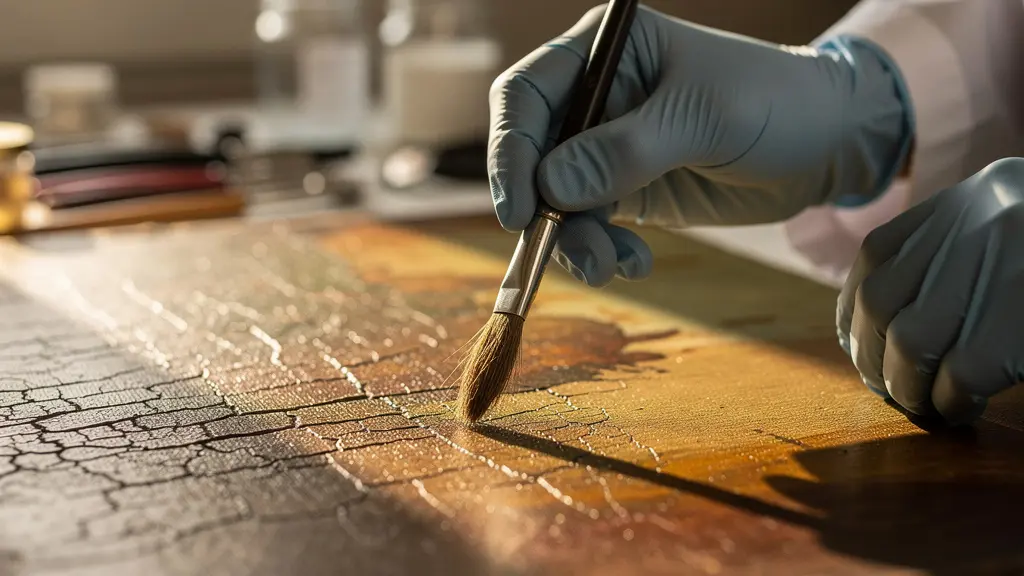
True art conservation isn’t about making objects look new; it’s an ethical and scientific promise to the future, governed by the principle of reversibility.
- Minimal, scientifically-backed intervention is always prioritized over aggressive cleaning to preserve an object’s historical integrity.
- Every treatment, from cleaning agents to repairs, is chosen for its ability to be undone by future conservators with more advanced technology.
- Preventing damage through environmental control is as crucial as active treatment, representing the ultimate form of reversible action.
Recommendation: The next time you watch a restoration video, look for what *isn’t* done—the subtle, careful choices are where the real expertise lies.
There is a deep, almost primal satisfaction in watching the grime of centuries dissolve under a conservator’s patient swab. Viral videos have turned art restoration into a mesmerizing spectator sport, where a darkened canvas or tarnished silver is brought back to brilliant life. We watch, captivated, as artists like Julian Baumgartner perform what looks like magic. But this captivating surface hides a much deeper, more complex reality. The goal of a professional conservator is not, as is often assumed, to make an object look brand new. Their work is not an act of erasure, but one of preservation.
The true guiding principle of modern conservation is not aesthetics, but ethics. It is a profound commitment to the object’s historical truth and a dialogue with the future. At the heart of this philosophy lies a single, powerful concept: reversibility. This idea dictates that any intervention—any cleaning, repair, or consolidation—should ideally be undoable. Why? Because we must humbly accept that our knowledge and technology are imperfect. A future conservator, armed with tools we can’t yet imagine, must be able to remove our work and start again if needed. This is the conservator’s oath: do no irreversible harm.
This article will peel back the layers of varnish and mystique to reveal the scientific and ethical framework that governs the life of a conservator. We will explore how this core principle of reversibility dictates every choice, from the chemical composition of a cleaning agent to the very light that illuminates a medieval manuscript. This is the science behind the satisfaction.
For those who prefer a visual format, the following video offers a beautifully narrated look into the meticulous process of restoring a single painting, perfectly complementing the principles discussed in this guide.
text
To navigate this complex field, this article is structured to walk you through the core dilemmas and scientific principles that define modern conservation. Each section addresses a critical question that conservators face daily.
Summary: The Ethical and Scientific Principles of True Conservation
- The Patina Debate: When Does Cleaning an Object Remove Its History?
- Acetone to Saliva: How Do Conservators Choose the Right Cleaning Agent?
- Restoring for Sale vs Restoring for Truth: How the Goals Differ?
- Gloves or Clean Hands: Which is Better for Handling Old Paper?
- Toxic Pigments: How Conservators Protect Themselves From Arsenic Green?
- Bronze Disease: How to Spot the Pale Green Powder That Eats Metal?
- Fat Over Lean: The Rule You Must Follow to Prevent Cracking Oil Paint?
- How to Display Medieval Manuscripts Without Fading the Ink?
The Patina Debate: When Does Cleaning an Object Remove Its History?
The first challenge in conservation is defining “damage.” Is the dark layer on an old painting simply dirt, or is it part of its journey through time? This is the heart of the patina debate. In conservation, patina is not seen as grime; it is the stable, often beautiful, surface layer that develops on an object over time due to natural aging and use. It can be the soft green on a bronze statue or the warm glow of old, oil-based varnish. According to conservation specialists, patina can carry critical historical information and is considered an integral part of the object’s authenticity.
Removing this layer in a quest for a “like-new” appearance can be an act of historical vandalism. The conservator’s job is to distinguish between this meaningful patina and unstable corrosion or damaging surface dirt. It’s a delicate balance. The goal is to stabilize the object and reveal the artist’s original intent without erasing the centuries of life the object has lived. An overly aggressive cleaning, even with the best intentions, is an irreversible act that strips the object of its story.
Therefore, the decision-making process is meticulous. It involves historical research, scientific analysis of the surface layers, and a deep philosophical consideration of the object’s value. The question is never “How clean can we get it?” but rather “What cleaning is necessary to ensure the object’s long-term survival while respecting its complete history?”
This careful, intellectual approach separates professional conservation from simple cleaning, establishing a baseline of respect for the object itself.
Acetone to Saliva: How Do Conservators Choose the Right Cleaning Agent?
Once the decision to clean is made, the next question is: with what? The answer is a testament to the chemical literacy required of a modern conservator. The choice of a cleaning agent is governed by the principle of minimal intervention. You might be surprised to learn that human saliva, with its specific enzymatic properties, is a classic and effective tool for cleaning certain surfaces, as it can gently break down surface debris without harsh chemicals. But the toolkit is vast, ranging from simple deionized water to complex gels and powerful solvents like acetone.
The selection is a scientific process. The conservator must understand the object’s material composition (the pigment, the binder, the substrate) and the nature of the grime. The ideal cleaning agent is one that will act only on the dirt layer without affecting the original material beneath it. This is often achieved using aqueous solutions with carefully controlled pH levels or custom-made gels that allow the solvent to sit on the surface without penetrating too deeply. This controlled application is a form of reversibility; the action can be stopped and removed at any point.
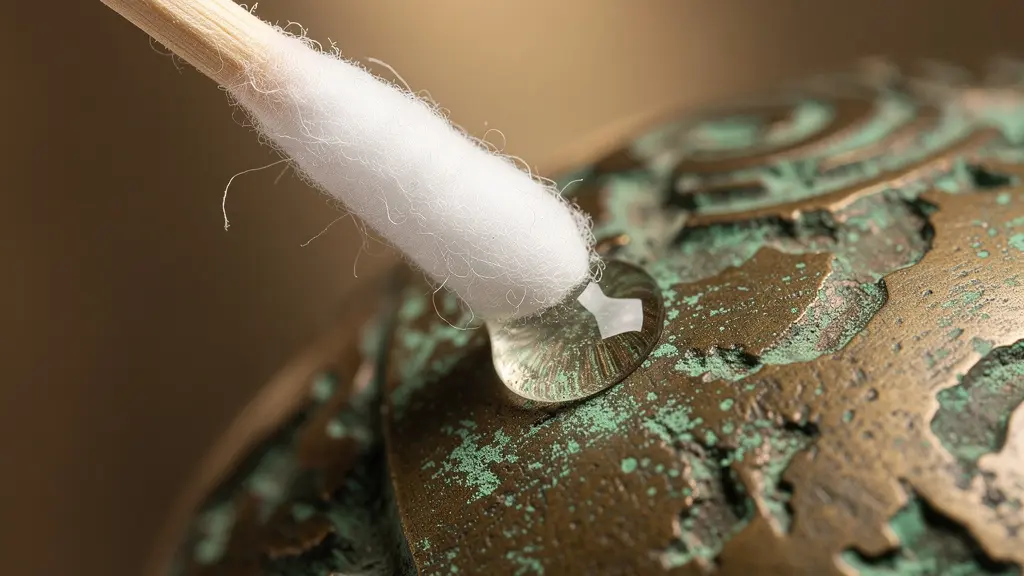
This field is constantly evolving. For instance, research on bronze disease treatment shows a significant shift. The once-common corrosion inhibitor benzotriazole (BTA) has been identified as a toxic and suspected carcinogen. Modern conservation science, as detailed in research on safer, more effective treatments, now explores nanocarriers and naturally derived products. This demonstrates the profession’s commitment to finding solutions that are not only effective but also safer for both the object and the conservator, and are fundamentally more reversible in their long-term impact.
Ultimately, the conservator’s cleaning kit is less like a janitor’s cart and more like a chemist’s laboratory, where every choice is deliberate, measured, and scientifically justified.
Restoring for Sale vs Restoring for Truth: How the Goals Differ?
The purpose of a restoration dramatically influences the methods used. The needs of a private client looking to sell a painting at auction can be very different from the goals of a museum’s conservation department. A commercial restoration might prioritize aesthetic appeal, sometimes leading to “inpainting” that makes damage invisible, presenting a more flawless—and marketable—object. This approach, while often technically brilliant, can sometimes blur the line between restoration and artistic re-creation.
In contrast, museum conservation is typically bound by a stricter ethical code of material honesty. Here, the primary goal is long-term preservation and the faithful representation of the object’s history. When a museum conservator fills a loss in a painting, they might use a technique called “tratteggio,” where the new paint is applied in fine vertical lines. From a distance, the color blends in, but up close, the repair is clearly distinguishable from the original. This is an irreversible acknowledgment that the object has been damaged and repaired; it doesn’t try to deceive the viewer.
However, this is not a simple binary of good versus bad. As renowned conservator Julian Baumgartner notes in an interview with the Journal of Antiques and Collectibles, there is a complex negotiation at play. He says, “I work in service of the image. Between the needs and wants of the client, the needs and wants of the artist, and the artwork, as well as those of the conservator, there is a sweet spot where all objectives can be met.” This highlights the nuanced reality where a professional navigates multiple stakeholders while trying to remain true to the object itself.
Action Plan: How to Analyze a Restoration Video Like a Conservator
- Identify the Goal: Is the object for a private client, a gallery, or a museum? This context shapes all subsequent decisions.
- Document the “Before”: Pause and analyze the initial state. Try to distinguish between surface dirt, stable patina (history), and active damage (cracks, flaking).
- Observe the Method: Are the tools small and precise? Are the actions slow and deliberate? This indicates a focus on minimal intervention.
- Look for Reversibility: Does the narrator mention using reversible adhesives or varnishes? This is a key sign of professional, ethical practice.
- Judge the “After”: Is the object’s history preserved, or has it been erased to look brand new? Look for subtle signs of age that have been respectfully maintained.
Understanding the “why” behind a restoration is as important as understanding the “how,” and it equips you to watch these fascinating processes with a more critical and appreciative eye.
Gloves or Clean Hands: Which is Better for Handling Old Paper?
One of the most common images associated with handling old artifacts is the pristine white cotton glove. It seems like the epitome of care. However, in the world of paper and book conservation, this practice is now heavily debated and often rejected. This debate provides a perfect case study in how the principle of reversibility and risk assessment guides conservation practice, sometimes leading to counter-intuitive conclusions.
The argument against gloves is based on a simple trade-off. While gloves do protect paper from the oils and acids on our skin, this is a minor, cumulative, and arguably reversible form of damage. On the other hand, cotton gloves significantly reduce manual dexterity and tactile sensitivity. The handler is more likely to misjudge the fragility of a page, apply too much pressure, or snag a corner, leading to a physical tear. A tear is major, immediate, and irreversible damage.
Faced with this choice, many of the world’s leading institutions have changed their protocols. The modern consensus, championed by places like the British Library, favors a “clean hands” policy for many types of paper-based artifacts. The protocol is strict: hands must be washed thoroughly with non-lotioned soap and dried completely immediately before handling. This approach accepts a minimal risk of chemical transfer to avoid a much greater risk of catastrophic physical damage. It is a pragmatic decision rooted in the core principle of doing the least possible irreversible harm.
It’s a reminder that in conservation, common sense must sometimes yield to a more nuanced, evidence-based understanding of risk and the true meaning of preservation.
Toxic Pigments: How Conservators Protect Themselves From Arsenic Green?
The beauty of historical artifacts can conceal dangerous secrets. Many of the vibrant pigments used by artists of the past were highly toxic. “Scheele’s Green” or “Emerald Green,” a brilliant hue popular in the 19th century, was made with copper acetoarsenite—a compound containing arsenic. Handling a book bound in this color or restoring a wallpaper sample could expose a conservator to a potent poison. This is where modern science provides a form of “intellectual reversibility”: the ability to know everything about an object before committing to a physical, potentially irreversible, action.
Before any physical treatment begins, conservators use non-invasive analytical techniques to identify the materials they are dealing with. A key tool in this process is X-ray fluorescence (XRF) spectroscopy. An XRF analyzer is a handheld device that can be pointed at an object. It bombards the surface with X-rays, causing the elements within the material to fluoresce at specific energy levels. The device reads these energy signatures, providing a complete elemental breakdown without taking a sample or even touching the surface.
This pre-emptive analysis is crucial. As detailed in scientific studies on pigment identification, XRF allows conservators to spot the signature of arsenic in a green pigment or mercury in the red of cinnabar long before any dust is disturbed. Knowing the object’s chemical makeup allows the conservator to implement appropriate safety protocols, such as using respirators and glove boxes, and to choose treatments that will not have a dangerous chemical reaction with the pigments. It is the ultimate expression of minimal intervention: gather all the information first, act second.
This scientific foresight prevents harm to both the conservator and the artifact, embodying the careful, evidence-based approach that defines the profession.
Bronze Disease: How to Spot the Pale Green Powder That Eats Metal?
Not all threats to an artifact are from the outside. Sometimes, the danger comes from within. Bronze disease is a terrifying example of this. It manifests as a pale, fuzzy, greenish-white powder on the surface of bronze, copper, or brass objects. Unlike stable green patina, this powder is a sign of an active, aggressive, and self-sustaining corrosion cycle. It is, in essence, a cancer for metal.
Bronze disease is caused by the presence of chlorides (often from being buried in the ground or exposed to salt water) that react with the copper in the alloy in the presence of moisture and oxygen. The chemical reaction produces hydrochloric acid, which then attacks more of the metal, creating more chlorides and perpetuating the cycle. If left unchecked, it will continue until the object is completely destroyed, leaving behind nothing but a pile of green dust. This is an irreversible process of total loss.
While there are chemical treatments to remove the chlorides, the most effective and reversible long-term solution is environmental control. The corrosion cycle cannot continue without a certain level of humidity. By placing the afflicted object in a controlled environment with extremely low relative humidity (RH), the disease can be arrested. Guidelines from institutions like the Canadian Conservation Institute for chloride-contaminated metals recommend creating an anoxic environment with 0-10% RH to halt the reaction. This is a perfectly reversible action. If the object is removed from the dry environment, the disease may reactivate, but while it is inside, the damage stops without adding or removing anything from the object itself.
It highlights a key tenet of modern conservation: prevention is always better than cure, and controlling the environment is the most powerful preventative tool available.
Fat Over Lean: The Rule You Must Follow to Prevent Cracking Oil Paint?
The principle of reversibility and the importance of material science extend all the way back to the moment of an artwork’s creation. A classic rule in oil painting, known as “fat over lean,” is a perfect illustration of this. Understanding this rule is crucial for conservators because its violation leads to a type of cracking that is fundamentally irreversible and incredibly difficult to treat.
The rule is based on the chemistry of drying oil paint. “Lean” paint has a higher ratio of solvent (like turpentine) to oil, so it dries quickly and becomes rigid and brittle. “Fat” paint has a higher ratio of oil (the “binder”), making it dry very slowly and remain flexible for much longer. The “fat over lean” rule dictates that an artist must always apply more flexible layers (fatter paint) on top of less flexible layers (leaner paint).
What happens if this rule is broken? If a fast-drying, brittle “lean” layer is painted over a slow-drying, flexible “fat” layer, disaster is inevitable. The bottom layer will continue to shift and dry long after the top layer has become rigid. This tension causes the top layer to crack and pull apart, creating a deep, structural web of cracks known as alligatoring. This is not surface damage; it is a catastrophic failure of the painting’s structure from its conception. As explained by conservation resources on painting chemistry, this type of cracking is permanent. A conservator can try to consolidate the flaking paint, but they cannot undo the fundamental structural flaw.
It serves as a constant reminder that an object’s future stability is often determined before it is even finished, and a conservator must be a master of material science to understand these inherent vices.
Key Takeaways
- Patina is History, Not Dirt: The first duty of a conservator is to distinguish between damaging corrosion and the meaningful layers of time that give an object its authenticity.
- Reversibility is an Ethical Pact: Every treatment is a temporary solution, chosen so that future experts with better technology can undo it without harming the original object.
- Science Over Scrubbing: The conservator’s most important tools are knowledge and analysis—from understanding pigment chemistry to calculating a “light budget” to prevent fading.
How to Display Medieval Manuscripts Without Fading the Ink?
The work of conservation doesn’t end when an object is stable; it extends to its entire life, including how it is displayed. For light-sensitive materials like medieval manuscripts, with their fragile organic paper and iron gall inks, light itself is the enemy. Every photon that strikes the page contributes to its slow, irreversible decay. This process, called photochemical damage, causes fading, discoloration, and embrittlement. You cannot undo it. Once the color is gone, it’s gone forever.
So how can museums share these treasures with the public without destroying them? The answer lies in a concept called the “light budget.” Museums understand that damage from light is cumulative. Exposure to a bright light for a short time causes the same amount of damage as exposure to a dim light for a long time. Conservators manage this by strictly controlling both the intensity of the light (measured in lux) and the duration of the exposure.
International conservation standards are incredibly strict. According to the Royal Library of Belgium (KBR), for highly sensitive materials, light levels are kept at a bare minimum, often around a maximum of 50 lux (a typical office is 300-500 lux). Furthermore, they operate on a strict rotational policy: an object might be displayed for only a few months before being returned to complete darkness for several years to “rest” its light budget. The KBR, for example, often follows a rule of 6 months on display followed by 6 years in storage. As the Northeast Document Conservation Center explains, this entire process is a scientific calculation of total exposure to manage and slow inevitable, irreversible decay.
This careful stewardship ensures that future generations will have the same opportunity to see these artifacts, embodying the ultimate goal of conservation: to preserve our shared cultural heritage for as long as humanly and scientifically possible.