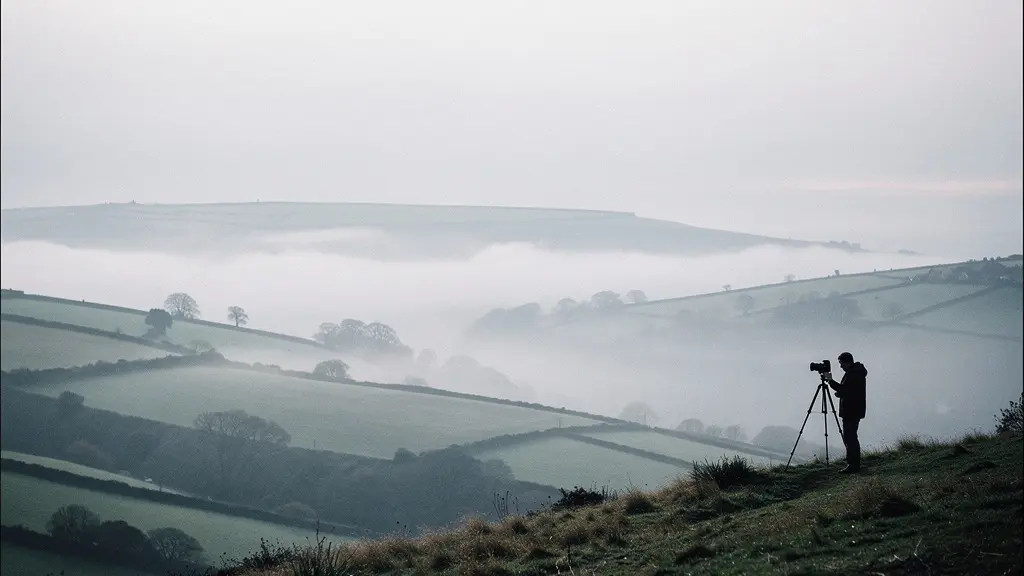
Contrary to popular belief, the UK’s famously grey sky isn’t a curse for photographers; it’s a world-class lighting tool you don’t have to pay for.
- Overcast conditions act as a giant, natural softbox, producing soft, wrapping light that reveals subtle textures and eliminates harsh shadows.
- This diffused light enhances atmospheric perspective, adds depth to landscapes, and provides a perfect canvas for emotive black and white photography.
Recommendation: Instead of waiting for a sunny day, learn to see the grey sky as your primary light source and use its unique qualities to create sophisticated, nuanced images.
As a portrait photographer, I’ve heard the complaint a thousand times: the sky in Britain is relentlessly grey, the light is flat, and the weather is a constant battle. Many photographers pack their bags away, waiting for that rare, brilliant burst of sun. They see the thick blanket of cloud as a problem to be solved, a limitation to endure. But what if this perspective is fundamentally wrong? What if the very thing everyone complains about is, in fact, an unparalleled artistic advantage?
The common advice for shooting on an overcast day often involves technical fixes: increase your ISO, use a fast lens, or convert to black and white to salvage a “boring” scene. While these tips have their place, they miss the bigger picture. They treat the symptoms of “drab” light without understanding its profound power. The truth is, that consistent, soft, and diffused light is the secret ingredient behind the unique aesthetic of British photography, from windswept landscapes to intimate portraits.
This is the core of what we will explore. We are going to reframe your entire understanding of British weather. Forget seeing it as a hindrance. It’s time to see the sky for what it truly is: the world’s largest, most sophisticated, and completely free giant softbox. It’s a tool that sculpts form, reveals texture, and captures emotion with a subtlety that the harsh, direct light of a sunny day can never hope to match.
This guide will deconstruct the aesthetic and practical advantages of this light. We’ll explore its impact on social documentary, its unique legal landscape, its challenges, and ultimately, how to train your eye to master it. By the end, you won’t just tolerate the grey sky—you’ll actively seek it out.
Summary: Mastering the Nuances of British Photography
- The British Class System: How Photographers Document Social Divides Today?
- Privacy Laws in the UK: What Can You Legally Photograph on the Street?
- Protecting Gear From Salt Spray: The Maintenance Routine You Cannot Skip
- Why British Cities Look Better in High Contrast Black and White?
- Pictorialism to Modernism: How British Landscape Photography Evolved?
- Why the Golden Hour in the Highlands Lasts Longer in Winter Months?
- Seeing in Grey: How to Train Your Eye to Ignore Color Distractions?
- How to Capture Scale and Depth in the Lake District Fells?
The British Class System: How Photographers Document Social Divides Today?
The soft, revealing light of an overcast British day does more than illuminate landscapes; it lays bare the subtleties of human expression and social texture. Unlike harsh sunlight, which creates dramatic but often concealing shadows, diffused light wraps gently around faces, revealing every nuance and line. This quality makes it an incredibly powerful tool for documentary photography, an arena where British photographers have long excelled at capturing the country’s complex class system.
This approach isn’t about creating stark, dramatic poverty or extravagant wealth. Instead, it’s about observing the quiet details: the fabric of a coat, the expression in a subject’s eyes, the environment they inhabit. The soft light ensures that no detail is lost to overexposure or deep shadow, allowing for a more honest and layered reading of the scene. It encourages a quieter, more observational style of photography, where the story is told through an accumulation of details rather than a single dramatic moment.
Contemporary photographers continue this tradition, using the unique atmospheric conditions to explore modern social divides with a candid, unflinching eye. They understand that the “drab” sky provides a neutral, non-judgmental canvas that places the focus squarely on the human subjects and their stories.
Case Study: The Evolution of Martin Parr
The work of Martin Parr exemplifies this evolution. A 2024 documentary directed by Lee Shulman explores how Martin Parr evolved from documenting Britain’s working-class decline in black-and-white to using controversial, flash-heavy color. His initial shift to a Plaubel 6×7 camera with flash caused an uproar, as it broke from the traditional, more somber documentary style. This journey shows how photographers constantly challenge conventions to find new ways of representing Britain’s enduring social fabric.
Privacy Laws in the UK: What Can You Legally Photograph on the Street?
Embracing the UK’s public spaces as your studio requires not just an eye for light, but also a firm understanding of your legal rights. For street photographers, the country’s legal framework is refreshingly permissive, especially when compared to many of its European neighbors. The fundamental principle is that there is no general right to privacy in a public place. If a person is on a public street or in a park, they can generally be photographed without their consent, particularly for artistic or editorial purposes.
This freedom is a cornerstone of the UK’s vibrant street photography culture. It allows for the candid, spontaneous capture of daily life that is essential to the genre. You do not need a model release for individuals photographed in public spaces when the images are used for art, journalism, or editorial content. However, the introduction of UK GDPR (General Data Protection Regulation) adds a layer of responsibility. Publishing photos of identifiable people is considered processing personal data.
Fortunately, a crucial “artistic and journalistic exemption” exists. This allows photographers to process this data without explicit consent, provided they are doing so for legitimate artistic work. It’s best practice to mention in your website’s privacy policy that you operate under this exemption. While the law is on your side, confrontations can still happen. The key is to remain calm, know your rights, and understand that private security, for instance, has no legal authority to seize your camera or delete your images on public land. Their only power is to ask you to leave if you are trespassing on private property.
This legal clarity is a significant advantage. While photographers in other nations must navigate complex consent laws, the UK’s more liberal approach, compared to countries like France or Germany, empowers artists to document society with fewer restrictions, making it one of the best places in the world for the art of street photography.
Protecting Gear From Salt Spray: The Maintenance Routine You Cannot Skip
While the British sky is an asset, the island’s geography presents a tangible threat: salt. Shooting along the UK’s magnificent coastline means exposing your expensive equipment to a fine mist of corrosive saltwater spray. This is not a risk to be taken lightly. Salt can work its way into lens barrels, degrade weather seals, and corrode electronic contacts, causing irreparable damage. A disciplined maintenance routine isn’t just good practice; it’s essential for the longevity of your gear.
Protection begins before you even leave the house. A UV or protective filter is your first line of defense—a cheap, sacrificial piece of glass that takes the brunt of the salt deposits, protecting the expensive front element of your lens. On location, a simple rain cover or even a plastic bag can provide a crucial shield against heavy spray during windy conditions. Wiping your gear down frequently with a dry microfiber cloth prevents salt from building up.
The most critical phase, however, is the post-shoot clean. This cannot be put off until the next day. As soon as you are indoors, you must meticulously clean every piece of equipment. Use a microfiber cloth slightly dampened with fresh water to wipe down the camera body, lens barrels, and tripod, followed immediately by a dry cloth to remove all moisture. Pay special attention to moving parts and contact points. Finally, storing your gear in a dry bag with a few silica gel packets will help absorb any lingering humidity.
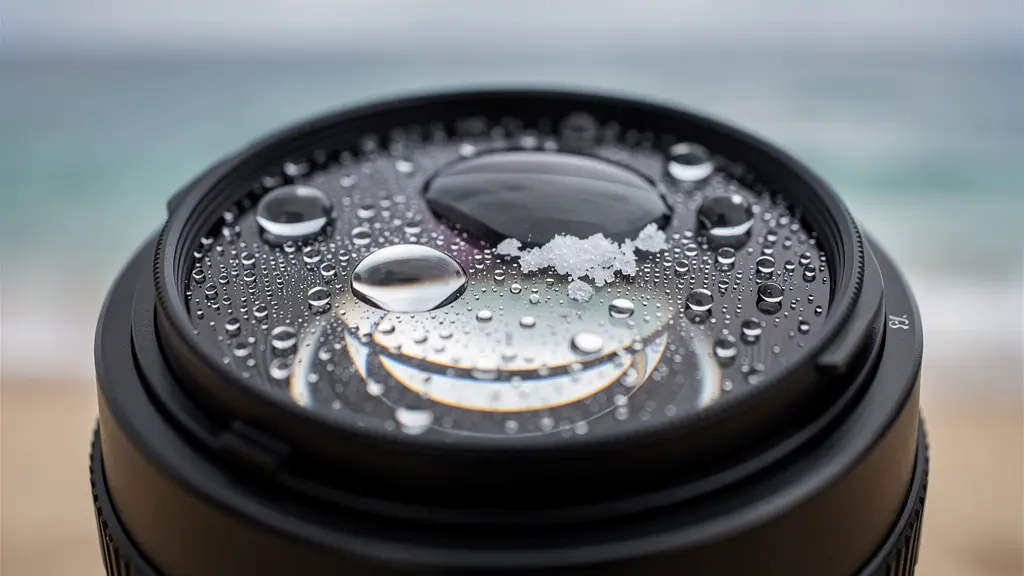
This three-step process—prepare, protect, and purge—will ensure your camera and lenses survive the harsh coastal environment, allowing you to capture those dramatic seascapes without sacrificing your equipment to the elements. The discipline it requires is a small price to pay for peace of mind.
Your Essential Salt Spray Maintenance Checklist
- Pre-Shoot Shielding: Apply protective coatings to rubber seals and mount a sacrificial UV or protective filter on every lens you plan to use.
- On-Site Wipedown: Use a rain cover in active spray and perform regular wipedowns with a clean microfiber cloth to prevent salt accumulation during the shoot.
- Post-Shoot Deep Clean: Immediately wipe all gear with a cloth dampened with fresh water, then dry thoroughly. Use a lens pen or blower to clean optics.
- Dry Storage Protocol: Store your cleaned equipment in a sealed camera bag with fresh silica gel packets to absorb any residual moisture.
- Contact & Seal Inspection: Regularly inspect all electronic contacts, dials, and weather seals for any signs of corrosion, stickiness, or degradation.
Why British Cities Look Better in High Contrast Black and White?
When the sky is a uniform grey and colors are muted, many photographers see a lack of vibrancy. The expert, however, sees an opportunity for something more profound: texture, form, and tonality. This is why British cities, with their rich architectural history, so often sing in high-contrast black and white. The “giant softbox” sky removes the distraction of color and forces the eye to focus on the fundamental building blocks of a powerful image.
Think of wet cobblestones, weathered brick facades, and glistening slate roofs. Under harsh sunlight, these surfaces would be a chaotic mix of bright highlights and deep, information-less shadows. But under the soft, diffused light of an overcast day, their micro-contrast and texture are revealed in exquisite detail. Every crack, every ripple in a puddle, and every layer of worn paint contributes to the story. Converting to monochrome strips away the potentially muddy color palette of a grey day and amplifies this textural information.
To achieve this look, it’s not simply about desaturating the image. A successful conversion involves managing the tonal range. By using the color channel mixer in post-production, you can emulate the effect of physical lens filters. For example, pulling down the blue channel will dramatically darken a grey sky, adding instant mood and making architectural forms stand out. The goal is to embrace the full spectrum from pure whites to deep, rich blacks, creating a dynamic interplay of light and shadow that guides the viewer’s eye through the composition. It is a common mistake to believe cloudy days are low contrast; in reality, the tonal gradation is simply more subtle and requires a deliberate approach to be revealed.
By focusing on shape, line, and texture, black and white photography transforms a seemingly “dull” urban scene into a timeless, graphic, and emotionally resonant image. It’s a technique that plays directly to the strengths of the British weather.
Pictorialism to Modernism: How British Landscape Photography Evolved?
The unique quality of British light has shaped the country’s photography for over a century, influencing a dramatic evolution from the soft, romantic ideals of Pictorialism to the sharp, unflinching gaze of Modernism. Early pictorialists in the late 19th and early 20th centuries sought to elevate photography to the level of painting. They embraced the soft, misty atmosphere of the British Isles, using techniques like soft focus and complex printing processes to create dreamy, evocative landscapes that hid detail in favor of mood.
However, as the 20th century progressed, a new wave of photographers began to reject this romanticism. Influenced by the social and industrial changes around them, Modernists sought realism and clarity. Instead of obscuring detail, they used the same soft light to reveal it. This shift is vividly seen in the transition from ethereal, misty landscapes to the stark, socially-conscious documentary work that came to define British photography in the post-war era.
No figure embodies this transition more than Martin Parr. As documented by the Martin Parr Foundation, his move from black-and-white to saturated color with his series ‘The Last Resort’ (1983-86) was a pivotal moment. While some critics decried his portrayal of working-class holidaymakers in New Brighton as derisive, others praised its raw honesty. Parr wasn’t just documenting a scene; he was challenging how Britain saw itself, using a bright, almost garish aesthetic that stood in stark contrast to the somber tones of his predecessors. His influence is undeniable, and the sheer volume of his work speaks to his impact.
Indeed, Martin Parr’s extensive body of work includes around 60 solo photobooks and appearances in about 90 exhibitions worldwide, cementing his role as a key figure in the evolution of modern British photography. He demonstrated that documenting Britain wasn’t just about capturing its moody landscapes, but also its vibrant, and often awkward, social realities.
Why the Golden Hour in the Highlands Lasts Longer in Winter Months?
While this guide champions the overcast sky, photographers understandably still cherish the ‘golden hour’. In the UK, particularly in northern latitudes like the Scottish Highlands, winter offers a surprising gift: a golden hour that can feel luxuriously extended. This isn’t just a feeling; it’s a phenomenon rooted in the physics of the Earth’s orbit. During winter, the sun’s trajectory across the sky is much lower and shallower. It spends significantly more time near the horizon, prolonging that period of warm, soft, directional light.
This extended duration provides a broader window for capturing stunning images. The low sun angle rakes across the landscape, sculpting the dramatic peaks and glens of the Highlands with long, elegant shadows. This interplay of warm light and cool shadow emphasizes the terrain’s form and creates a powerful sense of depth and dimension. While general research shows that the golden hour’s duration varies with latitude and season, it is at these higher latitudes in winter that the effect becomes most pronounced and photographically advantageous.
The quality of the light is also different. The winter sun, filtered through more of the Earth’s atmosphere, is often softer and warmer than its summer equivalent. It bathes the snow-dusted peaks and frozen lochs in a golden glow that contrasts beautifully with the blue tones in the shadows. This creates a rich, complementary color palette that is unique to the season.
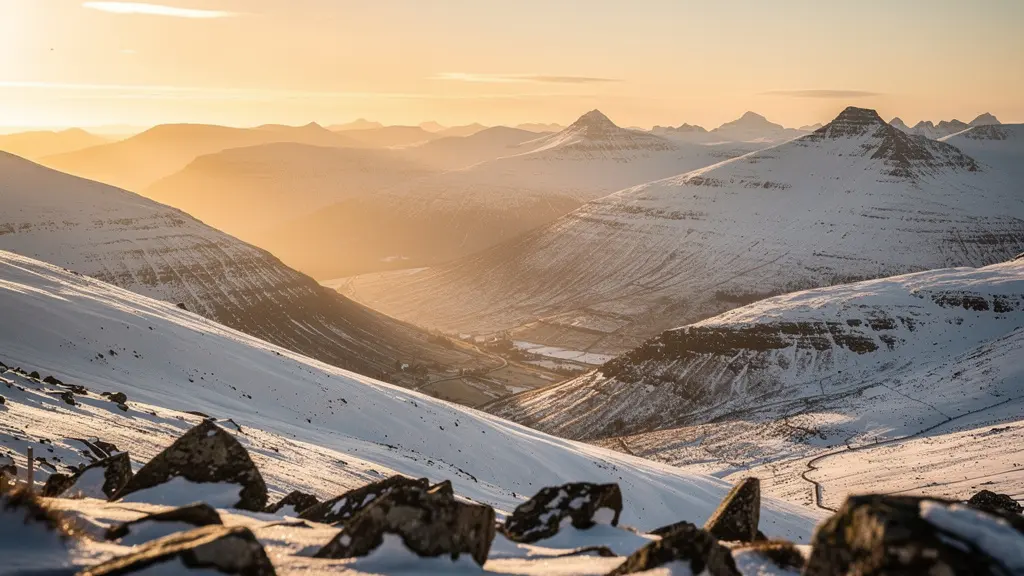
For landscape photographers willing to brave the cold, the reward is access to some of the most beautiful light imaginable. The winter Highlands offer a chance to work at a more considered pace, making the most of a golden hour that refuses to be rushed. It’s another example of how the UK’s challenging climate offers unexpected and profound rewards.
Seeing in Grey: How to Train Your Eye to Ignore Color Distractions?
The single most important skill for a photographer in the UK is learning to “see in grey.” This doesn’t mean ignoring beauty; it means training your eye to look past the often-muted color palette and see the underlying structure of a scene: tone, texture, and form. When you stop searching for vibrant color, you start noticing the elegant gradation of light on a stone wall, the subtle shape of clouds, and the way soft light wraps around a subject.
A practical way to begin this training is to set your camera’s electronic viewfinder or rear screen to a monochrome picture style. This forces you to evaluate the world in terms of luminosity, not hue. You’ll quickly learn to identify which scenes have a strong tonal structure and which are genuinely “flat.” You’ll start to see how the soft, overcast light is perfect for rendering subtle shifts from light to dark, something that is often blown out or crushed into shadow by harsh sun.
This quality of light is explained perfectly by experts in the field. The diffused nature of an overcast sky creates a fundamentally different kind of illumination. As the team at Cambridge in Colour notes in their comprehensive guide to natural light, this is the essence of soft lighting.
Shade and overcast light typically have a cool, soft appearance, since the source of such light is spread across the entire sky, and doesn’t include any direct sunlight. Textures therefore appear much subtler, and reflections on smooth surfaces are more diffuse and subdued.
– Cambridge in Colour, Natural Light Photography Tutorial
This expert insight confirms our “giant softbox” theory. The light source is the entire sky, creating a gentle, wrapping effect. To master it, you must actively look for texture and form. Look for leading lines in wet streets, the silhouette of a tree against the grey sky, or the soft shadows defining a person’s face. By learning to see in grey, you are not settling for less; you are attuning your vision to a more sophisticated and nuanced language of light.
Key Takeaways
- Embrace the UK’s overcast sky as a ‘giant softbox’ that provides soft, wrapping light ideal for revealing texture and form.
- Mastering black and white conversion is key, as it plays to the strengths of diffused light by emphasizing tonality and shape over muted colors.
- Understand and leverage the UK’s permissive street photography laws, but always be prepared with a solid gear maintenance routine for coastal shoots.
How to Capture Scale and Depth in the Lake District Fells?
The rolling fells and vast lakes of the Lake District present a classic photographic challenge: conveying their immense scale and depth within a two-dimensional frame. Here, again, the often-misty, overcast conditions of the British climate become a powerful ally. The key is to leverage a principle known as atmospheric perspective. This is the effect where distant objects appear lighter, less detailed, and bluer due to particles in the air like haze, fog, and rain.
On a perfectly clear, sunny day, distant mountains can appear sharp and close, flattening the scene. But on a typical Lake District day, layers of mist and low cloud create natural separation between the foreground, mid-ground, and background. Peaks emerge from the clouds like islands in the sky, instantly communicating depth. Your job as a photographer is to compose your shot to emphasize these layers. Using a dry stone wall or a winding path as a leading line from the foreground into the misty distance is a classic and highly effective technique.
Another powerful method for showing scale is to include a human element. A single hiker with a brightly colored jacket—a splash of red or yellow—standing on a fellside immediately gives the viewer a reference point, transforming an abstract landscape into a relatable space. As many professional photographers note, overcast lighting conditions are like working with a giant softbox, spreading light evenly. This even light ensures that details in both the nearby foreground and the distant, misty peaks are retained, allowing the eye to travel through the entire scene.
Don’t fight the mist; use it. Look for moments when cloud inversions trap fog in the valleys, creating those magical scenes of peaks floating above a sea of white. By embracing the atmospheric conditions, you can create images that not only show the beauty of the Lake District but also convey its breathtaking scale and profound sense of place.
Stop waiting for the sun. The UK’s sky is a gift, a constant source of beautiful, malleable light. The next time you see a blanket of grey, grab your camera and head out. Start practicing the art of seeing in grey, and you will unlock a level of sophistication and mood in your photography that you never thought possible.